


Supplement efficacy is defined as the measured ability of a dietary supplement to produce its intended health benefit under controlled, ideal conditions. The industry term you will encounter in clinical literature is “efficacy,” distinct from the broader concept of “effectiveness,” and understanding the difference shapes every smart supplement decision you make. Efficacy measures performance under controlled conditions, while effectiveness describes what happens in the real world where adherence, diet, and lifestyle all interfere. For adults aged 25 to 50 investing in longevity and cellular health, this distinction is not academic. It determines whether the supplement in your cabinet is genuinely working or simply expensive reassurance.
What is supplement efficacy vs. supplement effectiveness?
These two terms are used interchangeably in marketing, but they measure entirely different things. Efficacy answers the question: does this supplement work under ideal conditions? Effectiveness answers: does it work for real people in real life?
Here is why the gap matters:
- Efficacy is established in randomized controlled trials (RCTs) where dosage, timing, and participant behavior are tightly controlled.
- Effectiveness reflects outcomes in free-living populations where people miss doses, eat inconsistently, and combine supplements without guidance.
- A supplement can show strong efficacy in a clinical trial yet deliver modest real-world results if bioavailability drops due to poor timing or food interactions.
- Conversely, a supplement with modest clinical efficacy data may still deliver meaningful personal benefit if your individual biology responds well.
Both concepts matter when evaluating supplement performance. Efficacy data tells you whether a mechanism is real. Effectiveness data tells you whether that mechanism translates to your life.
Pro Tip: When reading a supplement study, check whether it was conducted in a controlled clinical setting or in a free-living population. The setting determines whether you are reading efficacy data or effectiveness data, and the practical implications are completely different.

What research methods are used to measure supplement efficacy?
Rigorous supplement science follows a hierarchy of evidence. Not all studies carry equal weight, and knowing the difference protects you from being misled by weak data dressed up as proof.
- Randomized controlled trials (RCTs): The gold standard. Participants are randomly assigned to a supplement or placebo group, eliminating selection bias. Placebo-controlled trials confirm efficacy only when the treatment group improves significantly more than the placebo group.
- Double-blind designs: Neither participants nor researchers know who receives the active supplement. This eliminates expectation bias on both sides and produces the most reliable efficacy signal.
- Meta-analyses and systematic reviews: These pool data from multiple RCTs to identify consistent patterns across populations. A single positive trial means little. Consistent findings across several well-designed trials carry real weight.
- Bioavailability studies: These measure how much of an active ingredient actually reaches systemic circulation. A supplement with strong in-vitro data but poor oral bioavailability will underperform in human trials regardless of its theoretical mechanism.
- Dose-response studies: These establish the minimum effective dose and identify the point at which higher doses produce no additional benefit or cause harm.
“Even if a study reports a benefit, the effect size must exceed placebo variability to be considered true efficacy. Active-vs-placebo comparison is the critical benchmark, not improvement from baseline alone.”
Common pitfalls in supplement research include small sample sizes under 50 participants, trial durations too short to detect meaningful physiological change, and lack of independent replication. The COSMOS trial, a large-scale study examining multivitamins, found no significant mortality reduction with multivitamin use, illustrating that even nutritionally plausible interventions can fail to demonstrate efficacy at the population level. That result does not mean multivitamins are useless for every individual. It means the population-level efficacy signal is weak, which is a meaningful distinction.
How do placebo effects influence perceived supplement efficacy?
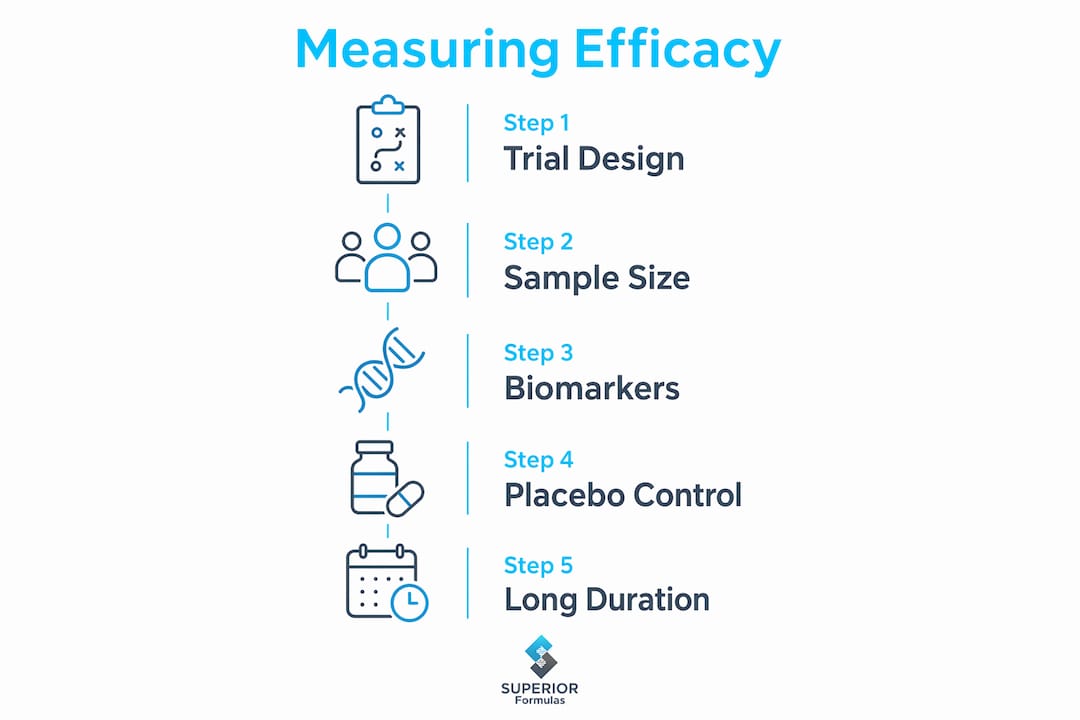
The placebo effect is not imaginary. It is a measurable physiological response triggered by belief and expectation, and it is one of the most underappreciated forces in supplement perception. Strong belief in a supplement can generate real symptom improvements without any active ingredient present.
This creates a serious problem for self-assessment. If you start a new supplement and feel better within two weeks, you cannot know whether the improvement came from the active compound, a placebo response, a concurrent lifestyle change, or natural symptom fluctuation. All four are plausible.
Key facts about placebo effects and supplements:
- Placebo response rates in supplement trials commonly range from 20% to 40%, meaning a substantial portion of perceived benefit in uncontrolled settings is expectation-driven.
- Marketing language that emphasizes transformation, energy, and vitality actively amplifies placebo response by raising expectation before the first dose.
- Double-blind placebo-controlled trials are the only study design capable of separating true pharmacological efficacy from expectation-driven improvement.
- Subjective outcomes like mood, energy, and mental clarity are more susceptible to placebo inflation than objective biomarkers like blood glucose or inflammatory markers.
Pro Tip: If a supplement brand relies exclusively on testimonials and subjective before-and-after reports without citing peer-reviewed clinical data, treat those claims with skepticism. Subjective reports cannot distinguish active benefit from placebo response.
Understanding clinical evidence standards is the most reliable way to cut through marketing noise and identify supplements with genuine mechanistic support.
What practical steps can you take to measure supplement efficacy personally?
Personal supplement testing follows a method called the N-of-1 experiment. This is a single-subject research design where you serve as both the treatment group and the control, cycling through active and inactive phases to identify your individual response. N-of-1 designs allow individuals to test personal supplement efficacy through repeated baseline and active intervention phases.
Follow this structure:
- Baseline phase (7 days): Track your chosen metrics without the supplement. Record sleep quality, energy levels, relevant biomarkers, and any symptoms you are targeting. This establishes your personal control data.
- Active phase (21 days): Introduce the supplement at the clinically studied dose. Continue tracking the same metrics daily. Do not change other variables like diet, exercise, or sleep schedule during this phase.
- Washout phase (7 days): Stop the supplement and continue tracking. A true washout period reveals whether your metrics revert toward baseline, which is the strongest signal that the supplement was producing a real effect.
- Repeat the cycle: A single A/B comparison is suggestive. Repeating the active and washout phases at least twice produces an A/B/A/B design that significantly strengthens causal inference.
The following table summarizes the metrics most useful for personal efficacy tracking:
| Metric type | Examples | Why it matters |
|---|---|---|
| Objective biomarkers | Blood glucose, CRP, lipid panel, HRV | Resistant to placebo bias; confirms physiological impact |
| Subjective symptoms | Energy, mood, joint comfort, sleep quality | Captures lived experience but requires placebo-aware interpretation |
| Performance measures | Workout output, cognitive test scores | Quantifiable and reproducible across phases |
| Body composition | Weight, waist circumference | Slow-moving but objective over longer cycles |
Objective measures like heart rate variability and blood biomarkers improve reliability significantly compared to subjective-only tracking. Biomarker confirmation also helps verify whether a supplement is being absorbed and impacting the body, identifying whether you are a “response-capable” individual for that particular compound.
Pro Tip: Use a free app like Apple Health or a dedicated tracking tool like Prova to log daily metrics during your N-of-1 experiment. Consistent data collection is more valuable than perfect data collection.
What is the regulatory context for supplement efficacy claims in the US?
The regulatory framework governing supplements in the US is fundamentally different from the one governing pharmaceutical drugs. The FDA does not require supplement manufacturers to prove safety or efficacy before bringing a product to market. This single fact has enormous implications for consumers.
Here is what the current regulatory structure actually requires and permits:
- Structure-function claims are permitted without FDA pre-approval. A label can state “supports immune health” or “promotes cellular resilience” without clinical proof, as long as the claim does not reference a specific disease.
- Disease claims are prohibited without FDA drug approval. A supplement cannot legally claim to “treat,” “cure,” or “prevent” any named disease.
- Adverse event reporting is required for serious events, but manufacturers self-report, and the FDA acts reactively rather than proactively.
- GMP certification governs manufacturing quality and consistency, not efficacy. A GMP-certified product is produced to a quality standard. That does not mean the formula has been clinically validated.
| Claim type | FDA pre-approval required? | Example |
|---|---|---|
| Structure-function | No | “Supports healthy aging” |
| Nutrient content | No | “High in vitamin C” |
| Disease claim | Yes (drug standard) | “Treats cardiovascular disease” |
| Health claim | Requires significant evidence | “May reduce risk of osteoporosis” |
Supplements are not held to the Kefauver-Harris Amendment standards applied to pharmaceutical drugs, which require proof of both safety and efficacy before market entry. The practical consumer takeaway is straightforward: regulatory approval of a supplement tells you nothing about whether it works. Your job is to seek brands that voluntarily provide clinical evidence, third-party testing, and transparent ingredient sourcing. Explore evidence-based options for longevity as a starting point for identifying formulas with genuine scientific backing.
Key takeaways
Supplement efficacy is only meaningful when measured against a placebo-controlled standard, verified through biomarker tracking, and evaluated within a regulatory context that places the burden of proof on the consumer rather than the manufacturer.
| Point | Details |
|---|---|
| Efficacy vs. effectiveness | Efficacy is measured under controlled conditions; effectiveness reflects real-world outcomes with all variables present. |
| Gold standard evidence | RCTs with double-blind, placebo-controlled designs are the only reliable method for confirming true supplement efficacy. |
| Placebo awareness | Subjective improvements alone cannot confirm efficacy; objective biomarkers are required to separate real effects from expectation. |
| Personal N-of-1 testing | A 7-day baseline, 21-day active, and 7-day washout cycle repeated twice produces actionable personal efficacy data. |
| Regulatory reality | The FDA does not pre-approve supplements for efficacy; consumers must independently seek clinical evidence and third-party verification. |
Why I think most people are asking the wrong question about supplements
Most adults I speak with want to know whether a specific supplement “works.” That is the wrong starting point. The better question is: works for whom, at what dose, measured how, and compared to what?
I have spent years reviewing clinical literature on longevity-focused compounds, from resveratrol and NMN to glutathione and Nrf2 activators. The pattern is consistent. Marketing claims routinely outpace the scientific evidence, and the gap is widest for the most aggressively marketed products. That does not mean supplements are ineffective. It means the evidence base is uneven, and your personal biology adds another layer of variability that no population-level trial can fully account for.
What I have found genuinely useful is treating supplements as hypotheses rather than solutions. You form a hypothesis based on clinical plausibility, you test it with a structured N-of-1 experiment, and you let objective data guide your decision. This approach respects both the real promise of evidence-based supplementation and the real limits of extrapolating clinical trial results to your individual physiology.
For longevity-focused adults, the supplements with the strongest mechanistic and clinical support tend to be those targeting cellular pathways, oxidative stress, and metabolic function. Compounds like glutathione at studied doses and polyphenols with Nrf2 activity have a growing body of peer-reviewed support. But even these require personal verification. Integrate them as part of a structured health protocol, track objective markers, and stay skeptical of any brand that cannot point you to the underlying clinical data.
The supplement industry rewards confident marketing. Your health rewards rigorous thinking.
— cristopher
How Superiorformulas supports evidence-based supplement choices
Superiorformulas was founded by a physician-scientist with a specific mandate: formulate supplements that can withstand clinical scrutiny, not just consumer enthusiasm. Every formula in the Superiorformulas line is built around ingredients with peer-reviewed mechanistic support, manufactured in GMP-certified facilities, and verified through third-party testing for purity and potency. The brand publishes the science behind its formulations so you can evaluate the evidence yourself rather than taking marketing language at face value. If you are ready to move from guesswork to a genuinely evidence-grounded supplement protocol, explore the clinical science behind Superiorformulas formulations and see exactly what supports each ingredient choice.
FAQ
What does supplement efficacy mean?
Supplement efficacy is the scientifically measured ability of a supplement to produce its intended health benefit under controlled, ideal conditions. It differs from effectiveness, which describes real-world outcomes where adherence and lifestyle variables affect results.
How is supplement efficacy measured in clinical research?
Efficacy is measured primarily through randomized, double-blind, placebo-controlled trials where the supplement group must show significantly greater improvement than the placebo group. Meta-analyses pooling multiple RCTs provide the strongest evidence base.
Does the FDA approve supplements for efficacy?
The FDA does not require proof of efficacy or safety before a supplement reaches the market. Manufacturers may use structure-function claims without clinical substantiation, placing the responsibility for evaluating evidence on the consumer.
Can I test supplement efficacy on myself?
Yes. An N-of-1 experiment using a 7-day baseline, 21-day active phase, and 7-day washout cycle, repeated at least twice, allows you to generate personal efficacy data. Tracking objective biomarkers alongside subjective symptoms produces the most reliable results.
Why do some supplements feel effective even without clinical proof?
The placebo effect produces measurable physiological responses driven by belief and expectation, which can simulate genuine supplement benefits. Only double-blind placebo-controlled trials can separate true pharmacological efficacy from expectation-driven improvement.
As an example of a formulation built to this efficacy standard, our Formula 9 — Superior Multi+ Daily (with AREDS2 nutrients) was designed with exactly this clinical rationale in mind. Explore the science behind the formulation to see how it applies to your own routine.


