


Short-term research suggests ashwagandha extracts can modestly reduce stress and improve certain aspects of sleep, but the evidence has real limits and safety checks matter. Most clinical trials run several weeks to a few months and use standardized root extracts at doses within a moderate range per day. Within that window, ashwagandha has shown measurable, if moderate, effects on perceived stress, cortisol levels, and sleep quality, according to a review from Harvard Health. It is not a sedative and it is not a cure for chronic insomnia or anxiety disorders. It is an adaptogen with a modest, reproducible signal in short trials.
Before you buy a bottle, here’s what matters most:
- Likely benefits: Modest reductions in perceived stress, cortisol, and some sleep disturbance in adults over 6 to 12 weeks.
- Typical doses studied: 250 to 600 mg/day of standardized root extract, most consistently around 500 to 600 mg/day.
- Main safety caveats: Possible drowsiness, GI upset, rare liver injury reports, and interactions with thyroid, diabetes, blood pressure, and immune-suppressing medications.
- Bottom line: Talk to a clinician first if you take prescription medication, have a chronic condition, or are pregnant or breastfeeding.
Key Takeaways
Ashwagandha’s clearest, most reproducible benefit is a modest reduction in perceived stress and improved sleep quality over 6 to 12 weeks at standardized doses of roughly 250 to 600 mg per day, with safety depending heavily on individual health status and medication use.
| Point | Details |
|---|---|
| Stress evidence is real but modest | RCTs show reduced perceived stress and cortisol, mostly at 500 to 600 mg/day over 6 to 12 weeks. |
| Sleep benefits favor poor sleepers | Improvements in sleep latency and efficiency are largest in people with existing insomnia. |
| Other benefits remain early-stage | Fertility and performance data are promising but limited; cognitive and metabolic claims lack strong support. |
| Safety requires a checklist | Watch for GI upset, drowsiness, and rare liver injury; check interactions with thyroid, diabetes, and blood pressure medications. |
| Formulation quality determines results | Superiorformulas uses physician-formulated, GMP-manufactured, third-party tested extracts standardized for withanolide content. |
Table of Contents
- Ashwagandha Benefits and How the Herb Works in the Body
- Evidence for Stress and Anxiety: What the Trials Show
- Ashwagandha Sleep Benefits: Which Metrics Actually Improve
- Ashwagandha Uses Beyond Stress and Sleep: Promise Versus Proof
- Ashwagandha Dosage: How to Read Extract Labels and Standardization
- Ashwagandha Side Effects and Drug Interactions to Watch For
- Who Should Avoid Ashwagandha or Use It Only With Medical Supervision
- Choosing a Quality Ashwagandha Supplement
- How I’d Approach an Ashwagandha Trial
- A Science-First Option Worth Comparing
- Sources
Ashwagandha Benefits and How the Herb Works in the Body
Ashwagandha comes from the root and, less commonly, the leaf of Withania somnifera, a shrub also known as winter cherry or Indian ginseng. It has been used for centuries in Ayurvedic practice, but its current popularity rests on a specific set of compounds called withanolides, steroidal molecules concentrated in the root that researchers believe drive most of the herb’s biological activity.
The leading explanation for ashwagandha’s effects centers on the hypothalamic-pituitary-adrenal axis, the body’s central stress-response system. Withanolides appear to help regulate this axis, which may blunt excessive cortisol release during periods of chronic stress. That is a meaningfully different mechanism than a sedative like a benzodiazepine, which suppresses the central nervous system directly. Ashwagandha instead seems to work upstream, on the hormonal signaling that triggers the stress response in the first place, according to Harvard Health.
Here is the catch worth sitting with: a plausible mechanism is not the same thing as a proven clinical benefit.
- Withanolides show anti-inflammatory and antioxidant activity in lab and animal models, but that does not automatically translate to the same effect in a human body under real-world stress.
- HPA-axis modulation is a reasonable, biologically coherent story, but it is inferred largely from downstream markers like cortisol, not from a fully mapped human mechanism.
- Extract potency varies by manufacturer, so a mechanism demonstrated with one extract does not necessarily apply to a different product on a store shelf.
That gap between plausible biology and proven outcome is exactly why the next sections lean so heavily on trial data rather than theory.
Evidence for Stress and Anxiety: What the Trials Show
The strongest evidence for ashwagandha benefits sits in the stress and anxiety category, and it is genuinely encouraging without being definitive. Multiple randomized, placebo-controlled trials have measured reductions in perceived stress scores and salivary or serum cortisol after participants took standardized extracts for 6 to 12 weeks, a pattern confirmed by the NIH Office of Dietary Supplements.
Statistic Callout: Trials reviewed by the NIH Office of Dietary Supplements consistently report reduced perceived stress and cortisol at moderate extract doses, with clearer benefit patterns emerging at higher amounts within the studied range.
Dose and duration matter more than most supplement marketing lets on. The trials showing the clearest benefit tend to share a few features:
- Doses clustered around 500 to 600 mg/day of a standardized root extract, rather than lower amounts.
- Trial length of at least 6 weeks, with 8 to 12 weeks the most common window for measuring change.
- Outcome measures based on validated psychological scales (like the Perceived Stress Scale) alongside a biological marker such as cortisol, rather than one or the other alone.
Higher doses have not been shown to work meaningfully better, and unstandardized or excessive amounts mostly raise the odds of GI side effects without adding measurable benefit.
That said, the evidence base has real cracks. Many of the trials are small, often enrolling fewer than 100 participants. A large share were conducted in India, where dietary patterns, baseline stress exposure, and extract sourcing may differ from a Western population buying a bottle off a supplement shelf in the United States. Extracts also vary widely between studies, some using root-only powder, others using proprietary standardized concentrates, which makes it hard to say that “ashwagandha” as a category produces a single, consistent effect size. A narrative review published in Nutrients makes this point directly: the direction of the evidence is promising, but heterogeneity in extracts and dosing complicates any firm, one-size-fits-all recommendation.
None of this erases the signal. It does mean that “ashwagandha reduces stress” is a reasonable, evidence-supported statement, not an settled fact with the certainty of, say, a well-established drug trial.
Ashwagandha Sleep Benefits: Which Metrics Actually Improve
Sleep is the second pillar of ashwagandha’s evidence base, and the trial data here tells a more specific story than most headlines suggest. Rather than knocking people out, ashwagandha appears to shift a handful of measurable sleep parameters: sleep latency (how long it takes to fall asleep), total sleep time, and sleep efficiency (the percentage of time in bed actually spent asleep).

The people who benefit most are not typically healthy sleepers looking for an edge. Trial data consistently shows the largest improvements in participants who already had diagnosed insomnia or significant sleep disturbance going into the study, a pattern echoed by NCCIH’s review of ashwagandha research. Someone sleeping fine already has less room to improve, which is a fairly intuitive finding but one worth stating plainly before you set expectations.
A few practical patterns show up across the sleep-focused trials:
- Effective doses in sleep-focused studies often land near the upper end of the general stress-dosing range.
- Trials that dosed participants closer to bedtime, rather than splitting doses through the day, more directly targeted sleep onset and quality.
- Improvements tend to build gradually over weeks, not overnight. Most protocols measured change within about one to three months.
Pro Tip: If sleep is your main goal, take ashwagandha in the evening rather than splitting the dose morning and night; this aligns well with recommendations on why magnesium helps you sleep better that suggest timing supplements to support sleep cycles. Most sleep-focused trials dosed participants closer to bedtime, which lines up with when the body’s stress hormones naturally taper for rest.
One caution worth flagging directly: combining ashwagandha with prescription sedatives, sleep medications, or alcohol has not been well studied, and stacking anything with sedating properties on top of a prescription sleep aid is not something to do without a conversation with your prescriber first.
Ashwagandha Uses Beyond Stress and Sleep: Promise Versus Proof
Stress and sleep get most of the attention, but ashwagandha research extends into a handful of other areas where the evidence ranges from genuinely interesting to still speculative.
Male reproductive health has some of the more consistent secondary findings. Several small trials report modest improvements in sperm parameters, including count and motility, along with small increases in testosterone in men, particularly those dealing with stress-related fertility concerns. These are real findings, but they come from a limited number of studies, and “modest improvement in a small trial” is a different claim than “clinically proven fertility treatment.”
Athletic performance research tells a mixed story. Some small randomized trials suggest improvements in VO2 max, muscle strength, and recovery markers after several weeks of supplementation, an area the MDPI clinical review covers alongside its stress and sleep findings. Other trials in the same category found no meaningful difference from placebo. If you are an athlete curious about ashwagandha, treat performance benefits as possible, not expected.
Everything else on the claims list gets thinner fast:
- Cognitive function: A few small studies hint at improved memory and reaction time, but sample sizes are too small to draw a real conclusion.
- Metabolic and blood sugar effects: Early, limited data exists; nowhere near enough to treat ashwagandha as a diabetes management tool.
- Anti-inflammatory effects: Strong in lab models, largely untested in well-designed human trials at scale.
- Immune or antiviral claims (including COVID-related claims): Insufficient evidence exists to support these uses, and they should be treated skeptically regardless of what a product label implies.
The honest summary: stress and sleep have the deepest evidence base. Everything else is a “watch this space” situation, not a settled benefit.
Ashwagandha Dosage: How to Read Extract Labels and Standardization
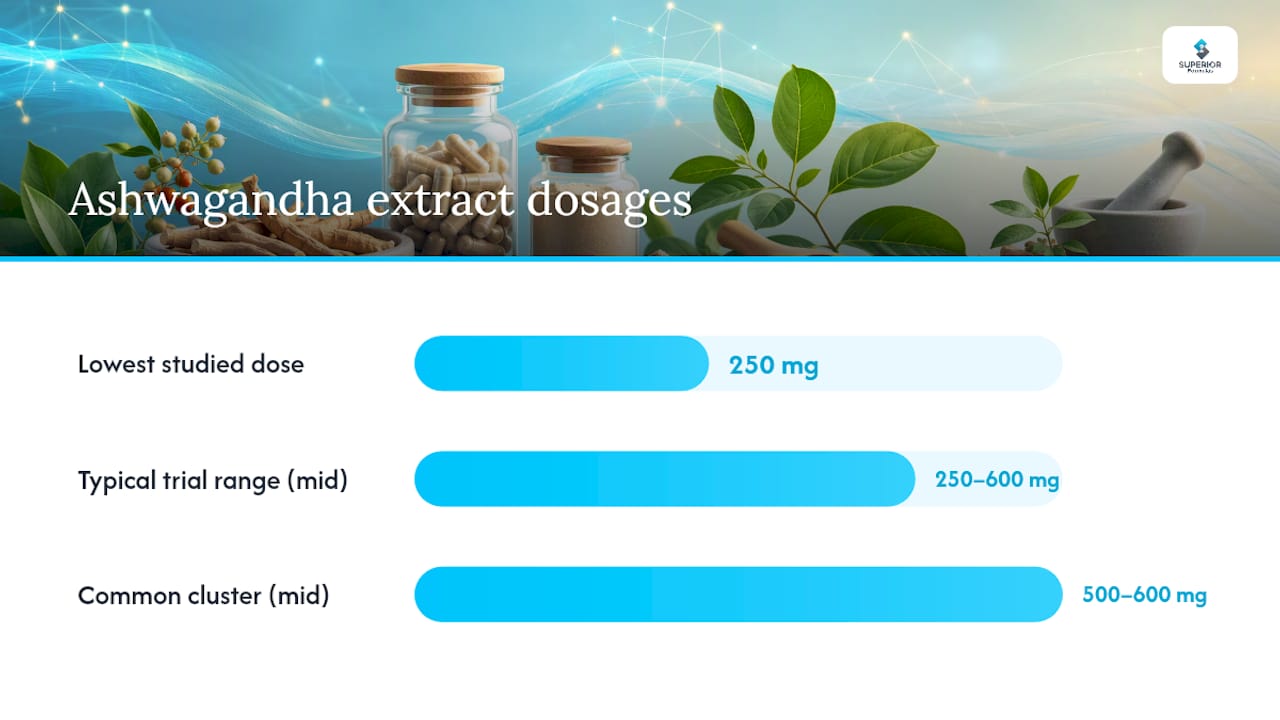
Dosing confusion is one of the biggest reasons people either give up on ashwagandha too early or take more than they need. Clinical trials generally use standardized root extracts, not raw powdered root, and the difference matters more than most labels make clear. Root powder contains a mix of withanolides at naturally variable concentrations, while standardized extracts are processed to guarantee a specific withanolide percentage in every dose, which is closer to what most trials actually tested.
A few things worth doing before you buy:
- Match the dose to the studied range. Look for products delivering somewhere between 250 and 600 mg/day of extract, with many of the clearer stress and sleep results clustering closer to 500 to 600 mg/day.
- Check for a named, standardized extract type. You will commonly see extract names like KSM-66, Sensoril, and Shoden in the research literature. These are standardized extract categories, not a ranking of quality; each represents a distinct processing method and withanolide concentration used in various trials.
- Look for a stated withanolide percentage. A product that lists “withanolide content” as a specific percentage is telling you it has been standardized rather than left to natural variability.
- Ask for a certificate of analysis (COA). Reputable manufacturers can show third-party lab testing confirming what is actually in the bottle, and at what concentration.
- Favor GMP-manufactured products. Good Manufacturing Practice certification is a baseline signal that a facility follows consistent quality and safety protocols.
If you want a broader framework for judging any supplement label, not just ashwagandha, a practical checklist for assessing supplement quality walks through the same standardization and testing questions in more depth.
Ashwagandha Side Effects and Drug Interactions to Watch For
Ashwagandha is generally well tolerated in short trials, but “generally well tolerated” is not the same as “risk-free for everyone.” The most common side effects are mild: gastrointestinal upset, nausea, and drowsiness, particularly at higher doses or when starting for the first time.
Statistic Callout: Rare but documented cases of liver injury have been reported in association with ashwagandha use, a finding flagged by both Harvard Health and the MDPI clinical review. These events appear uncommon, but they are serious enough to justify caution, especially for anyone with existing liver conditions.
The interaction list is longer than most people expect, and it spans several major medication classes:
- Thyroid medication: Ashwagandha may increase thyroid hormone levels, which can be a problem for people already on thyroid treatment or with undiagnosed thyroid disease. A closer look at this specific concern is covered in Superiorformulas’s guide to ashwagandha and thyroid health.
- Diabetes medications: Ashwagandha may lower blood sugar, which raises the risk of hypoglycemia when combined with insulin or oral diabetes drugs.
- Blood pressure medications (antihypertensives): Ashwagandha’s effect on blood pressure can compound with prescription antihypertensives, pushing pressure lower than intended.
- Sedatives and sleep medications: Combining sedating supplements with prescription sedatives or benzodiazepines increases the risk of excessive drowsiness.
- Anticonvulsants: Potential interactions with seizure medications have been noted, warranting clinician review before combining.
- Immunosuppressants: Ashwagandha may stimulate immune activity, which runs counter to the purpose of immunosuppressive therapy used after transplants or for autoimmune conditions.
A few practical safety habits go a long way. Start at the low end of the studied dose range rather than the highest amount on the label. Limit continuous use to the trial-tested window of roughly 6 to 12 weeks, since long-term safety beyond about three months has not been well studied, according to NCCIH. Stop immediately and seek medical care if you notice yellowing skin or eyes, dark urine, or unusual fatigue, which can signal liver stress. And if you take any prescription medication or manage a chronic condition, have that conversation with a clinician before starting, not after.
Who Should Avoid Ashwagandha or Use It Only With Medical Supervision
A handful of groups should treat ashwagandha as something to discuss with a clinician first, not something to self-prescribe.
- Pregnant or breastfeeding individuals should avoid ashwagandha; safety data in pregnancy and lactation are too limited to support use.
- Anyone on immunosuppressant therapy should consult a doctor first, since ashwagandha’s immune-stimulating effects can work against these medications.
- People taking thyroid medication need medical guidance, given the herb’s potential to raise thyroid hormone levels.
- People on blood sugar or blood pressure medications should check with a clinician, since ashwagandha can amplify the effects of both drug classes.
- Anyone with liver disease or a history of abnormal liver enzymes should seek medical advice given the rare but real reports of liver injury.
Choosing a Quality Ashwagandha Supplement
Superiorformulas builds its formulations around a physician-formulated standard, meaning every ingredient decision starts from clinical research rather than marketing trends. That approach matters more with an herb like ashwagandha, where extract type, standardization, and manufacturing consistency directly affect whether a product can plausibly deliver what the trials showed.
A few label checks separate a well-made formulation from a guess in a bottle:
- Standardized withanolide content, stated as a specific percentage rather than left vague.
- Third-party testing and an available certificate of analysis (COA), confirming potency and purity match the label.
- GMP-certified manufacturing, a baseline quality control standard across every production batch.
- A clean ingredient list, free of unnecessary fillers or proprietary blends that hide actual dosing.
For a broader view of how ashwagandha fits alongside other researched adaptogens and longevity ingredients, Superiorformulas’s guide to evidence-based supplements walks through the same evaluation criteria in more depth. Formulation consistency is not a marketing detail. It is the difference between a product that can plausibly replicate trial results and one that cannot.
How I’d Approach an Ashwagandha Trial
If you decide to try ashwagandha, treat it like a small personal experiment rather than a leap of faith. Choose a standardized extract, dose in the studied 500 to 600 mg/day range, and commit to a defined 6 to 12 week window before judging results.
Track something concrete along the way: a simple stress rating, sleep quality notes, or a basic sleep log, plus any side effects worth flagging to a clinician. Pair it with sleep hygiene basics and stress-management habits that already have solid evidence behind them; a supplement working alongside good habits will always outperform one working against poor ones. If a prescription medication enters the picture at any point, that changes the calculation immediately, and it deserves a real conversation with whoever manages that prescription.
A Science-First Option Worth Comparing
If you have read this far, you already know the honest version of the ashwagandha story: real evidence for stress and sleep, meaningful gaps everywhere else, and a quality gap between random bottles on a shelf and a formulation built the way clinical trials were actually designed. That gap is exactly where Superiorformulas focuses.
Every Superiorformulas formulation starts with a physician-formulated approach, gets manufactured in a GMP-certified facility, and gets verified through third-party testing before it reaches a customer. That means you can request a certificate of analysis and see the actual withanolide standardization and purity data behind a product, rather than taking a label’s word for it. For a longer look at how this evaluation process applies across different ingredient categories, the guide to interpreting clinical evidence in supplements breaks down what separates a well-supported formulation from marketing dressed up as science. If you manage a chronic condition or take prescription medication, talk with your clinician before adding anything new, then visit the Superiorformulas product pages to review current formulations and their testing documentation before you order.
Sources
- Ashwagandha: Benefits, side effects, and safety concerns - Harvard Health
- Ashwagandha: Is it helpful for stress, anxiety, or sleep? - ODS (Health Professional)
- Ashwagandha: Usefulness and Safety | NCCIH
- The Clinical Implications of Ashwagandha (Withania somnifera L.) with a Special Reference to Side Effects—A Review
This article is general information, not a substitute for advice from a qualified doctor. Consult a qualified healthcare professional about your own circumstances before acting on anything here.


