


The supplement aisle looks confident, but the products inside often aren’t. Knowing how to evaluate supplement quality is one of the most underrated health skills you can develop, because roughly 50% of top-selling supplements fail basic label accuracy standards. That means the bottle you’re trusting for your cellular health, energy, or longevity support may contain something entirely different from what’s printed on the label. This guide walks you through every layer of quality assessment, from decoding labels and spotting red flags to understanding what third-party certifications actually mean for you.
Table of Contents
- Key Takeaways
- How to evaluate supplement quality before you buy
- Reading labels and ingredient quality step by step
- Red flags and pitfalls that cost people their health
- What third-party certifications actually tell you
- Verifying supplement quality after you purchase
- My perspective on the supplement industry
- Science-backed supplements you can actually trust
- FAQ
Key Takeaways
| Point | Details |
|---|---|
| Label accuracy is not guaranteed | Nearly half of top-selling supplements contain inaccurate ingredient information, so always verify before buying. |
| Third-party seals matter | Look for USP, NSF, or Informed Choice certification to confirm purity and label compliance. |
| Proprietary blends reduce transparency | Blends that hide individual dosages make it impossible to assess whether ingredients are dosed effectively. |
| “FDA Approved” is a red flag | The FDA does not pre-approve dietary supplements; any product claiming otherwise is misleading you. |
| Post-purchase verification counts | Track lot numbers, monitor your body’s response, and consult your healthcare provider for complete due diligence. |
How to evaluate supplement quality before you buy
The most effective place to start is with a structured checklist of supplement quality indicators. Most people skip this step entirely and rely on brand reputation or a friend’s recommendation. That approach leaves real gaps.
Third-party certification seals are your first filter. Organizations like USP, NSF International, Informed Choice, and BSCG operate independently from manufacturers to verify that what’s on the label is actually in the bottle. Certification seals verify label accuracy and confirm the absence of dangerous contaminants, including heavy metals, pesticides, and microbiological hazards. A seal from one of these organizations means the product passed testing that the brand did not control or fund.
Key supplement quality indicators to check before purchasing:
- GMP compliance: Look for “manufactured in a GMP-certified facility” on the label. Good Manufacturing Practices are FDA-regulated standards for supplement production, covering everything from ingredient sourcing to finished product testing.
- Label transparency: Full disclosure of each ingredient and its exact dose is non-negotiable. If you see a blend with a combined weight but no individual amounts, treat that as a missing piece of information.
- Dosage ranges: Nutrition experts recommend that multivitamins contain most nutrients between 50% and 150% of the Daily Value. Anything dramatically above that threshold warrants careful scrutiny.
- Certificate of Analysis (CoA): A CoA is a document from an independent laboratory confirming the product’s tested composition. Reputable brands make these available on request or post them publicly on their website.
- Ingredient recognition: If your supplement contains five ingredients you cannot pronounce and cannot find in any published research, that’s worth investigating before you swallow the capsule.
Pro Tip: Search a brand’s name alongside “Certificate of Analysis” before buying. If you cannot find one anywhere, that absence tells you something important about their commitment to transparency.
Reading labels and ingredient quality step by step
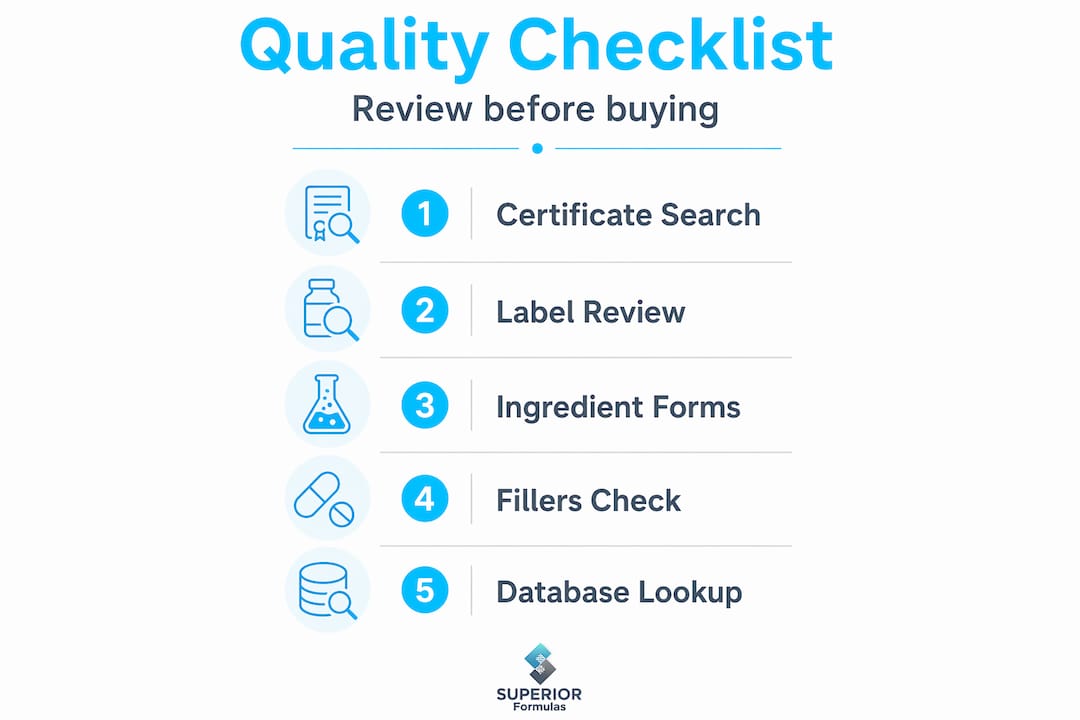
Once you have a product in hand, the real evaluation begins on the label itself. The Supplement Facts panel is regulated, but interpretation still requires attention.
Step 1: Check the serving size and servings per container. Some products look affordable until you notice a “serving” is four capsules and the bottle contains 30 servings. Compare the total capsule count to the serving size to understand the real cost and compliance burden.
Step 2: Analyze ingredient forms. Magnesium glycinate absorbs significantly better than magnesium oxide. Methylcobalamin is more bioavailable than cyanocobalamin for vitamin B12. The form of an ingredient directly affects how much your body can actually use. Ingredient forms are rarely mentioned in marketing, but they appear on the Supplement Facts panel.

Step 3: Look for fillers, allergens, and additives. Common fillers like magnesium stearate, silicon dioxide, and titanium dioxide are generally considered safe at low levels, but their presence can signal a cost-focused formulation. More concerning are unlisted allergens. Check “other ingredients” carefully if you have any sensitivities.
Step 4: Identify proprietary blends. Proprietary blends obscure individual doses, making it impossible to know whether any single ingredient reaches a clinically relevant amount. A blend labeled “Longevity Matrix 500mg” containing six adaptogens could theoretically have 490mg of one ingredient and trace amounts of the others.
Step 5: Cross-reference with independent databases. ConsumerLab and similar independent testing platforms publish results from nutritional supplement testing conducted outside any brand’s influence. Checking a product there before purchasing is one of the most direct ways to verify what you’re actually getting.
Here’s how label transparency compares across product types:
| Label feature | Transparent product | Opaque product |
|---|---|---|
| Ingredient doses | Listed individually | Hidden in proprietary blend |
| Certificate of Analysis | Publicly available | Not disclosed |
| Third-party certification | Seal displayed | None present |
| Ingredient forms | Specified (e.g., methylcobalamin) | Generic (e.g., vitamin B12) |
| “Other ingredients” | Minimal, recognized compounds | Long list of unrecognizable additives |
Red flags and pitfalls that cost people their health
Some warning signs are easy to overlook, particularly when a product’s marketing is sophisticated. Recognizing these patterns protects both your health and your money.
The contamination risk in certain categories is not theoretical. Weight-loss and sexual enhancement supplements show contamination rates ranging from 12% to 58%, often involving undisclosed pharmaceuticals. These are active drugs with real side effects being sold under wellness branding. This is not a fringe concern. It shows up repeatedly in FDA safety alerts and independent laboratory reports.
Common red flags to watch for:
- “FDA Approved” claims on supplement labels. The FDA does not pre-approve dietary supplements for safety or efficacy before they reach store shelves. When you see this phrase on a supplement, the brand is either uninformed or intentionally misleading you.
- Miracle or cure-all language. Phrases like “eliminates cancer cells” or “reverses aging completely” are not just exaggerations. They are illegal structure-function claims that the FDA prohibits, and they indicate a brand willing to overpromise.
- Anonymous manufacturing. If you cannot find the actual manufacturer’s name, location, or any GMP certification information, the supply chain is opaque enough to create real risk.
- No contact information or science page. Legitimate brands publish their clinical rationale, sourcing standards, and testing protocols. A beautiful website with no science content is a design investment that avoids scrutiny.
“Third-party certifications reduce risk, but they are one tool in a larger due-diligence process. Consumer responsibility does not end at the certification seal.” — BSCG
When you’re evaluating dietary supplements in a category you’re less familiar with, search for that specific category in the FDA’s database of tainted products. It takes two minutes and can prevent a genuinely harmful outcome.
What third-party certifications actually tell you
Third-party certification is where the supplement industry’s accountability gap gets partially closed. Understanding what these programs do and what they don’t do helps you use them correctly.
When a product earns a USP, NSF, or BSCG certification, it means an independent laboratory has tested it for ingredient identity, label accuracy, and the absence of specified contaminants. The key phrase is “specified contaminants.” Each program has its own analyte list, and no program tests for everything conceivable.
Here is how major certification bodies compare on key dimensions:
| Certification body | Focus area | Lab accreditation | Lot testing |
|---|---|---|---|
| USP | Identity, potency, purity | Yes | Selected lots |
| NSF International | Contaminants, label claims | Yes | Selected lots |
| BSCG | Banned substances (sports focus) | ISO 17025 | Yes |
| Informed Choice | Banned substances | ISO 17025 | Yes |
| ConsumerLab | Independent testing, consumer focus | Varies | Selected products |
ISO 17025 accreditation and public analyte lists are the two factors that most distinguish rigorous testing programs from less demanding ones. An accredited lab operates under internationally recognized standards for technical competence. A transparent analyte list tells you exactly what was tested, so you can judge whether the scope meets your needs.
One factor rarely discussed: lot-to-lot consistency testing is critical for meaningful quality assurance. A product that passed testing on one batch in January may look different in June if ingredient sourcing or manufacturing conditions changed. The best certification programs test multiple lots across the production year.
Pro Tip: Visit the certification body’s website directly and search for the specific product by name or batch number. Some programs maintain searchable public databases that show you whether the exact lot you purchased was tested and when.
Third-party testing reduces risk measurably, but it does not replace your own judgment or your healthcare provider’s guidance. A certified product is meaningfully safer than an uncertified one. It is not automatically safe in every context for every individual.
Verifying supplement quality after you purchase
Buying a high-quality supplement is step one. Monitoring it after purchase is step two, and most people skip it entirely.
- Record the lot number and expiration date. Write these down or photograph the bottle when you open it. Lot numbers are your link to specific CoA documents and allow you to verify that your batch was the one actually tested, not a different production run.
- Check for active recalls. The FDA maintains an online database of supplement recalls and safety alerts. Search your product’s name and manufacturer within the first week of purchase and again if you hear anything unusual about the brand.
- Monitor your physical response carefully. New symptoms within the first two to four weeks of starting a supplement, whether digestive, neurological, or dermatological, should prompt you to stop use and contact your healthcare provider. Bring the bottle and the CoA if you have it.
- Schedule a follow-up blood panel. For supplements targeting measurable biomarkers, like vitamin D, omega-3 index, or B12 levels, a blood test at baseline and again after 90 days of consistent use gives you objective data on whether the product is working as claimed.
- Report suspicious products. If you suspect a supplement harmed you or contained undisclosed ingredients, report it to the FDA via MedWatch. This reporting system directly feeds into the agency’s enforcement and recall decisions.
Pro Tip: Ask your physician or pharmacist to review your full supplement list, not just individual products. Interactions between supplements, or between supplements and medications, are often the source of side effects that get attributed to something else entirely.
Understanding how transparency connects to safety is something the team at why clean supplements matter has written about in depth, and it’s worth reading alongside your own post-purchase monitoring process.
My perspective on the supplement industry
I’ve spent considerable time working through supplement quality data, consumer reports, and the clinical literature behind ingredient claims. Here is what I’ve actually concluded, beyond the standard advice.
The biggest lie the industry tells is that label sophistication equals product quality. I’ve seen beautifully designed bottles with clinical-sounding terminology that contained underdosed ingredients in inferior forms. The graphic design budget has no correlation with the science budget. I always tell people: go past the front label before you go past the checkout.
What I’ve learned is that transparency is the single most reliable proxy for quality. When a brand publishes its CoA, names its testing laboratory, specifies ingredient forms, and explains the clinical rationale behind each dose, that behavior pattern predicts quality far more reliably than any marketing claim. Opacity in this industry is almost never accidental.
The uncomfortable truth about the regulatory gap is this: the supplement market operates on a presumption of innocence that does not exist for pharmaceuticals. Brands do not have to prove anything works or is safe before they sell it to you. That burden falls entirely on you as the consumer, at least until the FDA acts on a problem. Understanding that structure is not cynicism. It is the foundation of smart supplementation.
I also believe in the genuine benefits that well-formulated supplements can provide. Dismissing the entire category because of industry problems would be throwing out real science along with the bad actors. The answer is calibrated skepticism and continued vigilance, not avoidance.
— cristopher
Science-backed supplements you can actually trust
If working through this quality evaluation process has clarified what you’re looking for, Superiorformulas was built to meet exactly those standards. Every formulation is physician-developed, manufactured in a GMP-certified facility, and supported by third-party testing for purity and label accuracy. Ingredients are selected based on clinical evidence, specified by form, and disclosed in full, no proprietary blends obscuring what you’re actually taking.
For readers who want to go deeper into the research behind each formulation, the science and quality standards page at Superiorformulas walks through the clinical rationale, sourcing principles, and testing protocols that inform every product. You’ve now learned how to evaluate supplement quality at a high level. Superiorformulas is designed so that evaluation works in its favor.
FAQ
What makes a supplement high quality?
A high-quality supplement accurately lists all ingredients and doses, uses bioavailable ingredient forms, passes third-party testing for purity and label accuracy, and is manufactured in a GMP-certified facility.
How do I know if a supplement is third-party tested?
Look for certification seals from USP, NSF, BSCG, or Informed Choice on the label, then verify the product’s listing directly on the certifying organization’s website using the product name or lot number.
Are proprietary blends a problem?
Yes. Proprietary blends hide individual ingredient doses, making it impossible to determine whether any ingredient is present at a clinically relevant amount, which undermines any efficacy assessment.
Can the FDA guarantee a supplement is safe?
No. The FDA does not review or approve dietary supplements before they are sold, meaning FDA approval does not apply to supplements the way it does to pharmaceutical drugs.
How often should I reassess the supplements I take?
Review your supplement regimen with a healthcare provider at least once a year, or immediately after starting a new product, experiencing unexpected symptoms, or seeing a news report about a recall in a category you use.
Recommended
- How to assess dietary supplements for real wellness gains - SUPERIOR Formulas
- Why quality supplements matter for longevity and health - SUPERIOR Formulas
- Types of dietary supplements: A health-conscious guide - SUPERIOR Formulas
- Implement science-driven supplementation for better health - SUPERIOR Formulas


