


A Certificate of Analysis is a lab-issued document confirming that a specific supplement batch meets its identity, potency, purity, and contaminant specifications. Manufacturers, brand owners, retailers, and auditors rely on it to verify quality and cGMP compliance before a product ever reaches a shelf. Without a valid COA tied to the exact lot in question, there is no documented proof the product inside the bottle matches what the label claims.
TL;DR:
- Supplier COAs are generally sufficient for routine batches of well-documented ingredients from trusted suppliers, but independent testing is recommended for new or high-risk ingredients.
- Accreditation through ISO/IEC 17025 indicates that a laboratory has demonstrated competence and a quality management system, and most large retailers now require this accreditation for COAs.
- A complete COA must identify the product, lab, test methods, results, and include an authorized signature; vague language or missing lot numbers undermine its reliability.
- Potency results reported as percentages without actual units should raise red flags; requesting raw numerical data helps verify accuracy.
- Implementing a quality assurance program that includes raw material testing, thorough record keeping, and retesting triggers ensures ongoing product safety and compliance.
Table of Contents
- The Regulatory Foundation Behind Every Supplement COA
- The Standard Elements Every COA Should Include
- How to Get a COA and Vet the Lab Behind It
- Reading COA Results: What Passes and What Doesn’t
- Supplier COAs vs. Third-Party Certification: Choosing the Right Assurance Level
- Building a QA Program Around “Trust But Verify”
- A Physician-Led View on COAs as a Quality Signal, Not a Formality
- Where to Learn More About Superiorformulas’ Quality Standards
- Primary Sources for COA and Compliance Guidance
- Sources
- FAQ
The Regulatory Foundation Behind Every Supplement COA
The COA exists because FDA’s cGMP rule under 21 CFR Part 111 requires manufacturers to establish that finished products and raw materials meet specifications for identity, purity, strength, and composition. The regulation does not hand companies a template. It demands scientifically valid test methods and documentation that can withstand an FDA inspection or a retailer audit.
That distinction trips up a lot of brand owners. A COA is not paperwork you generate to check a box. It is evidence a quality system is functioning as intended. The rule expects:
- Identity confirmation for every dietary ingredient before it enters production
- Purity and strength testing against established specifications, not marketing claims
- Documented methods that a third party could reproduce and verify
- Records retained long enough to support a full batch history if regulators ask
Industry guidance from CHPA’s SIDI work group standardizes what a compliant COA should contain, giving suppliers, distributors, and manufacturers a shared framework for meeting these expectations consistently.
The Standard Elements Every COA Should Include
A complete supplement COA follows a predictable structure, and knowing that structure is the fastest way to spot a weak one.
- Product and sample identification. Product name, batch or lot number, and manufacture or sample date, all matching the physical product being sold.
- Laboratory identification. The testing lab’s name, address, and accreditation status, ideally ISO/IEC 17025.
- Test methods and units. The analytical method used (HPLC, ICP-MS, PCR, and similar), with units and acceptance criteria that match the label’s Supplement Facts panel.
- Results. Identity confirmation, potency or assay values, and contaminant screen outcomes, each compared against a stated specification.
- Sign-off and raw data availability. An authorized signature and a note on whether raw chromatograms or spectra can be requested.
The most common gaps are mismatched units (milligrams reported where the label states micrograms), missing lot numbers that make the COA impossible to trace to actual inventory, and vague “meets specification” language with no numeric result attached.
Pro Tip: If a COA reports potency as a percentage of label claim rather than an actual measured value with units, ask for the raw number. Percentage-only reporting can mask a result that barely meets the lower limit.
How to Get a COA and Vet the Lab Behind It
Deciding whether a supplier’s COA is good enough, or whether you need your own finished-product testing, comes down to risk. A well-established raw material supplier with a consistent testing history may justify accepting their COA for routine lots. A new supplier, a novel botanical extract, or an ingredient with known adulteration history warrants independent verification before it enters your product.
Lab accreditation is where most of that risk gets managed. ISO/IEC 17025 accreditation means a lab has demonstrated technical competence and a functioning quality management system, not just a certificate on the wall. You can verify accreditation status directly with the accrediting body rather than taking a lab’s word for it.
Marketplace rules raise the bar further. Amazon and other large retailers now require COAs from ISO/IEC 17025-accredited labs, with strict recency windows and formatting rules, including matching units and clear batch identification. When selecting a lab, look for:
- Documented method validation for the specific analytes you need tested
- Turnaround times that fit your production schedule without pressuring corner-cutting
- A willingness to provide raw data or chromatograms on request
- Clear chain-of-custody procedures from sample collection to final report
Retailer requirements have effectively pushed the entire industry toward a higher baseline for COA granularity, and brands selling through major platforms should expect that trend to continue.
Reading COA Results: What Passes and What Doesn’t
Interpreting a COA correctly means understanding what each test is actually measuring and where the acceptable range sits.
Identity testing confirms the raw material is what it claims to be, typically through methods like DNA barcoding for botanicals or spectroscopy for isolated compounds. A pass means the sample matches a reference standard. There is no partial credit here.
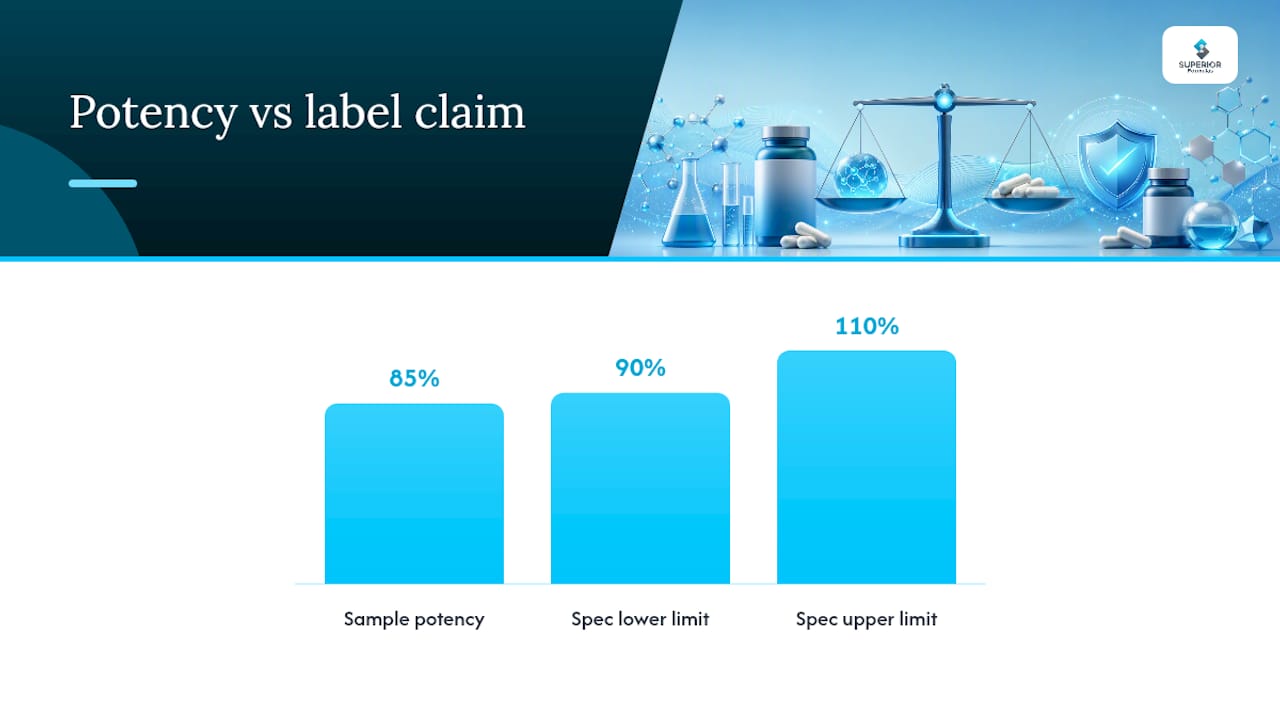
Potency or assay results need to be checked against the label claim, not just a generic specification. Most finished products carry a tolerance band, often expressed as a percentage range around the labeled amount. If a COA shows 85% of label claim and your internal specification requires 90 to 110%, that is a failure regardless of how the lab summarized it.
Contaminant panels cover heavy metals, microbial limits, pesticide residues, and residual solvents. Two terms confuse people constantly:
- ND (Not Detected) means the analyte was below the lab’s detection capability, not that it is absent at zero.
- LOQ (Limit of Quantitation) is the lowest concentration the method can measure reliably. A result reported as “below LOQ” is a pass only if that LOQ sits under your regulatory or internal limit.
When a heavy metal result lands close to its limit, or a potency figure sits at the edge of its tolerance band, request the raw chromatogram and the method validation summary before releasing the batch. That single step catches more discrepancies than any other verification you can do internally.
Supplier COAs vs. Third-Party Certification: Choosing the Right Assurance Level
A supplier COA tells you about one batch, tested one time, under conditions the supplier controlled. That is useful, but it is not the same thing as ongoing verification.
Third-party certification programs close that gap. NSF’s supplement certification program includes facility audits, formulation review, and label-to-bottle testing rather than a single point-in-time result. USP’s Dietary Supplement Verification Program goes further, combining facility audits with off-the-shelf testing that continues after the product reaches store shelves, confirming what is in the bottle stays consistent with what was originally verified.
The trade-off is cost and frequency. A supplier COA is fast and inexpensive; third-party verification requires ongoing investment and lead time. For most brands, the right approach depends on risk exposure:
- Low-risk, well-documented ingredients with a stable supplier history: supplier COA is usually sufficient
- Novel ingredients, high-dose actives, or products facing regulatory scrutiny: seek USP or NSF verification
- Products marketed with strong efficacy claims: third-party certification adds audit defensibility that a supplier COA alone cannot provide
Building a QA Program Around “Trust But Verify”
A COA is only as reliable as the process behind it, which is why quality teams should treat every incoming COA as a starting point, not a final answer.
- Design a sampling plan. Under 21 CFR §111.75, manufacturers must determine whether specifications are met, and identity testing on incoming components is generally required unless a documented exception applies. Statistically sound sampling, not spot-checking at random, is the standard regulators expect.
- Retain complete records. Keep chain-of-custody documentation, raw analytical data, and method validation files alongside every COA, not just the summary report.
- Set retesting triggers. New suppliers, discrepant results, formula changes, or a retailer compliance flag should all trigger independent verification before the lot ships.
- Document every decision. If you accept a borderline result or waive a retest, write down why. That record is what protects you in an audit.
Pro Tip: Build a rotating retest schedule, even for trusted suppliers. Testing 5 to 10% of incoming lots against your own third-party lab, chosen at random, catches supplier drift long before it becomes a recall.
A Physician-Led View on COAs as a Quality Signal, Not a Formality
Some supplement companies emphasize that a COA is one checkpoint inside a larger verification system, not a substitute for one. Formulations may go through supplier qualification and third-party testing in GMP-certified facilities before batch approval, and COA data is ideally cross-checked against label claims rather than filed and forgotten. Readers with technical questions about interpreting COA results or vetting a supplier are welcome to reach out directly.
— cristopher
Where to Learn More About Superiorformulas’ Quality Standards
Some brands aim to provide assurance that a supplement’s label matches what’s actually in the bottle by using physician-led development and third-party testing rather than relying on marketing language alone.
If you want to see how testing and formulation decisions connect in practice, Explore the Science walks through the reasoning behind Superiorformulas’ ingredient choices and quality checkpoints. For a deeper look at how compliance workflows fit together end to end, the supplement compliance process guide breaks down the steps brands follow from raw material to finished product. Readers evaluating their own supplier relationships can also check the supplement quality checklist for a field-by-field comparison point. Have a technical question about how a specific COA result should be interpreted? Reach out through the site’s contact page and start that conversation before your next purchase decision.
Primary Sources for COA and Compliance Guidance
For policy-level or audit-level detail beyond this overview, consult FDA’s cGMP regulation, CHPA’s COA guidance, USP’s verification program details, and IADSA’s global GMP guide. Each source addresses a different layer of compliance, from federal law to voluntary industry standards.
Sources
- Certificate of Analysis for Dietary Supplement Components (Consumer Healthcare Products Association)
- NSF Supplement & Vitamin Certification (NSF International)
- USP Dietary Supplement Verification Program (USP)
FAQ
What does COA stand for in supplements?
COA stands for Certificate of Analysis, a lab document verifying that a specific supplement batch meets its identity, potency, purity, and contaminant specifications.
What is a COA in pharmaceutical and supplement manufacturing?
In both industries, a COA is the official record confirming a product batch was tested against defined specifications before release, though pharmaceutical COAs typically follow pharmacopeial standards while supplement COAs follow 21 CFR Part 111 requirements.
How do I get a COA for my product?
You commission testing through an ISO/IEC 17025-accredited lab, either by requesting one from your raw material supplier or by submitting finished-product samples directly for independent analysis.
What vitamin is needed for COA?
No vitamin is required to produce a COA. A COA is a testing document, not a nutrient, though vitamin and mineral products still need identity and potency testing reported on their own COA like any other supplement.
Is a supplier COA enough, or do I need third-party certification?
A supplier COA covers a single batch and is often sufficient for low-risk, well-documented ingredients, but products with strong claims or novel ingredients benefit from added assurance through programs like NSF or USP verification.


