


Berberine for metabolism has real backing: randomized trials and meta-analyses link it to lower fasting glucose, reduced triglycerides, and modest waist circumference and weight loss. The evidence is genuine but imperfect, drawn largely from shorter trials with mixed formulations, so the safety picture matters as much as the benefit. Anyone on prescription medications should talk to a clinician first, since berberine interacts with several common drugs.
TL;DR:
- Most trials show berberine lowers fasting glucose, triglycerides, and waist circumference by modest, statistically significant amounts over three months.
- Its mechanisms involve activating AMPK, improving liver LDL receptor activity, and promoting fat browning, which collectively influence glucose and lipid metabolism.
- Doses around 1.5 grams daily, split across meals, are typical, but bioavailability is low, making formulation quality and gut bacteria conversion critical to effectiveness.
- Side effects are mostly gastrointestinal, and drug interactions with liver enzymes mean careful medical supervision is necessary for users on medications or with health conditions.
- Long-term effects remain uncertain due to short trial durations, so ongoing monitoring and a healthy lifestyle are essential for sustained metabolic benefits.
Table of Contents
- What Does the Clinical Evidence Show for Berberine and Metabolism?
- How Does Berberine Affect Metabolism at the Cellular Level?
- What’s the Right Berberine Dosage and Timing for Metabolic Support?
- Is Berberine Safe? Side Effects and Drug Interactions to Know
- Who Benefits Most From Adding Berberine to a Metabolic-Health Plan?
- Can Berberine Affect Thyroid Function?
- Does Berberine Work Long Term? What the Data Doesn’t Yet Show
- How Much Do Diet and Exercise Change Berberine’s Effects?
- A Reasonable Way to Think About Berberine’s Role
- A Physician-Formulated Approach to Metabolic Support
- Sources
What Does the Clinical Evidence Show for Berberine and Metabolism?
A 2025 systematic review and meta-analysis in Frontiers in Pharmacology pooled randomized, placebo-controlled trials and found berberine produced measurable shifts across three markers of metabolic syndrome. Triglycerides dropped, fasting plasma glucose fell, and waist circumference shrank compared to placebo. BMI also declined modestly, a change the meta-analysis flagged as statistically significant but small in real-world terms.
Statistic callout: Across systematic reviews of berberine health outcomes, 90.91% of studies on metabolic syndrome and 92.59% of studies on type 2 diabetes reported positive results, though the authors noted many underlying reviews carried quality concerns.
This pattern isn’t new. Earlier trials, including a frequently cited early randomized controlled study in people with type 2 diabetes, found glycemic improvements that held up against some standard glucose-lowering approaches, at least in small cohorts. Weight outcomes tell a similar, more modest story. Trials using doses around 1.5 g/day for eight to twelve weeks have reported average losses in the range of a few pounds rather than dramatic transformations.
Where the evidence gets shakier:
- Most trials originate in Asia, where dosing habits, diet, and genetics may differ from a typical American patient population.
- Formulations vary widely, from plain berberine hydrochloride to dihydroberberine derivatives, making cross-study comparisons imprecise.
- Trial durations rarely exceed three months, leaving long-term outcomes largely unstudied.
- Risk-of-bias concerns show up repeatedly, and a separate comprehensive pharmacology review calls for larger, standardized RCTs before firmer conclusions can be drawn.
How Does Berberine Affect Metabolism at the Cellular Level?
Berberine’s headline mechanism is AMPK activation. Think of AMPK as a cell’s energy gauge. Once berberine switches it on, cells respond by pulling in more glucose, breaking down stored fat for fuel, and dialing back the liver’s glucose production, a process called gluconeogenesis. That three-part effect explains why the compound shows up in both blood sugar and lipid research simultaneously, rather than one or the other.

The lipid effects run through a separate but related channel. Berberine appears to upregulate LDL receptors on liver cells, helping clear LDL cholesterol from the bloodstream, while also modulating PCSK9, a protein that normally works against that clearance process. Both actions plausibly contribute to the triglyceride reductions seen in trials.
A newer area of interest involves fat tissue itself. Research points to berberine’s role in adipose browning, the conversion of energy-storing white fat into more metabolically active beige fat, through pathways involving UCP1 and PGC1α. Appetite-regulating signals like GDF15 may also play a part, though this research remains preclinical in large part.
Other mechanisms worth knowing:
- Gut bacteria convert berberine into dihydroberberine (dhBBR), a metabolite absorbed more efficiently than the parent compound.
- Molecular docking studies have identified interactions with SIRT1, FOXO, Nrf2, GLP-1, GLUT2, and MPC1, suggesting berberine acts on multiple targets rather than a single switch.
- These combined mechanisms likely explain why the compound’s clinical effects touch glucose, lipids, and body composition together instead of in isolation.
What’s the Right Berberine Dosage and Timing for Metabolic Support?
Most clinical trials use 500 mg taken three times daily, totaling 1.5 g/day, though a meaningful share of the research showing benefit used doses closer to 1 g/day. Timing matters here almost as much as the total amount. Berberine has a short half-life, so splitting the daily dose into two or three servings supports steadier blood levels and tends to cause less stomach upset than one large dose.
- Start with a single 500 mg dose taken with a meal to gauge tolerance before adding a second or third dose.
- Space doses evenly across the day, typically with breakfast, lunch, and dinner, to align absorption with meal-related glucose spikes.
- Reassess after 8 to 12 weeks, the window most trials use to detect measurable changes in glucose, lipids, or waist circumference.
Absorption is the real bottleneck. Oral bioavailability sits below 1% for standard berberine, since most of it gets metabolized in the liver and intestines before reaching systemic circulation. Gut bacteria convert some berberine into dihydroberberine, a form the body absorbs more readily, which is why formulation quality and third-party testing matter more with this compound than with many supplements.
Pro Tip: Take berberine with food rather than on an empty stomach. Food slows gastric transit slightly, which appears to reduce the nausea some people experience during the first week or two of use.
Is Berberine Safe? Side Effects and Drug Interactions to Know
Gastrointestinal symptoms are the most common complaint: nausea, diarrhea, and bloating, particularly during the first few days. Starting at a lower dose and increasing gradually reduces the odds of these symptoms becoming a reason to quit altogether.
The bigger concern is drug interactions. Berberine affects CYP2D6 and CYP1A2 liver enzymes along with P-glycoprotein transport pathways, systems that also process metformin, cyclosporine, and omeprazole. That overlap means berberine can change how much of those drugs stays active in the body, in either direction.
- People taking glucose-lowering medications should watch for hypoglycemia symptoms, since combining agents can push blood sugar lower than expected.
- Anyone on immunosuppressants, particularly transplant recipients, should avoid berberine without direct physician oversight given cyclosporine’s interaction risk.
- Pregnant and breastfeeding individuals should skip berberine, as safety data in these groups is lacking.
- People with significant liver or kidney disease need medical guidance before use, since metabolism and clearance both run through those organs.
Statistic callout: One overview of systematic reviews found gastrointestinal disorders were addressed favorably in 94.74% of the studies examined, though “favorable” in that context often just means tolerable side effects rather than zero symptoms.
Who Benefits Most From Adding Berberine to a Metabolic-Health Plan?
Berberine tends to make the most sense for adults dealing with insulin resistance, early type 2 diabetes, dyslipidemia, or several overlapping features of metabolic syndrome, used as an addition to, not a replacement for, prescribed treatment.
Choosing a product matters as much as choosing to take one at all:
- Confirm manufacturing happens in a GMP-certified facility.
- Look for a certificate of analysis confirming purity and potency from third-party testing.
- Check that the label states a clear milligram dose per capsule, not a vague “proprietary blend.”
- Favor transparent ingredient sourcing over marketing claims alone.
A reasonable starting plan: begin with a low, divided dose, hold steady for 8 to 12 weeks, then recheck fasting glucose, a lipid panel, and liver enzymes if your clinician recommends it. Stop and check in with a provider if you notice persistent GI distress, signs of low blood sugar, or if you start a new prescription that might interact.
Pro Tip: Bring your supplement bottle to your next appointment. A pharmacist or physician can check the exact dose and formulation against your current prescriptions in minutes.
Can Berberine Affect Thyroid Function?
Berberine isn’t classified as a thyroid-active compound in the way iodine or selenium are, but its metabolic reach means it can indirectly touch thyroid-related processes. Thyroid hormone governs basal metabolic rate, and some of the same AMPK and mitochondrial pathways berberine influences also intersect with thyroid hormone signaling in peripheral tissues.
The direct human evidence here is thin. Most of what’s known comes from mechanistic and animal research rather than dedicated thyroid-focused trials in people, so drawing firm conclusions would outpace the data. What’s clear is that berberine’s downstream effects, weight loss, improved insulin sensitivity, and shifts in lipid metabolism, can all indirectly affect how thyroid hormone gets used at the tissue level, even without berberine acting on the thyroid gland itself.
This matters practically for one group in particular: people with diagnosed hypothyroidism or Hashimoto’s disease already on levothyroxine. There’s no strong signal that berberine blocks thyroid medication absorption the way calcium or iron supplements can, but the overlapping metabolic pathways are still reason enough to separate dosing times and mention berberine use at your next thyroid panel. Anyone managing a thyroid condition alongside metabolic concerns should treat berberine as one more variable worth tracking, not a wildcard to add without a conversation with the prescribing clinician.
Does Berberine Work Long Term? What the Data Doesn’t Yet Show
Nearly every berberine trial with meaningful sample sizes runs 8 to 12 weeks. That’s long enough to see glucose and lipid shifts, but it says nothing definitive about what happens after six months or two years of continuous use.
This is the honest gap in the literature. Reviewers calling for larger, standardized clinical trials aren’t being cautious for the sake of caution. Short trials can’t rule out tolerance developing over time, can’t confirm whether weight loss plateaus or reverses, and can’t fully characterize rare long-term interaction risks that only surface with sustained use across a larger population.
That said, the mechanistic case for durability is reasonable. AMPK activation and lipid-related pathways don’t have an obvious reason to lose potency after a few months, unlike some appetite-suppressant mechanisms that fade quickly. But reasonable biology isn’t the same as long-term trial data. Until multi-year studies exist, the practical approach is treating berberine as a monitored intervention: recheck labs periodically, watch for any drift in tolerance, and don’t assume that a benefit seen at week 12 will automatically hold at month 24 without ongoing reassessment.
How Much Do Diet and Exercise Change Berberine’s Effects?
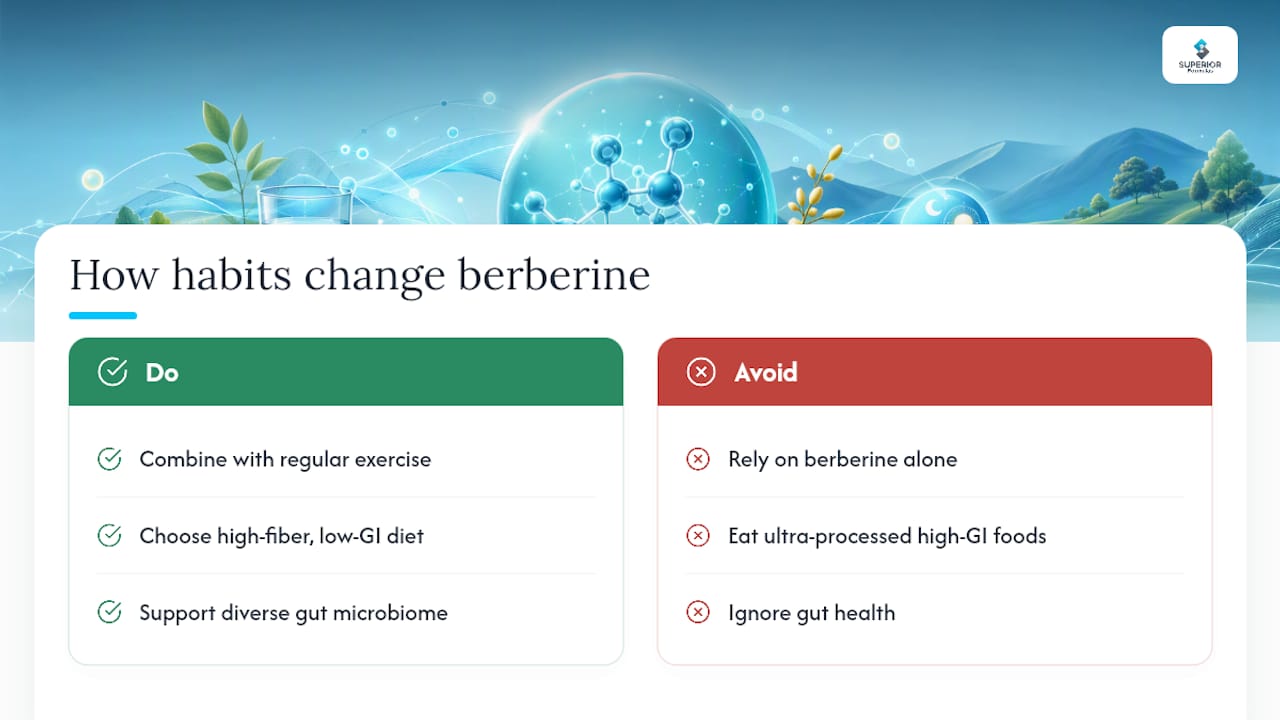
Berberine doesn’t work in a vacuum, and the trials showing its best results almost always involve participants who weren’t actively working against the compound’s mechanisms with their daily habits.
AMPK activation, berberine’s central mechanism, is the same pathway exercise triggers naturally. Physical activity and berberine appear to push on the same lever, which means combining the two plausibly produces a bigger effect than either alone, even though few trials have directly tested that stacking in humans. Diet works similarly. A high-glycemic, ultra-processed eating pattern keeps insulin demand elevated in ways that likely blunt the modest glucose improvements berberine can offer, while a diet built around fiber, lean protein, and lower glycemic load gives the compound less resistance to work against.
Gut microbiota composition adds another layer, since certain gut bacteria convert berberine into its better-absorbed metabolite, dihydroberberine. Diets rich in fiber and fermented foods support a more diverse microbiome, which may influence how much active compound actually gets absorbed. Readers curious about supporting that gut environment directly can look at evidence-ranked plant-based prebiotic ingredients as a complementary angle. None of this means berberine is useless without a perfect diet. It means the supplement is best understood as an amplifier of good habits, not a substitute for them, a distinction worth keeping in mind if you’re weighing it against broader metabolic health strategies.
A Reasonable Way to Think About Berberine’s Role
The data on berberine is more solid than most supplement claims you’ll encounter, but it’s also narrower than marketing often suggests. It moves specific numbers, fasting glucose, triglycerides, waist circumference, by amounts that are real but modest, in trials that mostly run three months. That’s worth taking seriously and worth not overselling.
What gets underestimated is how much formulation quality determines whether any of this applies to what’s actually in your bottle. Low bioavailability means a poorly made product can underdeliver even when the research on the molecule itself looks strong.
— cristopher
A Physician-Formulated Approach to Metabolic Support
If you’ve read this far, you already know berberine’s clinical story depends heavily on formulation quality, dosing accuracy, and third-party verification, not just the ingredient name on a label. That’s precisely where Superiorformulas built its Berberine+ formula, developed by a physician-scientist and manufactured in GMP-certified facilities with third-party testing on every batch.

The formulation reflects the dosing pattern discussed above, with a clearly labeled milligram dose per capsule rather than a vague blend, so you know exactly what you’re taking and can adjust intake with a clinician’s input. Superiorformulas also publishes ingredient sourcing details rather than hiding behind proprietary language, which matters given how much absorption and purity affect real-world results with this particular compound.
If you’re ready to see how a transparently formulated berberine product fits into your own metabolic-health plan, visit Superiorformulas to explore the Berberine+ formula and review the full supplement facts before you order.
Sources
- Efficacy and safety of berberine on the components of metabolic syndrome: a systematic review and meta-analysis of randomized placebo-controlled trials
- Berberine: What it is, benefits & side effects (Cleveland Clinic)
- Efficacy of Berberine in Patients with Type 2 Diabetes


