


, the FDA regulates supplements after they hit the market through inspectio...&media=http://cdn//csuxjmfbwmkxiegfpljm.supabase.co/storage/v1/object/public/blog-images/organization-27528/1789707824412_Ingredient-moving-through-notice-timeline.jpeg)


No. In the United States, dietary supplements are not FDA-approved before they go on sale. Under the Dietary Supplement Health and Education Act of 1994 (DSHEA), the FDA regulates supplements after they hit the market through inspections and adverse-event monitoring, not before. Any label claiming “FDA-approved” on a supplement bottle is making a claim that is not legally possible.
TL;DR:
- Dietary supplements in the U.S. are not FDA-approved before sale, and any claim of “FDA approval” on labels is false, making post-market regulation the norm.
- The FDA’s enforcement actions only occur after issues arise, primarily through facility inspections, adverse-event reports, or product recalls, but efficacy remains unverified post-launch.
- Label claims about disease treatment are illegal without FDA approval, and supplements making structure/function claims must include a disclaimer and FDA notification within 30 days of marketing.
- Manufacturers of new dietary ingredients must notify the FDA 75 days before market, but the agency’s review is informational, not a safety endorsement.
- Consumers should focus on checking for third-party testing, GMP certification, complete ingredient listing, and transparent sourcing rather than relying on “FDA-approved” labels or unverified claims.
Table of Contents
- How U.S. Law Treats Dietary Supplements Under DSHEA
- What FDA Enforcement Actually Looks Like After a Product Launches
- Structure/Function Claims, Disease Claims, and the Mandatory Disclaimer
- New Dietary Ingredients: What the 75-Day Notice Really Means
- A Practical Checklist for Judging Supplement Quality
- How Superiorformulas Approaches Quality Without Overselling Regulation
- A Straight Answer for Anyone About to Buy a Bottle
- Where to Check Testing and Ingredient Sourcing Before You Buy
- Official Resources for Verifying Supplement Safety
- Sources
- FAQ
How U.S. Law Treats Dietary Supplements Under DSHEA
DSHEA created a separate legal category for dietary supplements, distinct from drugs, and that distinction shapes everything about how these products reach consumers. A drug maker has to prove safety and effectiveness to the FDA before selling a single bottle. A supplement maker does not. Instead, DSHEA places the responsibility for safety and truthful labeling squarely on the manufacturer, not the agency.
This is a deliberate policy choice, not a loophole. Congress designed DSHEA to keep vitamins, minerals, herbs, and similar products broadly accessible without the years-long and multimillion-dollar approval pipeline drugs go through. The tradeoff is that the FDA typically only steps in after a problem surfaces, whether that’s a contamination report, an adverse-event pattern, or a lab test revealing an undisclosed ingredient.
What this means in practice for shoppers:
- No government agency verifies a supplement’s effectiveness before it reaches a shelf.
- The manufacturer decides what goes into the product and vouches for its safety.
- The FDA’s real power kicks in after the fact, once evidence of harm or fraud exists.
- A product can be sold legally for months or years before anyone outside the company scrutinizes its formula.
Supplement regulation under DSHEA rewards manufacturers who invest in quality controls voluntarily, because nothing forces their hand until something goes wrong.
What FDA Enforcement Actually Looks Like After a Product Launches
The FDA’s authority over supplements is real. It just arrives later in the process than most consumers assume. FDA’s regulation of dietary supplements works through three main channels once a product is already on shelves.
- Facility inspections. FDA investigators visit manufacturing sites to check compliance with Current Good Manufacturing Practices, reviewing batch records, testing procedures, and sanitation.
- Adverse-event monitoring. Manufacturers must report serious adverse events, and consumers or clinicians can file their own reports directly with the agency.
- Enforcement action. When evidence points to a real hazard, the FDA can issue warning letters, seize products, or push for a recall.
One detail surprises a lot of people: CGMP inspections check whether a facility is clean, consistent, and well-documented. They do not test whether the ingredients inside actually work. A company can pass every inspection and still sell a product with unproven benefits, because efficacy has never been part of what the FDA checks after launch.
Structure/Function Claims, Disease Claims, and the Mandatory Disclaimer
Supplement labels are allowed to make certain health-related statements, but the line between what’s legal and what’s not comes down to one distinction: structure/function versus disease claims. A structure/function claim describes how an ingredient supports normal body processes, something like “supports healthy joints” or “promotes cellular resilience.” These claims don’t require FDA approval, but they do require a specific disclaimer.
A disease claim is different. Saying a product “treats arthritis” or “cures insomnia” reclassifies that supplement as an unapproved drug in the eyes of the law, which triggers the same premarket approval requirement drugs face.
Here’s what to look for on the label:
- The mandatory disclaimer text: “This statement has not been evaluated by the Food and Drug Administration. This product is not intended to diagnose, treat, cure, or prevent any disease.”
- Manufacturers making a structure/function claim must notify the FDA within 30 days of first marketing the product, under the rule sometimes referenced by its statutory citation, 403®(6).
- Any supplement that skips this disclaimer, or that claims to treat a named disease, deserves a second look before you buy.
If you see the phrase “FDA-approved” printed anywhere on a supplement label, treat it as a warning sign rather than a selling point. Our guide to reading supplement labels breaks down what a compliant label actually looks like.
New Dietary Ingredients: What the 75-Day Notice Really Means
Ingredients not sold in the U.S. before October 15, 1994, count as “new dietary ingredients,” and manufacturers using them face an extra step. They must notify the FDA at least 75 days before marketing a product containing that ingredient.

That word “notify” is doing a lot of work. The 75-day NDI process is informational. The FDA reviews the notice, and if it doesn’t object within that window, the manufacturer can proceed. Silence from the agency is not a stamp of approval. It’s simply the absence of an objection within a fixed deadline.
A few things worth understanding about how loosely this system operates:
- The FDA can request more safety data or object to marketing if the notice raises red flags.
- Compliance with NDI notification is not tightly policed. Some manufacturers skip the filing entirely, and an absent NDI notice doesn’t automatically mean a product is illegal, though it does mean less transparency for the ingredient in question.
- There is no public FDA “pass” issued at the end of this process, unlike a drug approval letter.
This is one of the most misunderstood corners of supplement regulation. Consumers often assume that if an ingredient went through some kind of federal review, it must be safe in the same way an approved drug is safe. The NDI process was never built to make that promise.
A Practical Checklist for Judging Supplement Quality
Since the FDA guidelines for supplements don’t include a premarket safety check, the real work of evaluating quality falls on you. A few minutes of label reading before checkout catches most of the products worth avoiding.
- Check for a complete Supplement Facts panel listing every ingredient and its exact amount, not vague ranges.
- Look for manufacturer contact information, including a real address, not just a website.
- Search for GMP-certified manufacturing language on the label or the brand’s site.
- Confirm third-party testing seals, such as USP or NSF, which independently verify that what’s on the label matches what’s in the bottle.
- Avoid “proprietary blends” that hide individual dosages behind a combined total, since you can’t judge whether an ingredient is present at an effective level.
Pro Tip: Third-party seals like USP and NSF aren’t issued by the FDA, but they’re the closest thing to independent verification a supplement can carry. Our comparison of USP vs. NSF certification walks through what each seal actually tests for.
Red flags multiply fast once you know what to look for: any “FDA-approved” language, disease-treatment promises, missing dosage disclosures, or no way to contact the company. If a bottle checks even two of those boxes, put it back on the shelf. For a longer walkthrough, see our practical guide to evaluating supplement quality.
How Superiorformulas Approaches Quality Without Overselling Regulation
Superiorformulas doesn’t claim FDA approval, because no supplement brand legitimately can. What the brand does claim is narrower and verifiable: products are physician-formulated, built around clinically studied ingredients, and manufactured in GMP-certified facilities with third-party testing on every batch.
Those practices matter because:
- GMP certification addresses manufacturing consistency, the same territory FDA inspectors check.
- Third-party testing catches contamination or mislabeling before it reaches a customer.
- Physician formulation adds a layer of clinical judgment that pure marketing teams don’t bring to ingredient selection.
None of this substitutes for FDA approval. It’s a different kind of assurance, one focused on transparency rather than government sign-off.
A Straight Answer for Anyone About to Buy a Bottle
The biggest mistake consumers make with supplements isn’t taking them. It’s assuming a bottle on a store shelf has already been vetted the way a prescription has. It hasn’t, and understanding that changes how you should shop.
Talk to a clinician before adding anything new to your routine, especially if you take prescription medication or manage a chronic condition. Favor brands that publish their testing results and manufacturing details openly, and don’t hesitate to report a bad reaction to the FDA or check for existing recalls before assuming a product is clean. The gap between “on the market” and “verified safe” is wider than most labels want you to think.
— cristopher
Where to Check Testing and Ingredient Sourcing Before You Buy
Superiorformulas is built for people who want more than a marketing claim before they commit to a supplement. The brand’s physician-formulated approach, GMP-certified manufacturing, and third-party testing give you something to actually verify, not just take on faith.
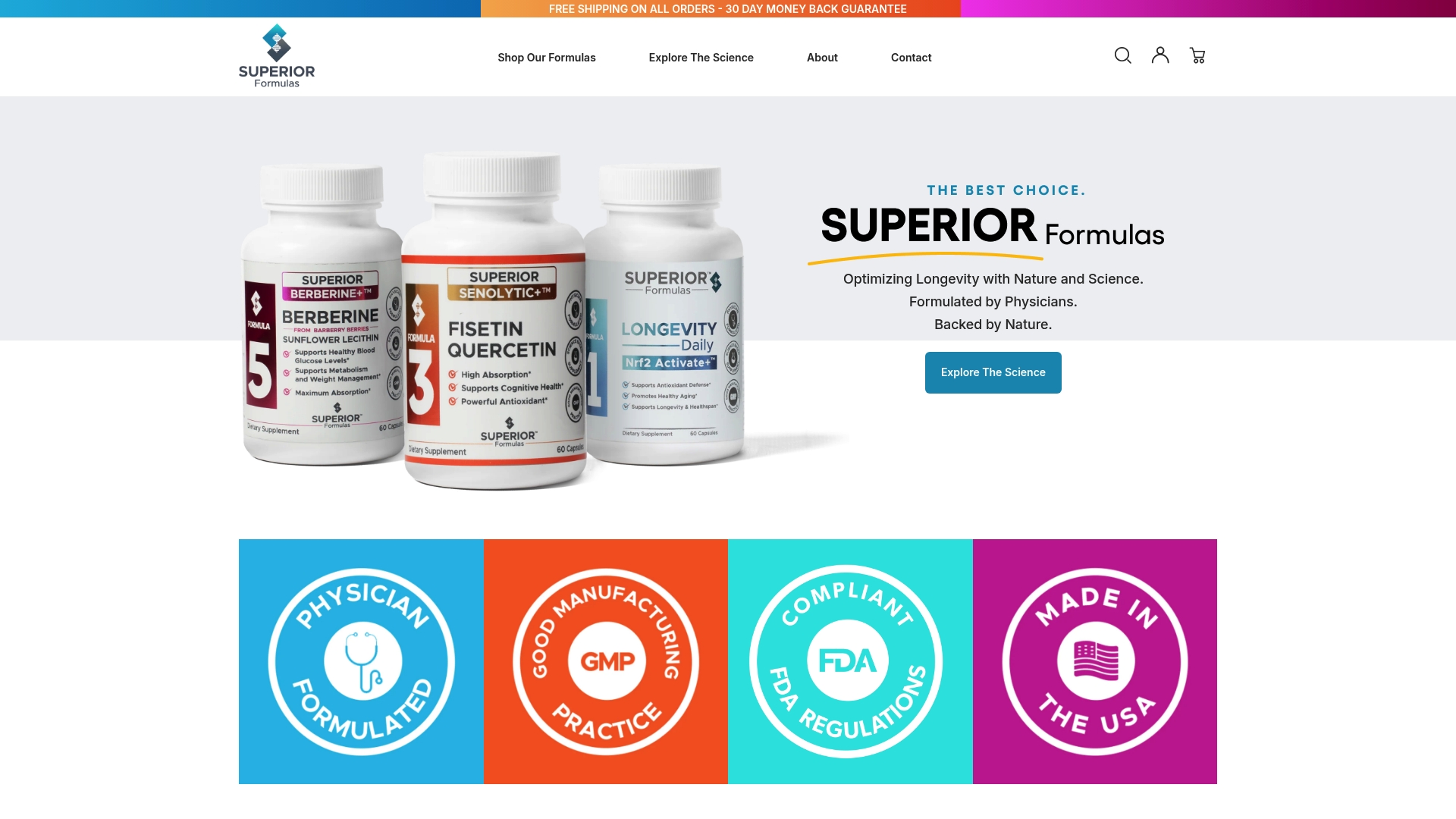
The Explore the Science pages walk through the research behind each formulation, including why specific compounds were chosen for Nrf2 activation and cellular support. If you’re comparing options like the Superior Senolytic+ formula, you can review ingredient sourcing and dosage details directly rather than guessing from a label. Browse the full product collection to see current formulas, from the Longevity Daily Antioxidant Blend to the High Potency Multivitamin, and check pricing and details before you decide what fits your routine.
Official Resources for Verifying Supplement Safety
This article is general information, not a substitute for advice from a qualified doctor. Consult a qualified healthcare professional about your own circumstances before acting on anything here.
FAQ
Are there any vitamin supplements that are FDA approved?
No individual vitamin or mineral supplement carries FDA approval, since the agency doesn’t approve dietary supplements before marketing under any category, including basic vitamins. The FDA does regulate supplement manufacturing and can act against unsafe products after the fact, but premarket approval simply doesn’t apply to this product class.
Why are so many supplements not FDA approved?
Supplements fall under DSHEA, a law that classifies them separately from drugs and places safety responsibility on manufacturers rather than requiring FDA premarket approval. This keeps the market accessible and affordable, but it also means no federal agency verifies effectiveness before a bottle reaches shelves.
What is the most trustworthy supplement company?
There’s no official FDA ranking of “trustworthy” supplement brands, since the agency doesn’t endorse products. The strongest signals to look for are GMP-certified manufacturing, third-party testing seals like USP or NSF, transparent ingredient sourcing, and physician involvement in formulation, all practices Superiorformulas follows across its product line.
What supplements are not FDA approved?
All dietary supplements sold in the U.S. fall into this category, since none receive FDA premarket approval regardless of brand, ingredient, or price point. That includes vitamins, minerals, herbal products, and specialty formulas like senolytics or adaptogens. The relevant question isn’t whether a supplement is approved, but whether the manufacturer follows CGMP standards and discloses testing results.


