


Anti-aging nutrition is the practice of using science-backed dietary strategies to support longevity, reduce age-related decline, and extend healthspan starting in mid-adulthood. The field has a formal name in research circles: geroprotective nutrition. Both terms describe the same goal. This anti-aging nutrition guide draws on the latest 2026 longitudinal research, clinical trials like the CALERIE study, and dietary pattern data from Blue Zones populations to give you a clear, practical framework for eating well as you age.
After 35, cellular repair slows, inflammation rises, and metabolic efficiency begins to shift. Nutrition after 35 becomes one of the most accessible levers you have for slowing those processes. The goal is not to live forever. The goal is to live well, longer.
Which dietary patterns most effectively promote healthy aging?
The evidence on eating patterns for longevity is now substantial. A 2025 longitudinal study of 105,015 participants found that high adherence to the Alternative Healthy Eating Index gave adults up to 86% greater odds of healthy aging by age 70, with even stronger effects at 75. That is not a marginal benefit. It is one of the largest dietary effect sizes in aging research.

The Alternative Healthy Eating Index rewards whole grains, vegetables, fruits, nuts, legumes, and healthy fats while penalizing red meat, sugar-sweetened beverages, and trans fats. Mediterranean-style diets follow a similar structure. Both patterns share three core features: they are plant-centered, they include moderate amounts of quality animal foods, and they minimize ultra-processed food.
Research confirms that plant-rich diets with low ultra-processed food are linked with higher odds of aging free of chronic disease across cognitive, physical, and mental health domains. The mechanism is not one single nutrient. It is the combined effect of fiber, phytochemicals, healthy fats, and micronutrients working together across years of consistent eating.
| Dietary Pattern | Core Features | Key Longevity Benefit |
|---|---|---|
| Alternative Healthy Eating Index | Whole grains, legumes, nuts, low red meat | Strongest association with healthy aging at 70+ |
| Mediterranean Diet | Olive oil, fish, vegetables, moderate wine | Reduced cardiovascular and cognitive decline |
| Blue Zones Diet | Plant-dominant, beans as staple, low caloric density | Associated with exceptional longevity in populations |
| Whole Food Plant-Based | Minimally processed plants, no refined foods | Improved metabolic markers and gut microbiome diversity |
Pro Tip: You do not need to follow any single named diet perfectly. The shared principle across all longevity patterns is the same: more whole plants, less processed food, and consistent daily practice.
What key nutrients and foods support anti-aging and youthful skin?
Specific nutrients drive the cellular processes that keep you functioning well as you age. Polyphenols, omega-3 fatty acids, vitamins B12 and D, magnesium, and antioxidants are the most studied. Polyphenols like resveratrol, quercetin, and curcumin act directly on mitochondrial health and cellular senescence pathways. They do not just neutralize free radicals. They signal longevity pathways at the molecular level.
Omega-3 fatty acids, found in fatty fish like salmon and sardines, reduce systemic inflammation and support brain cell membrane integrity. Vitamins B12 and D, along with magnesium, are critical for nerve function, bone density, and immune regulation. The Linus Pauling Institute notes that adults over 50 need higher intakes of these three micronutrients specifically because absorption efficiency declines with age.
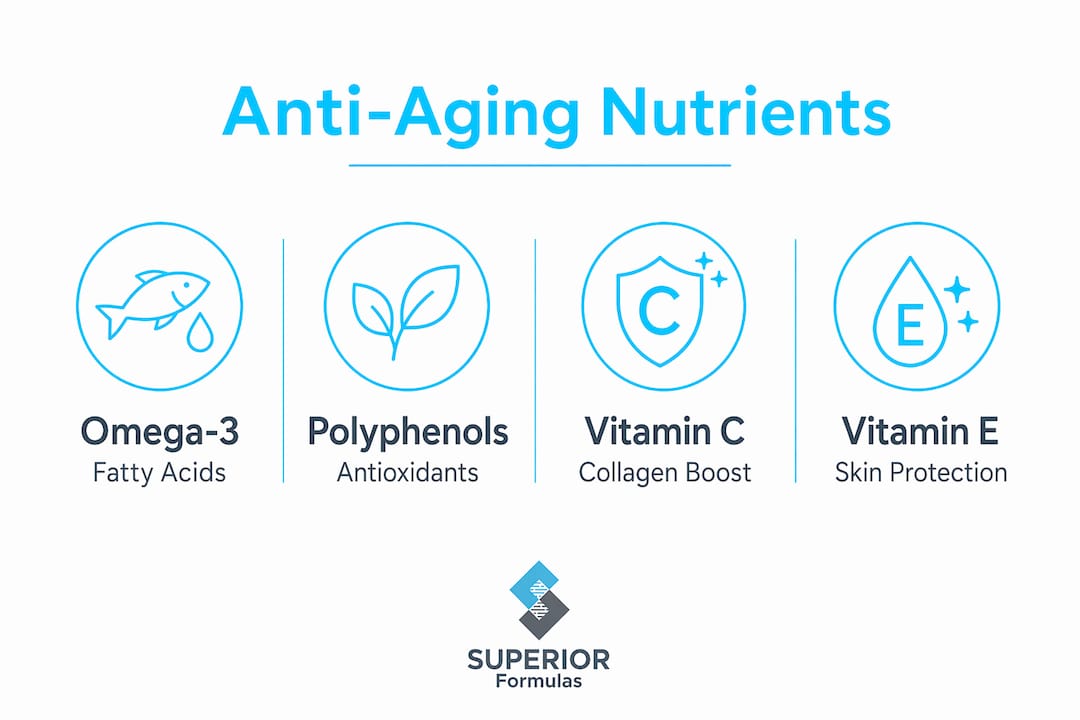
Nutrition for youthful skin depends heavily on the same nutrients. Vitamin C from citrus and bell peppers supports collagen synthesis. Zinc from pumpkin seeds and legumes accelerates skin repair. Astaxanthin from wild salmon provides one of the most potent antioxidant defenses available from food.
Top anti-aging foods to prioritize
- Fatty fish (salmon, sardines, mackerel): omega-3s, vitamin D, astaxanthin
- Leafy greens (spinach, kale, arugula): folate, magnesium, lutein
- Berries (blueberries, pomegranate, acai): anthocyanins and polyphenols
- Extra virgin olive oil: oleocanthal, polyphenols, monounsaturated fats
- Nuts and seeds (walnuts, flaxseed, chia): omega-3s, vitamin E, fiber
- Legumes (lentils, black beans, chickpeas): protein, fiber, resistant starch
- Spices (turmeric, ginger, cinnamon): curcumin, gingerols, anti-inflammatory compounds
Eating 30 or more distinct plant foods weekly enhances gut microbiome diversity and strengthens anti-aging signaling. Whole food matrices provide synergistic interactions among fiber, fats, and phytochemicals that isolated supplements cannot replicate. Variety is not just pleasant. It is mechanistically necessary.
Pro Tip: Count plant variety, not just servings. Herbs, spices, and legumes all count toward your 30 weekly plants. A single meal with lentils, turmeric, spinach, and walnuts already covers four.
How do caloric restriction and eating timing affect aging?
Caloric restriction and meal timing are two of the most studied interventions in anti-aging science. The CALERIE trial demonstrated that caloric restriction of 10–30% without malnutrition improves metabolic aging biomarkers in humans and robustly extends lifespan in animal models. The key word is “without malnutrition.” Cutting calories while maintaining micronutrient density is what produces the benefit.
The mechanisms involve autophagy, mTOR inhibition, and AMPK activation. Autophagy is the body’s cellular cleanup process. It removes damaged proteins and organelles that accumulate with age. Caloric restriction and fasting both trigger autophagy more reliably than most supplements. Intermittent fasting protocols like 16:8 and 5:2 show biomarker improvements in metabolic and cellular aging, making them a practical alternative for adults who find sustained caloric restriction difficult.
For adults over 35, sustainability matters as much as efficacy. A protocol you abandon after three weeks produces no long-term benefit. The 16:8 approach, eating within an eight-hour window each day, fits most schedules without requiring calorie counting.
Best practices for incorporating fasting and caloric moderation
- Start with a 12-hour overnight fast before extending to 14 or 16 hours
- Break your fast with protein and fiber to stabilize blood glucose
- Avoid ultra-processed foods during your eating window, since they undermine the metabolic benefits of fasting
- Stay well hydrated during fasting periods with water, black coffee, or plain tea
- Consult a physician before starting any fasting protocol if you have diabetes, a history of disordered eating, or take medications affected by food timing
What practical steps help build lasting anti-aging nutrition habits?
Sustainable dietary change is additive, not subtractive. The research is clear: the perfection trap causes more people to abandon anti-aging diets than any other factor. Focusing on adding variety and color rather than eliminating entire food groups produces better long-term adherence. Start by adding one new plant food per week rather than removing everything processed at once.
Meal planning is the single most effective structural tool for consistency. A simple Sunday prep session, cooking a pot of lentils, washing berries, and portioning nuts, removes the friction that leads to poor choices on busy weeknights. You do not need a rigid anti-aging meal plan. You need a flexible template: half the plate as vegetables, a quarter as quality protein, a quarter as whole grains or legumes, with olive oil as the primary fat.
Micronutrient auditing becomes more important after 40. Age-related absorption changes mean that even a good diet may leave gaps in B12, magnesium, and vitamin D. A basic blood panel once a year gives you the data to adjust. If you eat little to no animal products, B12 supplementation is not optional. It is necessary.
Reducing ultra-processed food is among the highest-impact changes you can make. Ultra-processed foods accelerate biological aging through glycation, chronic inflammation, and metabolic dysfunction. Swapping one ultra-processed snack daily for a handful of walnuts and a piece of fruit is a change that compounds over years.
Four practical steps to start this week
- Audit your plate: Track two days of eating and count how many distinct plant foods appear. If the number is below 10, that is your first target to raise.
- Upgrade your fats: Replace refined seed oils and margarine with extra virgin olive oil as your primary cooking fat.
- Add a legume daily: Lentils, chickpeas, or black beans at one meal per day adds fiber, protein, and resistant starch that feeds longevity-associated gut bacteria.
- Check your B12 and vitamin D: Ask your doctor to include these in your next blood panel. Deficiencies are common and correctable.
Pro Tip: Use a free app like Cronometer to track micronutrient intake for one week. Most people discover they are consistently low in magnesium and vitamin D before they ever feel a symptom.
Key takeaways
Evidence-based anti-aging nutrition centers on consistent, plant-rich eating patterns, targeted micronutrient management, and reducing ultra-processed foods, not on any single superfood or supplement.
| Point | Details |
|---|---|
| Dietary pattern matters most | High adherence to the Alternative Healthy Eating Index gives up to 86% greater odds of healthy aging at 70. |
| Plant diversity drives results | Eating 30 or more distinct plant foods weekly strengthens gut microbiome and longevity signaling. |
| Micronutrients need monitoring | Adults over 50 require higher B12, magnesium, and vitamin D due to declining absorption efficiency. |
| Fasting supports cellular repair | Protocols like 16:8 intermittent fasting activate autophagy and improve metabolic aging biomarkers. |
| Consistency beats perfection | Additive habit formation focused on variety and whole foods produces better long-term adherence than restriction. |
What I’ve learned after years of studying longevity nutrition
The most common mistake I see adults make after 35 is chasing the next superfood while ignoring the foundation. Acai bowls and collagen powders get the attention. Lentils and olive oil do the actual work. The research on dietary patterns is unambiguous: no single food or supplement matches the effect size of a consistently good overall diet.
What surprises most people is how little the science supports dramatic restriction. The CALERIE trial and Blue Zones research both point toward moderation and variety, not elimination. The longest-lived populations eat beans, whole grains, vegetables, and small amounts of fish or dairy. They do not count macros. They eat real food, mostly plants, and they do it every day for decades.
The supplement question is real, though. Whole foods are the foundation, but longevity-focused supplements fill genuine gaps that diet alone cannot always close, especially for polyphenols like resveratrol and quercetin that are difficult to obtain in therapeutic amounts from food. The key is choosing supplements built on actual clinical evidence, not marketing copy.
My honest advice: get your blood work done, build your plate around plants, and stop waiting for the perfect protocol. The best anti-aging diet is the one you actually eat consistently, starting now.
— cristopher
How Superiorformulas supports your longevity nutrition goals
Superiorformulas was founded by a physician-scientist with one purpose: to create supplements that fill the gaps evidence-based nutrition leaves behind. Every formulation targets longevity pathways like Nrf2 activation, mTOR modulation, and cellular resilience using clinically studied compounds including polyphenols, adaptogens, and phytonutrients. Products are manufactured in GMP-certified facilities and third-party tested for purity. If you want to understand the science behind each ingredient, explore the research behind Superiorformulas formulations. The science page breaks down exactly which compounds are used, why they were selected, and what the clinical evidence shows.
FAQ
What is anti-aging nutrition?
Anti-aging nutrition, also called geroprotective nutrition, is the practice of using specific dietary patterns and nutrients to support cellular health, reduce age-related decline, and extend healthspan. Research consistently shows that plant-rich, minimally processed diets produce the strongest longevity outcomes.
What are the best foods for anti-aging?
Fatty fish, leafy greens, berries, extra virgin olive oil, legumes, nuts, and spices like turmeric are the most evidence-backed anti-aging foods. These foods supply polyphenols, omega-3 fatty acids, fiber, and key micronutrients that support cellular repair and reduce inflammation.
Does intermittent fasting slow aging?
Intermittent fasting protocols like 16:8 and 5:2 activate autophagy and improve metabolic aging biomarkers, producing effects similar to caloric restriction. The CALERIE trial and related fasting studies confirm these cellular repair benefits in human subjects.
Which nutrients are most important after 50?
Vitamin B12, magnesium, and vitamin D are the three micronutrients most likely to become deficient after 50 due to age-related absorption changes. The Linus Pauling Institute identifies these as critical for maintaining bone density, brain health, and immune function.
How many plant foods should I eat weekly for longevity?
Eating 30 or more distinct plant foods per week enhances gut microbiome diversity and strengthens anti-aging signaling pathways. Herbs, spices, legumes, whole grains, fruits, and vegetables all count toward that total.


