


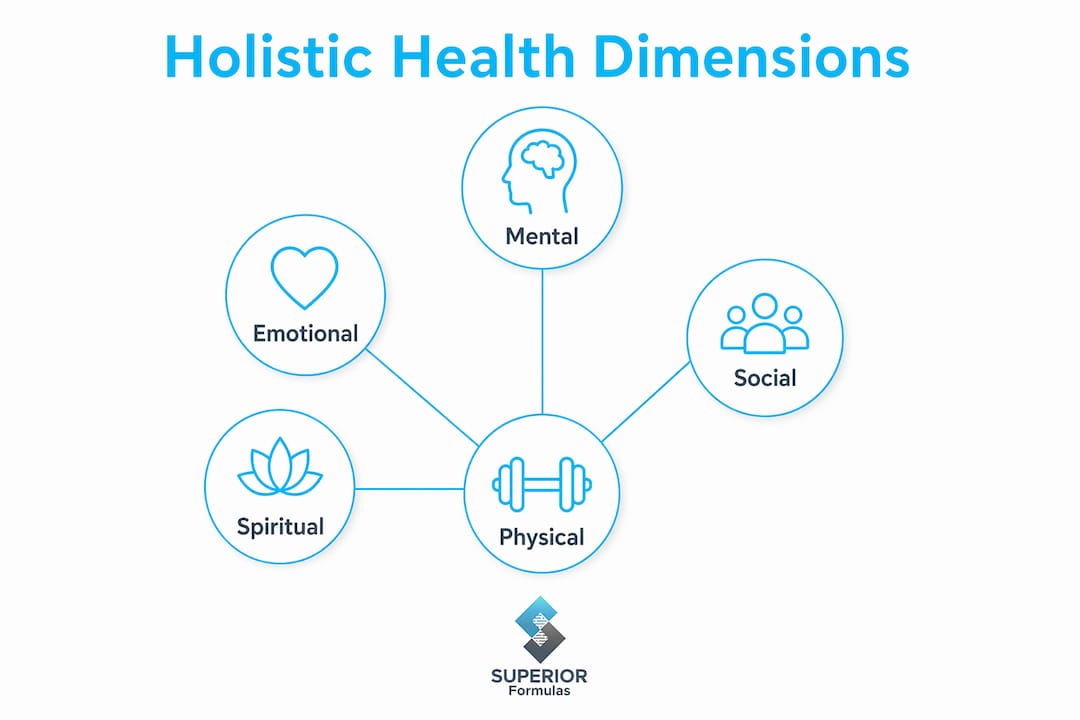
Holistic health is defined as a whole-person approach to wellness that integrates physical, mental, emotional, social, and spiritual dimensions rather than treating isolated symptoms. Unlike conventional medicine’s focus on diagnosing and managing specific conditions, this model targets the root causes of imbalance across every area of life. The World Health Organization’s definition of health as “a state of complete physical, mental, and social well-being” aligns directly with this framework. Superiorformulas builds its supplement formulations on these same principles, recognizing that cellular resilience and longevity depend on more than one variable.
What is holistic health and why does it matter?
Holistic health is the practice of caring for the entire person across five interconnected dimensions: physical, mental, emotional, social, and spiritual well-being. Each dimension influences the others in measurable ways. Chronic stress, for example, produces physical symptoms including headaches, disrupted sleep, and muscle pain. That connection proves the body does not separate “mind problems” from “body problems.”

The importance of this model becomes clear when you look at outcomes. People who address health across all five dimensions report more energy, better mood, and lasting quality of life improvements compared to those who manage only physical symptoms. The standard medical term for this practice is “integrative health,” and both terms appear throughout clinical literature. Understanding the distinction between treating a symptom and resolving its cause is the first step toward lasting wellness.
What are the main dimensions of holistic health?
Five core pillars define the structure of whole-person wellness. Each one functions as part of an interconnected system, not a standalone category.
| Dimension | Core Focus | Key Practices |
|---|---|---|
| Physical | Body function and vitality | Nutrition, exercise, sleep, preventive care |
| Mental/Emotional | Thought patterns and feelings | Therapy, mindfulness, stress management |
| Social | Relationships and community | Connection, communication, support networks |
| Spiritual | Purpose and meaning | Meditation, values alignment, reflection |
| Environmental | Surroundings and exposures | Clean air, toxin reduction, nature access |
Physical health forms the most visible layer. Nutrition, regular movement, and consistent sleep create the biological foundation everything else depends on. Mental and emotional health determine how you process stress, make decisions, and recover from setbacks. Social health matters more than most people expect. Strong relationships influence blood pressure, stress hormone levels, and even cancer prognosis. Spiritual well-being provides the sense of purpose that sustains long-term behavior change. Environmental health, often overlooked, covers the quality of air, water, and physical spaces that shape daily physiology.
What does scientific research say about holistic health approaches?
Clinical evidence for integrative health is substantial and growing. Patients using whole-person health models report higher satisfaction, better chronic disease management, and less reliance on multiple medications compared to those receiving conventional care alone. This finding applies across conditions including Parkinson’s disease, Type 2 diabetes, and chronic pain.
The biological mechanisms are well documented. Mindfulness, meditation, and targeted lifestyle changes reduce inflammation markers, lower stress hormones, and improve heart health indicators including blood pressure and blood sugar control. These are not minor effects. They represent the kind of measurable shifts that reduce long-term disease risk.
Integrative care also produces economic benefits. When patients add lifestyle, nutritional, and mind-body interventions to their existing treatment plans, overall medical costs decrease. Fewer medications, fewer emergency visits, and better adherence all contribute. For anyone managing a chronic condition, this model offers a path toward both better outcomes and lower burden.
- Reduced systemic inflammation through mindfulness and dietary change
- Improved blood pressure and blood sugar control
- Lower reliance on multiple medications in chronic disease management
- Better long-term weight management through behavioral integration
- Higher patient satisfaction and treatment adherence
Pro Tip: When evaluating any integrative practice, look for clinical trial data rather than anecdotal reports. Practices like mindfulness-based stress reduction (MBSR) and Mediterranean-style nutrition have peer-reviewed evidence behind them. Start there before adding anything new.
How is holistic health practiced in real life?
Holistic practice begins with a different kind of intake process. Comprehensive assessments in integrative care can last 60–90 minutes, covering lifestyle habits, emotional health, social dynamics, and environmental exposures. That depth of evaluation shapes a personalized plan no standard 15-minute appointment can produce.
Holistic treatment is highly personalized, considering genetics, daily habits, and living environment to tailor care plans. Two people with the same diagnosis may receive entirely different recommendations based on their individual profiles. This personalization is what separates integrative care from one-size-fits-all protocols.
Common therapies used in real-life holistic practice include:
- Mindfulness and meditation for stress regulation and emotional resilience
- Nutritional therapy targeting anti-inflammatory dietary patterns
- Acupuncture for pain management and nervous system support
- Yoga and movement practices combining physical conditioning with breath work
- Herbal supplements and nutraceuticals selected for their clinical evidence base
- Sleep optimization protocols addressing circadian rhythm and recovery
- Social support programs including group therapy and community engagement
Patient empowerment sits at the center of this model. Integrative healthcare emphasizes shared decision-making, aligning care with personal values rather than prescriptive treatments. Patients who feel heard and respected show better adherence and stronger outcomes. Daily habits compound over months, not days. The benefits of a consistent practice build gradually, which is why personalized supplementation strategies and lifestyle integration matter more than short-term interventions.
How does holistic health differ from conventional medicine?
The core difference is directional. Conventional medicine moves from symptom to diagnosis to treatment. Integrative health moves from root cause to system-wide intervention to prevention. Both directions have value, and the most effective care combines them.
| Factor | Conventional Medicine | Integrative/Holistic Health |
|---|---|---|
| Primary focus | Symptom diagnosis and treatment | Root cause identification |
| Care model | Episodic, condition-specific | Continuous, whole-person |
| Patient role | Passive recipient | Active participant |
| Tools used | Pharmaceuticals, surgery | Lifestyle, nutrition, mind-body, supplements |
| Goal | Manage disease | Build resilience and prevent disease |
The most persistent myth about whole-person wellness is that it replaces conventional medicine. Holistic health works best as an integrative model used alongside standard care, not instead of it. A person managing Type 2 diabetes, for example, continues prescribed medications while adding nutritional therapy, stress reduction, and movement protocols. The integrative layer addresses what medication alone cannot reach.
Conventional medicine excels at acute crisis management. Integrative health excels at building the resilience that prevents crises. A complete wellness guide for any individual includes both. The shift happening across American healthcare right now is not a replacement of one model by another. It is a recognition that both are necessary, and that the gap between them has cost patients measurable health outcomes.
Key Takeaways
Whole-person health requires addressing physical, mental, emotional, social, and spiritual dimensions together, because each one directly shapes the others.
| Point | Details |
|---|---|
| Five interconnected dimensions | Physical, mental, emotional, social, and spiritual health each influence the others and must be addressed together. |
| Root cause over symptom | Integrative health targets the underlying drivers of imbalance, not just the presenting condition. |
| Science supports the model | Mindfulness, nutrition, and lifestyle interventions produce measurable reductions in inflammation, blood pressure, and disease risk. |
| Complements conventional care | Holistic practices work best alongside standard medicine, not as a replacement for it. |
| Personalization drives results | Effective integrative care accounts for genetics, habits, and environment to build a plan that fits the individual. |
Why I think most people misunderstand what whole-person wellness actually demands
Most articles on this topic make whole-person wellness sound like a checklist. Meditate in the morning. Eat more vegetables. Get eight hours of sleep. That framing misses the point entirely.
What I have observed, both in reviewing clinical literature and in watching how people actually change their health, is that the dimension most people neglect is the one doing the most damage. For many adults in the 35–55 age range, that dimension is social isolation or unresolved chronic stress. No supplement or exercise protocol compensates for a nervous system that never fully recovers from daily pressure. The research on stress hormones and inflammation makes this clear.
The shift that actually produces lasting results is moving from reactive to proactive. Integrative healthcare promotes sustainability and patient empowerment rather than episodic symptom management. That is not a philosophical preference. It is a clinical finding backed by outcomes data. People who build resilience across all five dimensions before a health crisis hits fare significantly better than those who address only the crisis.
The other thing worth saying plainly: personalization is not optional. A personalized health program that accounts for your genetics, your environment, and your actual daily habits will outperform any generic wellness protocol. The evidence for this is consistent across chronic disease management research. Generic advice produces generic results. The goal is a plan built around you, not around an average patient.
— cristopher
Superiorformulas and science-backed wellness support
Superiorformulas was founded by a physician-scientist with one clear purpose: to create supplements that reflect how the body actually works across multiple systems, not just one.

Every formulation in the Superiorformulas line draws on clinical research in nutrition, biochemistry, and cellular aging. Products target pathways like Nrf2 activation, antioxidant support, and cellular resilience because those are the mechanisms that matter for long-term health. All products are manufactured in GMP-certified facilities and tested by third parties for purity and consistency. For anyone building a whole-person wellness plan, physician-formulated supplements designed around clinical evidence are a logical next step. Visit Superiorformulas to review the full product line and the research behind each formulation.
FAQ
What is the holistic health definition in simple terms?
Holistic health is a whole-person approach to wellness that addresses physical, mental, emotional, social, and spiritual dimensions together. It focuses on root causes of imbalance rather than treating individual symptoms in isolation.
Does holistic health replace conventional medicine?
Holistic health works best alongside conventional medicine, not as a replacement. Patients maintain standard treatments while adding lifestyle, nutritional, and mind-body interventions for better long-term outcomes.
What are the most evidence-based holistic health practices?
Mindfulness-based stress reduction, Mediterranean-style nutrition, regular physical movement, and targeted nutraceuticals all have peer-reviewed clinical support. These practices reduce inflammation, improve blood pressure, and support long-term disease prevention.
How long does it take to see results from holistic health practices?
Benefits from integrative practices accumulate over months rather than days. Consistent daily habits produce cumulative improvements in energy, mood, and measurable health markers over time.
How do I start a holistic wellness approach?
Begin with a comprehensive assessment of all five health dimensions: physical, mental, emotional, social, and spiritual. Identify which area shows the most strain, then build a personalized plan that addresses that root cause first while supporting the others.


