


Cellular senescence is defined as a permanent state of cell cycle arrest in which damaged or stressed cells stop dividing but remain metabolically active. This process sits at the center of how your body ages, repairs itself, and sometimes breaks down. Understanding what is cellular senescence matters more after age 35, because senescent cell accumulation accelerates from midlife onward. These cells carry a dual identity: they protect against tumor formation and support wound healing, yet they also secrete inflammatory compounds that drive tissue dysfunction. Key biological markers, including the Hayflick limit, the CDK inhibitors p16 and p21, and the senescence-associated secretory phenotype (SASP), define how researchers identify and study this process.
What causes cellular senescence at the molecular level?
Cellular senescence is triggered by a range of biological stressors, each activating a shared pathway of permanent growth arrest. The most studied trigger is replicative senescence, which occurs when telomeres shorten with each cell division until they reach a critical length. The Hayflick limit defines this threshold at approximately 50 population doublings for normal human fibroblasts. Once telomeres erode past that point, the cell reads the signal as irreparable DNA damage and halts division permanently.
Beyond telomere attrition, several other triggers push cells into senescence:
- DNA damage from radiation or toxins. Double-strand breaks activate the p53/p21 pathway, locking the cell cycle.
- Oxidative stress. Excess reactive oxygen species from mitochondrial dysfunction damage DNA and lipid membranes, accelerating arrest.
- Oncogene activation. Mutations in growth-promoting genes like RAS trigger a protective senescence response to prevent cancer.
- Chronic psychological stress. Elevated cortisol and systemic inflammation accelerate telomere shortening over time.
- Environmental exposures. Ultraviolet radiation, air pollutants, and certain chemicals induce DNA lesions that activate senescence pathways.
The cell cycle arrest itself is enforced by CDK inhibitors. p16 and p21 block the cyclin-dependent kinases that normally push cells from the G1 phase into active division. Once these inhibitors are expressed at high levels, the arrest becomes self-reinforcing and essentially irreversible.
Identifying senescent cells in living tissue remains a challenge. No single biomarker definitively marks a senescent cell. Researchers rely on panels that include SA-βgal (senescence-associated beta-galactosidase) activity, elevated p16 expression, and SASP factor secretion. These markers vary by tissue type and context, which complicates clinical diagnostics.

Pro Tip: If you want to understand your personal oxidative stress burden, a good starting point is reviewing your lifestyle exposures. Poor sleep, processed food, and chronic stress are the most modifiable drivers of premature senescence.
What are the effects of cellular senescence on aging and health?
The effects of cellular senescence depend entirely on whether the process is acute or chronic. Acute senescence is physiologically beneficial. During embryonic development, senescent cells guide tissue patterning. After injury, they promote wound closure and then get cleared by the immune system. This short-term, controlled senescence is a feature, not a flaw.
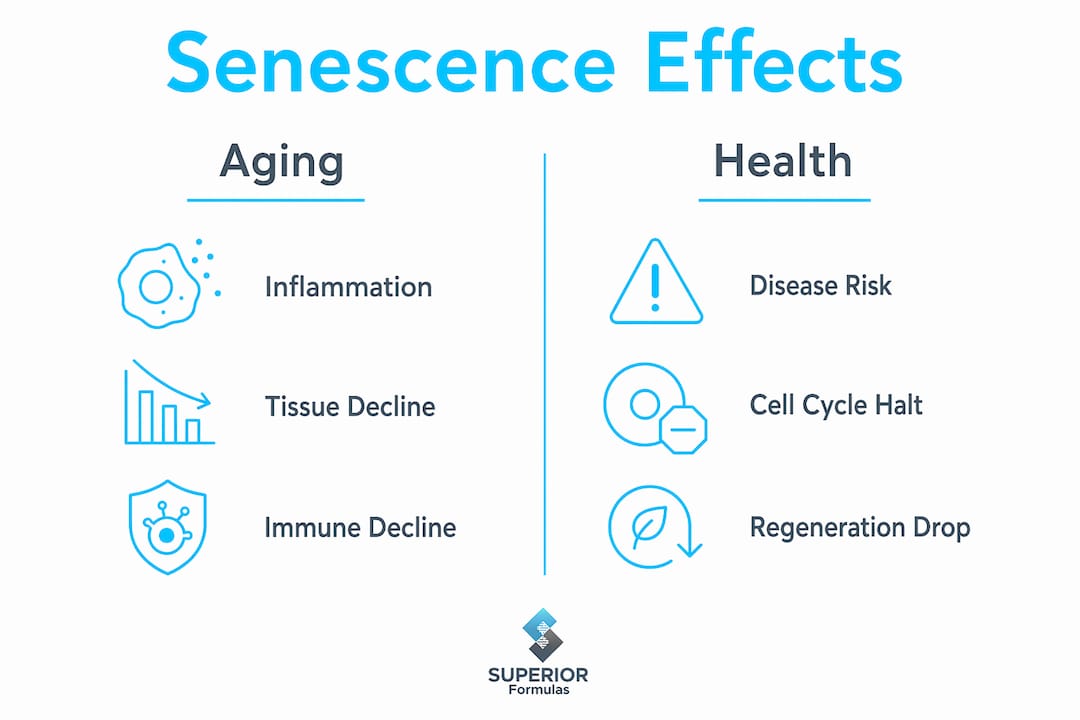
Chronic senescence is a different story. When senescent cells accumulate faster than the immune system can clear them, the consequences compound:
- Persistent inflammation. SASP factors, including interleukins, matrix metalloproteinases, and chemokines, create a low-grade inflammatory environment that damages surrounding tissue.
- Bystander senescence. SASP drives neighboring cells into senescence, spreading dysfunction through tissue like a slow-moving wave.
- Tissue remodeling failure. Senescent fibroblasts and endothelial cells lose their structural roles, weakening connective tissue, blood vessels, and organ architecture.
- Immune dysregulation. Chronic SASP disrupts immune signaling, impairing the body’s ability to clear pathogens and even senescent cells themselves.
- Disease acceleration. Senescent cell accumulation correlates with cardiovascular disease, neurodegeneration, metabolic dysfunction, and cancer progression.
“SASP not only promotes inflammation but also modulates immune responses and tissue remodeling, underscoring its complex role in both tissue repair and disease progression. Managing this secretome, rather than simply eliminating senescent cells, represents one of the most promising frontiers in aging research.”
The immune system’s declining ability to clear senescent cells with age creates a feedback loop. More senescent cells produce more SASP, which further impairs immune function, which allows even more senescent cells to accumulate. This cycle is a core mechanism behind what researchers now call “inflammaging,” the chronic low-grade inflammation that underlies most age-related diseases.
Understanding cellular renewal and how it slows with age helps explain why this cycle becomes harder to break after 35.
How does cellular senescence differ from general cellular aging?
Cellular aging and cellular senescence are related but distinct processes. Cellular aging is a progressive, cumulative decline in cellular function that unfolds over a lifetime. Cellular senescence is a specific, induced biological state that can occur at any life stage, including during fetal development.
The distinction matters because senescence contributes causally to aging rather than simply accompanying it. Removing senescent cells in animal models delays multiple age-related conditions simultaneously. That finding suggests senescence is not just a marker of aging but an active driver of it.
| Feature | Cellular aging | Cellular senescence |
|---|---|---|
| Definition | Progressive functional decline over time | Permanent, induced cell cycle arrest |
| When it occurs | Continuously throughout life | At any stage, including embryogenesis |
| Reversibility | Not reversible | Generally irreversible |
| Key mechanism | Accumulated molecular damage | p16/p21-mediated growth arrest |
| Role in disease | Correlates with dysfunction | Causally drives tissue pathology |
| Biological utility | Neutral decline | Both protective and harmful |
One clarifying analogy: cellular aging is like a car slowly wearing down from use. Cellular senescence is like a car that has locked its brakes. The car still runs, still consumes fuel, and still affects traffic around it. It just cannot move forward. That distinction shapes how researchers think about therapeutic targets.
What current strategies target cellular senescence for healthier aging?
The field of senotherapeutics divides into two main categories. Senolytics eliminate senescent cells. Senomorphics modulate SASP without killing the cells. Both approaches have shown promise in animal models, and early clinical trials are now testing their safety and efficacy in humans. Standard clinical integration is still years away, but the trajectory is clear.
Current and emerging strategies include:
- Senolytic compounds. Dasatinib combined with quercetin is the most studied senolytic pair in early human trials. These compounds selectively trigger apoptosis in senescent cells while sparing healthy ones.
- Senomorphic agents. Rapamycin and certain flavonoids suppress SASP factor secretion, reducing the inflammatory burden without eliminating the cells.
- Mitochondrial support. Reducing oxidative stress through antioxidant pathways, including Nrf2 activation, directly reduces one of the primary triggers of pathological senescence.
- Caloric restriction and fasting protocols. Both activate autophagy, the cellular cleanup process that removes damaged organelles and reduces senescence-promoting debris.
- Exercise. Regular aerobic and resistance training reduces circulating SASP markers and supports immune clearance of senescent cells.
- Stress management. Chronic psychological stress accelerates telomere shortening. Practices that lower cortisol, such as sleep optimization and mindfulness, slow this process measurably.
Research on regenerative approaches to aging-related tissue decline also points toward SASP modulation as a key mechanism in skin and connective tissue health.
Mitochondrial health sits at the center of most of these strategies. Supporting mitochondrial function with targeted antioxidants may reduce pathological senescence burden by cutting off one of its primary fuel sources.
Pro Tip: You do not need to wait for clinical-grade senolytics to act. Consistent sleep, resistance training, and a diet rich in polyphenols, such as those found in berries, green tea, and olive oil, address the same upstream pathways that senolytic drugs target.
Recent trials also emphasize the importance of combining senolytics and senomorphics rather than relying on either alone. The goal is not to eliminate all senescent cells, which would impair wound healing and embryonic processes. The goal is to reduce the chronic, pathological accumulation that drives disease.
Key Takeaways
Cellular senescence is a permanent, stress-induced cell cycle arrest that drives aging and disease when it accumulates chronically, but serves essential protective roles when it operates acutely.
| Point | Details |
|---|---|
| Senescence definition | Permanent cell cycle arrest triggered by DNA damage, oxidative stress, or telomere shortening. |
| Dual biological role | Acute senescence supports healing; chronic accumulation drives inflammation and tissue dysfunction. |
| SASP as key driver | SASP factors spread inflammation and induce bystander senescence in neighboring healthy cells. |
| Senescence vs. aging | Senescence causes aging rather than simply accompanying it, making it a therapeutic target. |
| Actionable strategies | Mitochondrial support, antioxidants, exercise, and stress reduction address senescence upstream. |
Why I think the senescence conversation is missing its most important point
Most articles on cellular senescence focus on the science of elimination. Senolytics get the headlines. The idea of “clearing out” damaged cells is intuitive and satisfying. But after spending years reading the clinical literature and working with people navigating midlife health, I think the elimination framing misses the deeper lesson.
Senescence is not a malfunction. It is a regulation problem. The same cells that protect you from cancer in your 30s become a liability when your immune system can no longer clear them in your 50s. The biology did not break. The balance shifted.
That reframing changes what you should prioritize. Lifestyle factors, specifically sleep quality, mitochondrial nutrition, and chronic stress reduction, are not consolation prizes while you wait for a senolytic drug. They are the most direct tools available right now for keeping the immune clearance system functional. A body that clears senescent cells efficiently does not accumulate the chronic burden that drives disease.
The people I see making the most meaningful progress on cellular health after 35 are not chasing the newest compound. They are doing the foundational work consistently. That is not a popular message, but it is the one the evidence supports most clearly.
— cristopher
Cellular health resources from Superiorformulas
Understanding senescence is the first step. Applying that knowledge through daily choices is where the real work happens.

Superiorformulas develops physician-formulated supplements built around the same pathways this article covers: Nrf2 activation, mitochondrial resilience, antioxidant defense, and cellular renewal. Each formulation uses clinically studied ingredients, manufactured in GMP-certified facilities with third-party testing for purity. If you are ready to support your cellular health with science-backed nutrition, the Superiorformulas longevity collection is a practical next step. You can also review the cellular health checklist to assess where your current routine stands.
FAQ
What is cellular senescence in simple terms?
Cellular senescence is when a cell permanently stops dividing after experiencing stress or damage, but continues to function and secrete inflammatory signals. It plays both protective and harmful roles depending on whether it is acute or chronic.
What are the main causes of cellular senescence?
The primary causes are telomere shortening, DNA damage, oxidative stress from mitochondrial dysfunction, and oncogene activation. Chronic psychological stress and environmental toxins also accelerate the process.
How does cellular senescence contribute to aging?
Senescent cells accumulate with age and secrete SASP factors that drive chronic inflammation, impair tissue repair, and spread dysfunction to neighboring cells. This accumulation is now recognized as a causal driver of aging rather than just a byproduct.
Can cellular senescence be reversed or prevented?
Senescence itself is generally irreversible once established, but its accumulation can be slowed. Senolytics and senomorphics show early clinical promise, while lifestyle strategies like exercise, antioxidant nutrition, and stress management reduce the rate of pathological senescence.
What biomarkers identify senescent cells?
Researchers use panels including SA-βgal activity and elevated p16 expression, but no single marker definitively identifies senescent cells across all tissue types. Clinical diagnostics based on these markers are still in development.


