


 is an investigational senolytic combination with tissue-specific benefits in animal studies and limited, biomarker-dependent signals in humans. The strongest human data come from a phase 2 randomized tria...&media=http://cdn//csuxjmfbwmkxiegfpljm.supabase.co/storage/v1/object/public/blog-images/organization-27528/1790060787106_How-Dasatinib-and-Quercetin-Clear-Senescent-Cells-overview-diagram.jpeg)


Dasatinib plus quercetin (D+Q) is an investigational senolytic combination with tissue-specific benefits in animal studies and limited, biomarker-dependent signals in humans. The strongest human data come from a phase 2 randomized trial in postmenopausal women that missed its primary endpoint but showed exploratory benefit in participants with high T-cell p16 expression. Given dasatinib’s oncology-grade safety profile, D+Q belongs in clinical trials or closely supervised research protocols, not routine or self-directed use.
TL;DR:
- Human clinical evidence for dasatinib and quercetin is limited, with mixed results and a primary endpoint failure in the most rigorous trial to date.
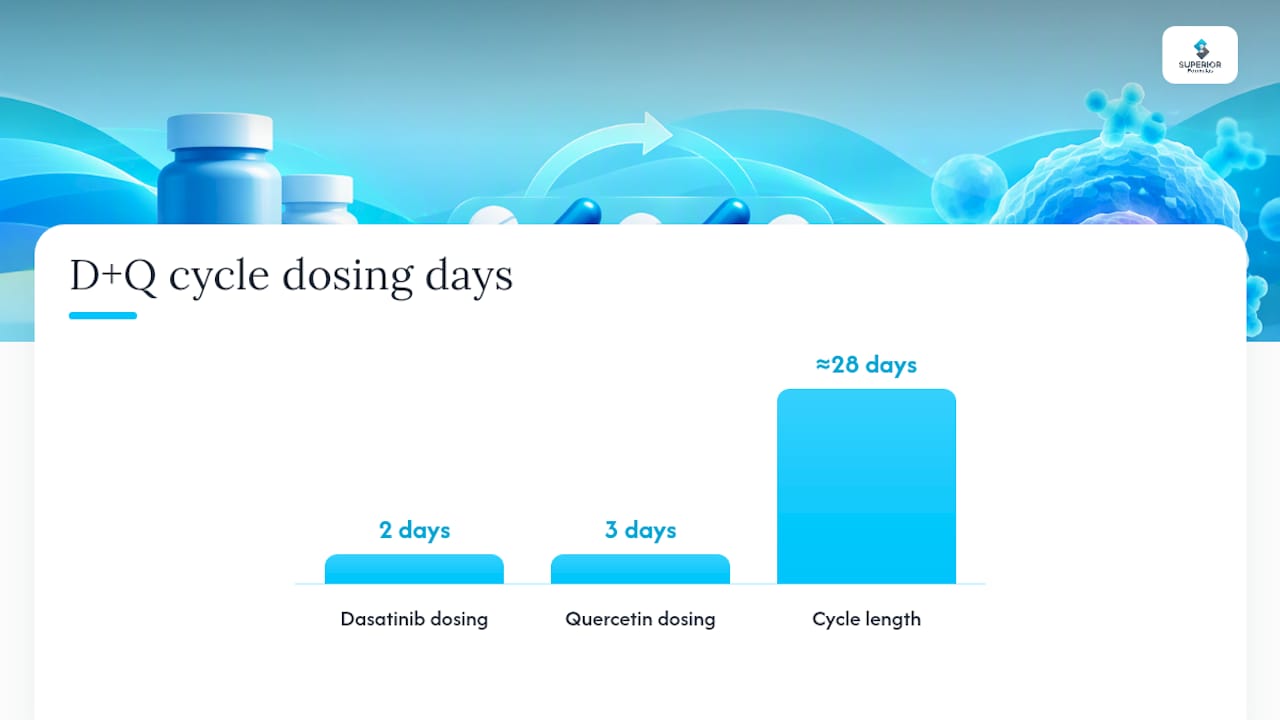
- The most common dosing schedule involves dasatinib 100 mg for two days plus quercetin 1,000 mg daily for three days every four weeks, but protocols vary widely.
- Safety concerns are significant because dasatinib is an oncology drug with known risks such as blood cell suppression, heart issues, and fluid retention, requiring strict monitoring.
- The strongest biomarker signal for potential benefits comes from high p16 expression, but routine testing for senescent cell burden is not yet standardized or validated.
- Using D+Q outside of clinical trials or supervised protocols is risky and not supported by conclusive evidence; commercial quercetin supplements differ greatly from trial formulations.
Table of Contents
- Dasatinib Quercetin: Two Very Different Regulatory Categories
- How Dasatinib and Quercetin Clear Senescent Cells
- What Human Trials of D+Q Have Actually Shown
- Dasatinib Quercetin Dosing Protocols and Safety Monitoring
- Why p16 Biomarkers Matter for Senolytic Trial Design
- What Clinicians Should Do Before Considering D+Q
- Who’s Behind This Analysis
- Where This Research Needs to Go Next
- A Vetted Quercetin Option for Everyday Cellular Support
- Sources
- FAQ
Dasatinib Quercetin: Two Very Different Regulatory Categories
Understanding D+Q starts with a distinction that gets blurred constantly in longevity discussions: these are two compounds with completely different legal and clinical statuses, combined for an application neither was approved for.
Dasatinib is a prescription tyrosine kinase inhibitor, FDA-approved for chronic myeloid leukemia and certain cases of acute lymphoblastic leukemia. It carries a detailed prescribing label because it’s a potent, narrow-margin oncology drug. Quercetin, by contrast, is a flavonol sold over the counter as a dietary supplement, with no FDA approval for any therapeutic indication and no standardized dosing requirement across manufacturers.
That gap matters more than most articles on senolytics acknowledge. Combining an oncology drug with a supplement for a use neither was studied for at approval is, by definition, off-label and investigational. This has direct implications for who should be involved in any D+Q protocol and how it should be monitored.
Dasatinib’s labeled risk profile includes:
- Cytopenias (low blood counts), requiring routine complete blood count monitoring
- Bleeding events, including reported cases of severe hemorrhage
- Fluid retention, pulmonary edema, and pleural effusion
- Cardiac effects, including heart failure and QT interval prolongation
- Pulmonary arterial hypertension, a rare but serious labeled risk
These aren’t theoretical concerns pulled from a general drug class warning. They’re documented in dasatinib’s FDA prescribing information, and they apply regardless of whether the drug is being used at oncology doses continuously or at lower doses intermittently for senolysis. Quercetin’s supplement status means formulation, purity, and bioavailability vary widely between brands, which is a separate but equally important consideration covered later in the dosing section.
The practical takeaway for clinicians: prescribing or recommending dasatinib for any senolytic purpose is an off-label decision that carries the same monitoring obligations as any experimental oncology-drug use, layered onto a supplement with no standardized dose.
How Dasatinib and Quercetin Clear Senescent Cells
Senescent cells stop dividing but refuse to die. They accumulate with age and secrete a cocktail of inflammatory proteins known as the senescence-associated secretory phenotype, or SASP, which drives local and systemic inflammation. Senolytics work by disrupting the survival pathways senescent cells rely on to resist apoptosis, effectively removing the brakes the cell has placed on its own death.
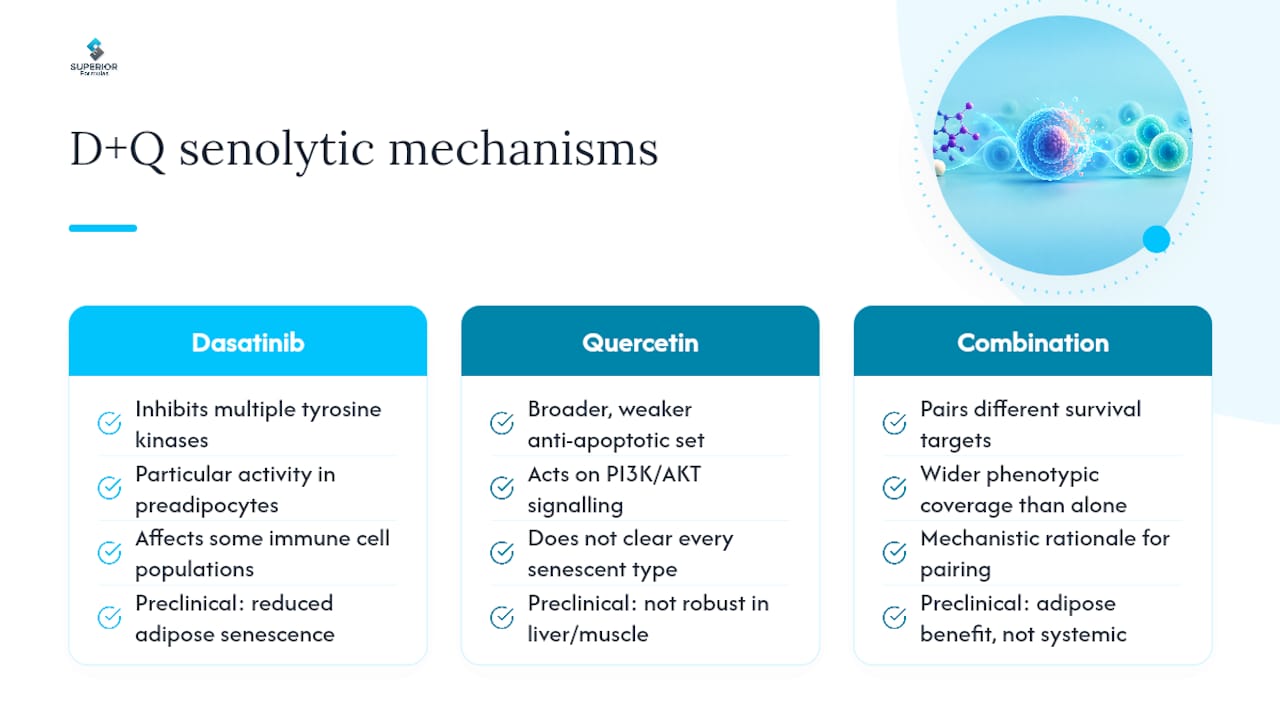
Dasatinib and quercetin appear to hit different survival pathways, which is the biological rationale for combining them rather than using either alone. Dasatinib inhibits several tyrosine kinases that senescent cells use for survival signaling, with particular activity against senescent preadipocytes and some immune cell populations. Quercetin acts on a broader but weaker set of anti-apoptotic pathways, including PI3K/AKT signaling. Neither compound clears every senescent cell type on its own; the combination targets a wider range of senescent phenotypes than either agent alone, which is the mechanistic case for pairing them.
Pro Tip: If you’re evaluating senolytic claims for any compound, ask which cell types and tissues the evidence actually covers. “Senolytic” is not a uniform property. A drug that clears senescent preadipocytes efficiently may do almost nothing to senescent hepatocytes or myocytes.
Preclinical work backs this up in a way that should temper expectations about systemic effects. In aged mice, intermittent D+Q dosing reduced senescence markers and SASP gene expression in perigonadal adipose tissue, alongside improved glucose tolerance and lipid measures. The same study found the effect was not robust in liver or skeletal muscle tissue, even in the same animals given the same regimen.
That single finding, benefit in fat tissue but not liver or muscle, is arguably the most important preclinical result in the entire D+Q literature. It tells you senescent cell clearance is not an all-or-nothing systemic event.
Why the discrepancy? Senescence isn’t one biological state. A senescent adipocyte and a senescent hepatocyte arrive at that condition through different triggers and rely on different anti-apoptotic machinery to survive. Clearing senescent cells in one compartment doesn’t guarantee clearance in another, which is the central caution running through this entire evidence base. A deeper primer on this biology is available in Superiorformulas’s explainer on senolytics, and readers wanting more background on senescence itself can review what cellular senescence means after age 35.
The translational leap from mouse adipose tissue to human systemic aging outcomes is large, and it has not been demonstrated. Rodent studies use controlled genetics, controlled diets, and endpoints measured in tissue biopsies, none of which map cleanly onto the heterogeneity of human trial populations discussed next.
What Human Trials of D+Q Have Actually Shown
Human evidence for D+Q remains sparse, and the trials that exist tell a more nuanced story than most consumer coverage suggests. The best-designed study to date is a phase 2 randomized controlled trial in 60 postmenopausal women testing intermittent D+Q for bone metabolism.
Participants received dasatinib and quercetin given in intermittent cycles over several weeks in clinical trials. The primary endpoint was change in bone resorption marker CTx at 20 weeks, and the trial did not meet it: CTx changed by negative 4.1% in the D+Q group versus negative 7.7% in controls, a difference that was not statistically significant.
The finding that generated the most interest was exploratory, not primary. Participants with high T-cell p16 expression, a senescence biomarker, showed a more favorable response pattern than the overall trial population. That’s a subgroup signal in a modestly sized trial, not confirmed benefit, and it needs replication in a biomarker-stratified design before it means anything for practice.
Other human data points come from smaller, more exploratory studies:
- An Alzheimer’s disease pilot study found dasatinib detectable in cerebrospinal fluid after dosing, but reported no significant changes in cognition, amyloid, tau, or senescence biomarkers over the study period.
- Small biopsy-based studies in diabetic kidney disease and adipose tissue have explored senescent cell burden and D+Q response, generally as proof-of-concept rather than efficacy trials.
- A phase 2 pilot in triple-negative breast cancer (NCT06355037) tested dasatinib and quercetin alongside chemotherapy using a different regimen entirely, illustrating how much protocols vary by indication.
| Trial | Population | Regimen | Primary Result |
|---|---|---|---|
| Phase 2 bone RCT | 60 postmenopausal women | Dasatinib 100 mg ×2 days + quercetin 1,000 mg ×3 days, every 28 days ×5 cycles | Primary CTx endpoint not met; exploratory p16-high subgroup signal |
| AD pilot | Alzheimer’s disease patients | Dasatinib with CSF sampling, 6 cycles | Dasatinib detected in CSF; no cognitive or biomarker change |
| TNBC pilot (NCT06355037) | Triple-negative breast cancer patients | Dasatinib with chemotherapy, differing schedule | Ongoing; distinct regimen from geroscience trials |
Clinicaltrials lists additional ongoing and completed studies evaluating D+Q in narrowly defined populations, including frailty, chronic kidney disease, and skeletal aging cohorts. None of these protocols function as general dosing guidance. Each trial regimen was designed around a specific population, specific endpoints, and specific safety monitoring built into the study design, not extracted for outside use.
The honest summary: one moderately sized RCT with a negative primary endpoint and a promising subgroup finding, one negative CNS pilot, and a scattering of small mechanistic studies. That’s a real but early evidence base, appropriate for guiding further trial design, not clinical practice.
Dasatinib Quercetin Dosing Protocols and Safety Monitoring
The regimen that shows up most often in both academic literature and internet discussion is dasatinib 100 mg for two consecutive days combined with quercetin 1,000 mg daily for three days, repeated in cycles roughly every 28 days. That’s the protocol used in the bone metabolism RCT and it’s often treated online as a standardized “senolytic cycle.” It isn’t. It’s one protocol from one trial in one population.
Other trials use meaningfully different schedules. The triple-negative breast cancer pilot tested a different dosing schedule driven by chemotherapy timing rather than senolysis kinetics was used in other trials. That kind of protocol heterogeneity across ClinicalTrials.gov registrations should signal to clinicians and researchers that no single dose has been validated as optimal across indications, ages, or senescent cell burdens.
The intermittent “hit-and-run” rationale behind these protocols is biologically coherent. Because senolytics need to be present only long enough to trigger apoptosis in vulnerable senescent cells, dosing doesn’t need to be continuous the way it does for most oncology indications. But coherent rationale is not the same as an established optimal regimen. Pharmacokinetics, tissue penetration, and toxicity thresholds likely vary by disease state and patient, and no dose-ranging study has settled these variables in humans.
Pharmacokinetic findings from the human pilots add useful, if incomplete, detail. Dasatinib was detectable in cerebrospinal fluid in the Alzheimer’s pilot after standard dosing, suggesting meaningful blood brain barrier penetration at the doses tested. Quercetin detection in CSF was inconsistent across samples, raising questions about whether it reaches CNS senescent cells at the doses used in that trial.
Statistic callout: In the phase 2 bone trial, the primary CTx endpoint showed no statistically significant difference between the D+Q group and placebo. The positive secondary signal, a 16% rise in P1NP, didn’t hold past four weeks.
Safety monitoring for any investigational D+Q protocol should track dasatinib’s labeled risks directly:
- Baseline and periodic complete blood count to catch cytopenias
- Liver function tests, given dasatinib’s hepatic metabolism
- ECG or QT assessment in patients with cardiac risk factors
- Screening for pulmonary symptoms, including shortness of breath or chest tightness
- Review of concurrent medications for interactions, since dasatinib is a CYP3A4 substrate and quercetin has documented interactions with several drug classes, including some chemotherapy agents
Pro Tip: A study reporting “no serious adverse events” over a handful of cycles in a few dozen carefully screened trial participants is not evidence that unsupervised use is safe. Trial populations are pre-screened for cardiac, hepatic, and hematologic risk factors that a self-directed user has no way to rule out.
One more distinction worth underlining: the quercetin used in trials like the skeletal health study is typically a defined phytosome formulation with known bioavailability. Retail quercetin supplements vary enormously in form (aglycone, glycoside, phytosome-complexed) and absorption, meaning a commercial bottle labeled “1,000 mg quercetin” may deliver a very different systemic exposure than what any trial actually tested. A closer look at that variability is available in Superiorformulas’s review of quercetin supplement evidence.
Why p16 Biomarkers Matter for Senolytic Trial Design
The most consequential detail in the bone metabolism RCT wasn’t the missed primary endpoint. It was that participants with elevated T-cell p16/CDKN2A expression, a marker linked to cellular senescence burden, showed a more favorable exploratory response than the trial population as a whole. That finding reframes how future D+Q research should be designed.
If senescent cell burden varies substantially between individuals of the same age, and the current data suggest it does, then testing a senolytic in an unselected population dilutes any real effect with non-responders. A biomarker-stratified trial, enrolling only participants above a defined senescence threshold, would be a more sensitive test of whether D+Q actually works for its intended mechanism.
The problem is that senescence biomarker testing isn’t there yet for routine use. There is no validated, universally accepted blood test for total-body senescent cell burden. p16/CDKN2A expression in circulating T-cells is one proxy used in research settings, but senescence is tissue-specific: a favorable T-cell signal doesn’t necessarily reflect senescent burden in bone, adipose tissue, or brain.
Populations currently under investigation reflect this tissue-specificity problem directly:
- Frailty and general aging cohorts, where systemic senescence burden is the target
- Chronic kidney disease populations, where renal tissue senescence is measurable via biopsy
- Alzheimer’s disease patients, testing CNS-specific effects
- Postmenopausal women for skeletal aging, the population in the bone RCT
Each population was selected because it offers a measurable, tissue-relevant senescence signal, not because D+Q has demonstrated broad efficacy across aging phenotypes. That distinction should shape how any clinician reads a headline claiming D+Q benefits from one trial and extrapolates to a completely different population.
What Clinicians Should Do Before Considering D+Q
If a patient or research participant is a candidate for D+Q exposure, the responsible path runs through structured protocols, not improvised dosing.
- Check for active trial enrollment first. ClinicalTrials.gov lists ongoing studies across several populations; trial participation provides monitoring infrastructure, standardized dosing, and data that advances the field.
- Require formal informed consent for any experimental use outside a trial. Consent language should explicitly state that D+Q is investigational, that benefit is unproven outside narrow research contexts, and that dasatinib carries oncology-grade risks.
- Establish predefined monitoring before the first dose. Baseline CBC, liver function tests, and an ECG or cardiac risk assessment for patients with relevant history should happen before, not after, dosing begins.
- Screen concurrent medications for interactions. Dasatinib’s CYP3A4 metabolism and quercetin’s documented interactions with several drug classes make a full medication review essential.
- Schedule follow-up labs after each dosing cycle, not just at the end of a protocol, to catch delayed cytopenias or hepatic changes.
Pro Tip: When counseling a patient who has read about D+Q online, the most useful thing you can say is that the retail quercetin they’d buy is not the same material tested in the skeletal health trial. Formulation differences alone can change the entire risk-benefit calculation.
Discourage self-directed sourcing of dasatinib for this purpose entirely. It’s a controlled prescription oncology drug with a narrow therapeutic window, and using it outside medical supervision removes every safety mechanism the label monitoring exists to provide.
Who’s Behind This Analysis
This synthesis draws on peer-reviewed trial data, FDA labeling, and registered clinical trial protocols rather than secondhand summaries. The company was built around integrating clinical research with nutritional biochemistry, which shapes how this article frames investigational compounds versus consumer-ready supplements.
A few relevant points on the brand behind this analysis:
- Products are manufactured in GMP-certified facilities with third-party testing for purity and label accuracy.
- Formula 3, Superior Senolytic+, combines quercetin with fisetin as a general antioxidant and cellular-health supplement, not as a substitute for any clinical trial protocol.
- Nothing sold as a dietary supplement, including Superiorformulas products, is equivalent to trial-grade dasatinib or the phytosome quercetin formulations used in registered studies.
That distinction between a vetted wellness supplement and an investigational drug combination is one this article maintains throughout, and it’s worth restating plainly here.
Where This Research Needs to Go Next
The field needs biomarker-driven trials with predefined senescence thresholds for enrollment, not broad, unselected populations diluting a real but narrow effect. A validated blood-based senescent cell assay, rather than proxy markers like circulating T-cell p16, would let researchers actually test the hypothesis the bone RCT only glimpsed.
Until that exists, routine or consumer use of D+Q for anti-aging is premature. Enroll patients in registered trials when eligible. Treat every claim about “proven” senolytic benefit with the skepticism one negative primary endpoint and one negative CNS trial actually warrant.
— cristopher
A Vetted Quercetin Option for Everyday Cellular Support
If you’re a clinician or informed reader looking for a quercetin-containing supplement outside the trial setting, the gap Superiorformulas fills is formulation transparency: knowing exactly what’s in the bottle and how it was tested. Formula 3, Superior Senolytic+, combines fisetin and quercetin in a formulation manufactured in a GMP-certified facility with third-party purity testing, which addresses the exact variability problem this article raised about retail quercetin products.

This is not a substitute for trial-grade dasatinib or the phytosome quercetin used in registered studies, and it should not be framed that way to patients. It’s a general cellular-health and antioxidant supplement for readers who want a physician-formulated, quality-controlled quercetin source for everyday use, not an investigational senolytic protocol. You can review the formulation details on the Formula 3 product page or see it alongside Superiorformulas’s other longevity-focused products in the full collection. For readers who want the company’s broader research rationale, the Explore the Science page walks through formulation choices in more depth.
Sources
- DailyMed - SPRYCEL- dasatinib tablet
- Effects of intermittent senolytic therapy on bone metabolism in postmenopausal women: a phase 2 randomized controlled trial
- Senolytic drugs, dasatinib and quercetin, attenuate adipose tissue inflammation, and ameliorate metabolic function in old age
- Dasatinib + Quercetin | ALZFORUM
FAQ
What Are the Downsides of Taking Quercetin?
Quercetin is generally well tolerated at supplement doses, but it can interact with certain medications, including some chemotherapy agents and drugs metabolized through CYP3A4. Commercial formulations vary widely in bioavailability, so the dose on a label may not reflect what actually reaches circulation compared to trial-grade phytosome formulations like the one used in the skeletal health study.
Can Quercetin Be Used With Chemotherapy?
Quercetin has documented interactions with some chemotherapy drug classes and should only be combined with cancer treatment under direct oncologist supervision. A phase 2 pilot in triple-negative breast cancer is actively studying dasatinib and quercetin alongside chemotherapy, but that’s a monitored research protocol, not a basis for unsupervised combination.
Can Dasatinib Improve Longevity?
There’s no clinical evidence that dasatinib extends human lifespan or reverses aging. The best available human trial, a phase 2 RCT in postmenopausal women, missed its primary bone metabolism endpoint and only showed exploratory benefit in a biomarker-selected subgroup.
Is Quercetin Good for Aging?
Quercetin shows senolytic activity in preclinical models, particularly in adipose tissue, but human evidence for anti-aging benefit remains limited and inconsistent across trials. For general antioxidant and cellular-health support outside a research context, a quality-controlled formulation like Superior Senolytic+ offers a transparent, tested option, though it isn’t equivalent to investigational D+Q dosing protocols.
What Dose of Dasatinib and Quercetin Was Used in Clinical Trials?
The most cited protocol used dasatinib 100 mg for two days plus quercetin 1,000 mg daily for three days, repeated every 28 days for five cycles, as tested in the bone metabolism RCT. Other trials, including oncology-focused studies, use different schedules, so no single dose is universally validated.


