


Senolytics are a class of experimental therapeutic agents designed to selectively eliminate senescent cells, which accumulate in tissues as you age and drive chronic inflammation. The science is genuinely promising, particularly in animal models, but human clinical trials remain early-stage. No senolytic drug has received FDA approval for any aging-related indication. The most frequently studied combination, dasatinib plus quercetin (D+Q), was identified in a landmark 2015 discovery described in reviews by Mayo Clinic researcher J. L. Kirkland and colleagues, and it remains the reference point for the entire field.
What you need to know right now:
- Core mechanism: Senolytics transiently disable the survival pathways that senescent cells rely on, triggering apoptosis in those cells while leaving healthy cells largely intact.
- Most-studied examples: Dasatinib + quercetin (D+Q), fisetin, and navitoclax (ABT-263) are the compounds with the most published preclinical and early human data.
- Practical bottom line: Do not self-prescribe prescription drugs like dasatinib. Cedars-Sinai experts explicitly advise consulting a healthcare provider before using any senolytic supplement, because safety and efficacy in healthy humans are not yet established.
Table of Contents
- What are senescent cells and why do they matter?
- How do senolytics work at the molecular level?
- What are the main classes of senolytics?
- What does the science actually show?
- What are the risks and how does U.S. regulation apply?
- How do researchers measure whether senolytics are working?
- Where is the field headed next?
- What should you do if you are curious about senolytics?
- How researchers, clinicians, and our team think about senolytic-supporting supplements
- Key Takeaways
- The gap between promise and proof in senolytics
- Superiorformulas and evidence-informed cellular health support
- Authoritative sources for further reading
What are senescent cells and why do they matter?
Every cell in your body carries a built-in emergency brake. When a cell sustains serious DNA damage, faces oxidative stress, or reaches the end of its replicative capacity, it can enter a state called cellular senescence. It stops dividing permanently. But it does not die. Instead, it stays metabolically active, sometimes for years, secreting a cocktail of signaling molecules that reshape the tissue around it.
That secretory output has a name: the Senescence-Associated Secretory Phenotype, or SASP. Understanding the SASP is central to understanding why senescent cells matter so much for aging. Common SASP components include:
- Pro-inflammatory cytokines such as IL-6 and IL-8, which sustain low-grade chronic inflammation
- Chemokines that recruit immune cells to the area, sometimes amplifying damage rather than resolving it
- Matrix metalloproteinases (MMPs), enzymes that degrade the structural scaffolding of tissues
In youth, senescent cells serve a purpose. They signal for wound healing and tumor suppression, and the immune system clears them efficiently. With age, clearance slows. Senescent cells accumulate in joints, fat tissue, the vasculature, and the brain. Their SASP output becomes persistent, contributing to the chronic, low-grade inflammation researchers sometimes call “inflammaging.” According to Kirkland et al.'s review, this accumulation is mechanistically linked to frailty, cardiovascular dysfunction, osteoporosis, pulmonary fibrosis, and several other age-related conditions. That mechanistic link is precisely what makes clearing senescent cells an attractive therapeutic strategy.
How do senolytics work at the molecular level?
Senescent cells have a paradox at their core. They secrete pro-apoptotic SASP factors that would normally signal a cell to die, yet they resist that signal themselves. The reason is that senescent cells simultaneously up-regulate a set of survival networks called Senescent Cell Anti-Apoptotic Pathways, or SCAPs. These pathways are the Achilles’ heel that the field exploits.

Senolytics work by transiently disabling one or more SCAPs, tipping the balance toward apoptosis specifically in senescent cells. Because healthy cells do not rely on the same up-regulated survival signals, they are largely spared. This selectivity is the defining feature of a true senolytic, as opposed to a general cytotoxic agent.
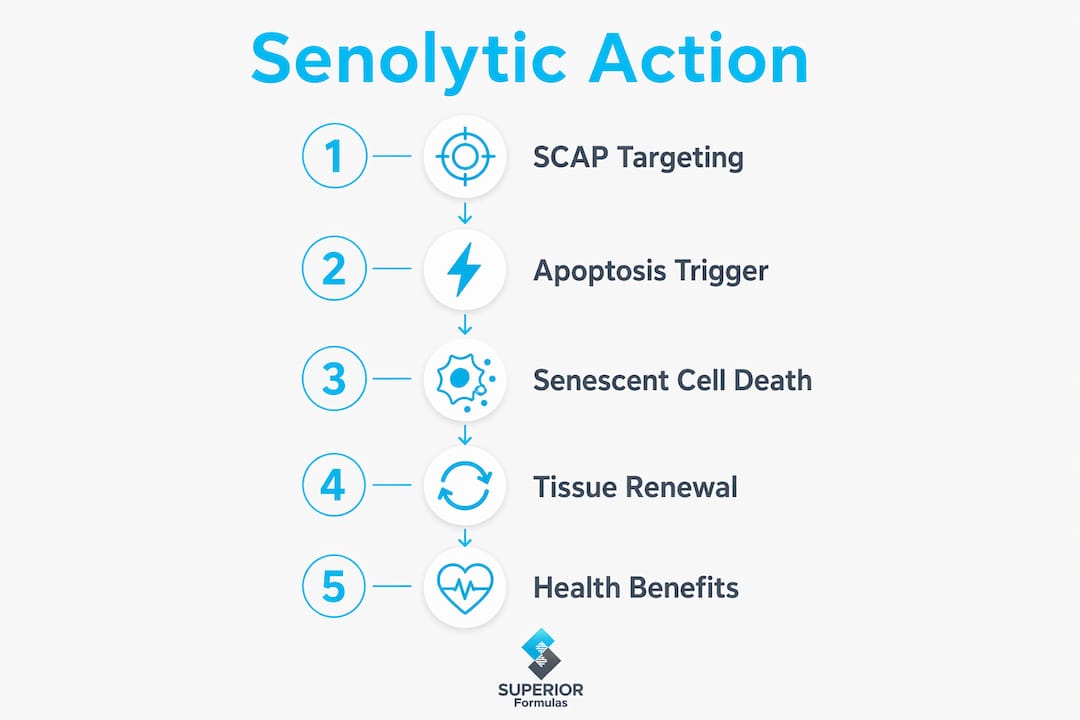
| Mechanism | What it does in the cell | Example compound |
|---|---|---|
| SCAP inhibition (multi-node) | Disables survival proteins unique to senescent cells, triggering apoptosis | Dasatinib + quercetin (D+Q) |
| BCL-2 family inhibition | Blocks mitochondrial anti-apoptotic proteins, releasing the apoptotic cascade | Navitoclax (ABT-263) |
| FOXO4-p53 disruption | Peptide breaks the interaction that keeps senescent cells alive | FOXO4-DRI peptide |
| — | Destabilizes chaperone proteins that senescent cells depend on | — |
One practical implication of this mechanism is “hit-and-run” dosing. Because senolytics clear a population of senescent cells rather than continuously suppressing a pathway, they can be given intermittently. Senescent cells reaccumulate over weeks, so periodic short courses may be sufficient, which also limits cumulative drug exposure and potential toxicity. Kirkland’s group identified this dosing concept as central to the therapeutic rationale.
It is also worth distinguishing senolytics from senomorphics. Senomorphics modulate the SASP, reducing the inflammatory output of senescent cells without killing them. They may reduce harm, but they leave the cells in place. Senolytics eliminate the source.
What are the main classes of senolytics?
The field spans repurposed pharmaceuticals, natural polyphenols, and next-generation biologics. Each class differs in evidence strength, availability, and risk profile.
Kinase inhibitors (repurposed oncology drugs)
- Dasatinib is an FDA-approved cancer drug (for certain leukemias) repurposed as a senolytic. It is a prescription medication. It is not approved for aging indications and carries significant side-effect risks outside oncology contexts.
BCL-2 family inhibitors
- Navitoclax (ABT-263) inhibits BCL-2, BCL-XL, and BCL-W, proteins that senescent cells rely on heavily. It is investigational for senolytic purposes and is associated with platelet toxicity because platelets also depend on BCL-XL for survival.
Flavonoid polyphenols
- Quercetin is a dietary flavonoid available as an over-the-counter supplement. In combination with dasatinib, it showed synergistic senolytic activity in preclinical work. Alone, its senolytic potency at supplement doses is uncertain.
- Fisetin, found naturally in strawberries, is another flavonoid with senolytic activity demonstrated in animal models. It is available as a dietary supplement, though clinical evidence in humans is limited.
Experimental peptides and targeted biologics
- FOXO4-DRI is a synthetic peptide that disrupts the FOXO4-p53 interaction keeping senescent cells alive. It is purely experimental, not commercially available.
- CAR-T cell therapies, antibody-drug conjugates (ADCs), and senolytic vaccines are in early development, discussed further in the future directions section.
Unity Biotechnology is one example of a company that has translated senolytic strategies into clinical-stage products, targeting conditions like osteoarthritis with intra-articular senolytic injections. Their work illustrates how the field is moving toward disease-specific, localized applications rather than systemic anti-aging treatments.
Availability at a glance: Dasatinib requires a prescription. Navitoclax is investigational. Fisetin and quercetin are sold as dietary supplements but are not FDA-approved to treat or prevent any disease. Experimental peptides and biologics are available only through clinical trials.

What does the science actually show?
The honest answer is: a lot in mice, and early signals in humans that need much larger trials to confirm.
Animal model evidence is the strongest part of the story. In mouse studies reviewed by Kirkland et al., senolytics produced a range of meaningful outcomes:
| Animal model | Senolytic used | Headline outcome |
|---|---|---|
| Old mice | D+Q | improvements in cardiac function and vascular reactivity |
| Progeroid Ercc1-/Δ mice | D+Q | reduction in frailty and bone degeneration |
| Radiation-damaged mice | D+Q / navitoclax | improvements in gait and blood function |
| Bleomycin lung-damage mice | Navitoclax | improved lung function and reduced fibrosis |
| Hypercholesterolemic ApoE-/- mice | D+Q | reduction in vascular calcification |
These results span multiple organ systems and disease models, which is what makes the mechanistic case compelling. Clearing senescent cells appears to benefit many tissues simultaneously, not just one.
Human clinical evidence is more limited. Pilot studies with D+Q have reported reductions in senescence markers and some functional signals in small patient groups, including individuals with idiopathic pulmonary fibrosis and diabetic kidney disease. Fisetin has entered early human trials. Navitoclax is being studied in oncology and, increasingly, in aging-adjacent indications. All of these trials are small, use surrogate endpoints rather than hard clinical outcomes, and have not yet produced the definitive evidence needed to change clinical practice.
Several registered trials are actively recruiting or reporting results through ClinicalTrials.gov. The field is at the proof-of-concept stage in humans. Larger randomized controlled trials with clinical endpoints, not just biomarkers, are what the evidence base needs next.
What are the risks and how does U.S. regulation apply?
Safety is where the enthusiasm needs to be tempered most carefully. Side-effect profiles differ meaningfully by drug class.
Known adverse effects by class:
- BCL-2 inhibitors (navitoclax): Thrombocytopenia (low platelet count) is the most significant concern, because platelets depend on BCL-XL. This limits dosing in non-cancer populations.
- Repurposed kinase inhibitors (dasatinib): Fatigue, fluid retention, immune suppression, and cardiovascular effects are documented in oncology use. These risks do not disappear when the drug is used off-label.
- Flavonoid supplements (fisetin, quercetin): Long-term safety data at the doses used in senolytic research are not established. Drug-supplement interactions are possible, particularly with anticoagulants and immunosuppressants.
U.S. regulatory categories:
- FDA-approved drugs: No senolytic has been approved by the FDA for any aging or longevity indication. Dasatinib is approved for cancer, not aging.
- Investigational drugs in clinical trials: The legitimate route to access pharmaceutical-grade senolytics is enrollment in a registered clinical trial.
- Dietary supplements: Fisetin and quercetin are sold legally as supplements under DSHEA. The FDA does not evaluate them for efficacy or safety before they reach shelves. Quality varies widely between manufacturers.
Cedars-Sinai experts are explicit: the clinical evidence for OTC senolytic supplements is insufficient to recommend them broadly, and self-prescribing carries real risks.
Pro Tip: To find legitimate senolytic clinical trials, search ClinicalTrials.gov using the term “senolytics” or specific compound names. For any supplement you consider, look for GMP-certified manufacturing and a third-party certificate of analysis (COA) confirming ingredient identity and potency.
How do researchers measure whether senolytics are working?
Measuring senolytic activity is harder than it sounds, because there is no single blood test that says “senescent cell burden.” Researchers use a combination of assays and endpoints.
Common laboratory assays:
- SA-β-galactosidase (SA-β-gal) staining: The most widely used marker. Senescent cells express elevated β-galactosidase activity at pH 6.0, producing a blue color in stained tissue sections.
- p16INK4a and p21CIP1 expression: These cyclin-dependent kinase inhibitors are up-regulated in senescent cells and measured by immunohistochemistry or gene expression analysis.
- SASP factor quantification: Plasma or tissue levels of IL-6, IL-8, MMP-3, and other SASP components serve as indirect markers of senescent cell activity.
- Telomere-associated foci (TAF): DNA damage foci at telomeres are a marker of replicative senescence in tissue biopsies.
Clinical endpoints in human trials move beyond the lab. Frailty scores, grip strength, six-minute walk distance, and physical performance batteries have been used in pilot studies to detect functional improvement after senolytic treatment. In the D+Q pulmonary fibrosis pilot, researchers measured walking distance and chair-stand speed alongside tissue biopsies.
The limitation is that no single assay is sufficient. Senescence is a heterogeneous state, and different cell types express different combinations of markers. That is why rigorous studies use multiple complementary measures rather than relying on any one readout.
Where is the field headed next?
The first generation of senolytics, repurposed small molecules like dasatinib and navitoclax, proved the concept but also exposed the limits. Their side-effect profiles and lack of tissue specificity have pushed the field toward more targeted approaches.
According to a review in npj Aging, next-generation strategies include:
- CAR-T cell therapies targeting uPAR: Urokinase plasminogen activator receptor (uPAR) is enriched on senescent cells. CAR-T cells engineered to recognize uPAR can selectively kill senescent cells in mouse models.
- Antibody-drug conjugates (ADCs): Antibodies directed at senescence-enriched surface markers deliver cytotoxic payloads specifically to senescent cells, sparing surrounding tissue.
- Senolytic vaccines: Immunizing against senescence-associated antigens to train the immune system to clear senescent cells on its own.
- SA-β-gal-activated nanoparticles: Drug-loaded particles that release their payload only when cleaved by the elevated β-galactosidase activity in senescent cells, enabling precise local delivery.
- More selective small molecules: Second-generation compounds designed from the start for senolytic selectivity, rather than repurposed from oncology.
The central challenge across all of these approaches is identifying surface markers that are truly enriched on senescent cells across different tissues and disease contexts. A marker that works in fat tissue may not be expressed on senescent lung fibroblasts. Translational success will depend on solving that specificity problem, along with navigating the regulatory pathway for what are essentially novel biological therapies.
What should you do if you are curious about senolytics?
Interest in senolytics is reasonable. Acting on that interest without medical guidance is not. Here is a practical, safety-minded checklist for anyone in the United States considering next steps.
- Talk to your primary care physician or a pharmacist first. Describe your interest in senolytics and ask whether any clinical trials are appropriate for your health status. This conversation matters especially if you take prescription medications, because drug-supplement interactions are real.
- Consider clinical trial enrollment for legitimate access. Registered trials at academic medical centers are the safest and most scientifically rigorous route to pharmaceutical-grade senolytics. Search ClinicalTrials.gov and ask your physician about eligibility.
- Do not self-prescribe dasatinib or other prescription drugs. Obtaining prescription drugs without a valid prescription is illegal and dangerous. Off-label use of cancer drugs outside clinical supervision carries serious risks.
- Vet any supplement you consider. If you choose an OTC product containing fisetin or quercetin, look for GMP-certified manufacturing, a published certificate of analysis (COA) from a third-party lab, and transparent ingredient sourcing. These are minimum quality signals, not guarantees of efficacy.
Pro Tip: Ask your physician specifically about academic medical centers running senolytic trials. Mayo Clinic, the University of Minnesota, and similar research institutions have been active in this space. A referral to a geriatrician or longevity medicine specialist may open doors to trial enrollment that a general practitioner cannot.
When evaluating any supplement, Superiorformulas’s guide on identifying research-backed supplements offers a practical framework for separating quality products from marketing noise.
How researchers, clinicians, and our team think about senolytic-supporting supplements
At Superiorformulas, the approach to senolytic-adjacent supplements starts with a clear acknowledgment: no dietary supplement is an approved senolytic therapy. That distinction matters, and the brand’s physician-founded team does not obscure it.
What the brand does offer is evidence-informed formulation built around compounds that appear in the senolytic research literature, specifically fisetin and quercetin, combined in Formula 3 — Superior Senolytic+. The product is positioned as cellular health support, not a replacement for clinical care or pharmaceutical-grade senolytics studied in trials.
Quality practices the Superiorformulas team follows:
- Physician formulation: Products are developed by a physician-scientist with a background in biochemistry and aging research.
- GMP-certified manufacturing: All products are made in facilities certified under Good Manufacturing Practices, the same standard the FDA requires for pharmaceutical production.
- Third-party testing: Each batch is tested by an independent laboratory for identity, potency, and purity, with certificates of analysis available.
- Educational transparency: The brand publishes detailed educational content on cellular senescence and supplement science so readers can make informed decisions.
Editorial note: This section represents the publisher’s own position and quality claims. Dietary supplements are not FDA-approved to treat, cure, or prevent any disease. The information in this article is educational and does not constitute medical advice. Before starting any new supplement regimen or changing medications, consult a qualified healthcare provider.
Key Takeaways
Senolytics are a scientifically grounded but still experimental class of agents: animal evidence is strong, human trials are early, and no FDA-approved senolytic therapy for aging exists yet.
| Point | Details |
|---|---|
| Mechanism is well-defined | Senolytics disable SCAPs, triggering apoptosis in senescent cells while sparing healthy tissue. |
| Animal evidence is robust | Mouse studies show benefits across frailty, cardiac function, bone density, and pulmonary fibrosis. |
| Human trials are early | Pilot studies with D+Q and fisetin show signals, but evidence is not yet definitive; larger trials are needed. |
| Safety varies by class | Navitoclax causes platelet toxicity; dasatinib carries oncology-level risks; flavonoid supplements lack long-term safety data. |
| Superiorformulas approach | Formula 3 combines fisetin and quercetin as evidence-informed cellular support, not a substitute for clinical therapies. |
The gap between promise and proof in senolytics
The science of senolytics is genuinely exciting. The mechanistic logic is tight, the animal data is unusually consistent across multiple disease models, and the idea that clearing one class of dysfunctional cells could benefit many organ systems simultaneously is a real departure from the one-disease-at-a-time model of medicine.
What concerns me is the speed at which that excitement has migrated into consumer marketing. The distance between “fisetin clears senescent cells in aged mice” and “take this fisetin supplement to reverse aging” is enormous, and most of the content circulating online collapses that distance without acknowledging it. The human trials are small. The endpoints are mostly surrogate markers. We do not yet know the optimal dosing, the right patient population, or the long-term safety profile for any senolytic compound in healthy adults.
The publisher’s role here, as I see it, is to hold both truths at once: the science is worth following closely, and the current evidence does not justify aggressive self-experimentation with prescription drugs or poorly characterized supplements. If you are genuinely interested in this field, the most productive thing you can do right now is stay informed, talk to a clinician, and watch the clinical trial results as they emerge.
Superiorformulas and evidence-informed cellular health support
Promotional content
If you have read this far, you understand that pharmaceutical-grade senolytics are not yet available outside clinical trials, and that the supplement market is full of products making claims the evidence does not fully support. Superiorformulas takes a different position: physician-formulated, GMP-manufactured supplements that use compounds from the senolytic research literature, fisetin and quercetin, at meaningful doses, with full transparency about what the science does and does not show.
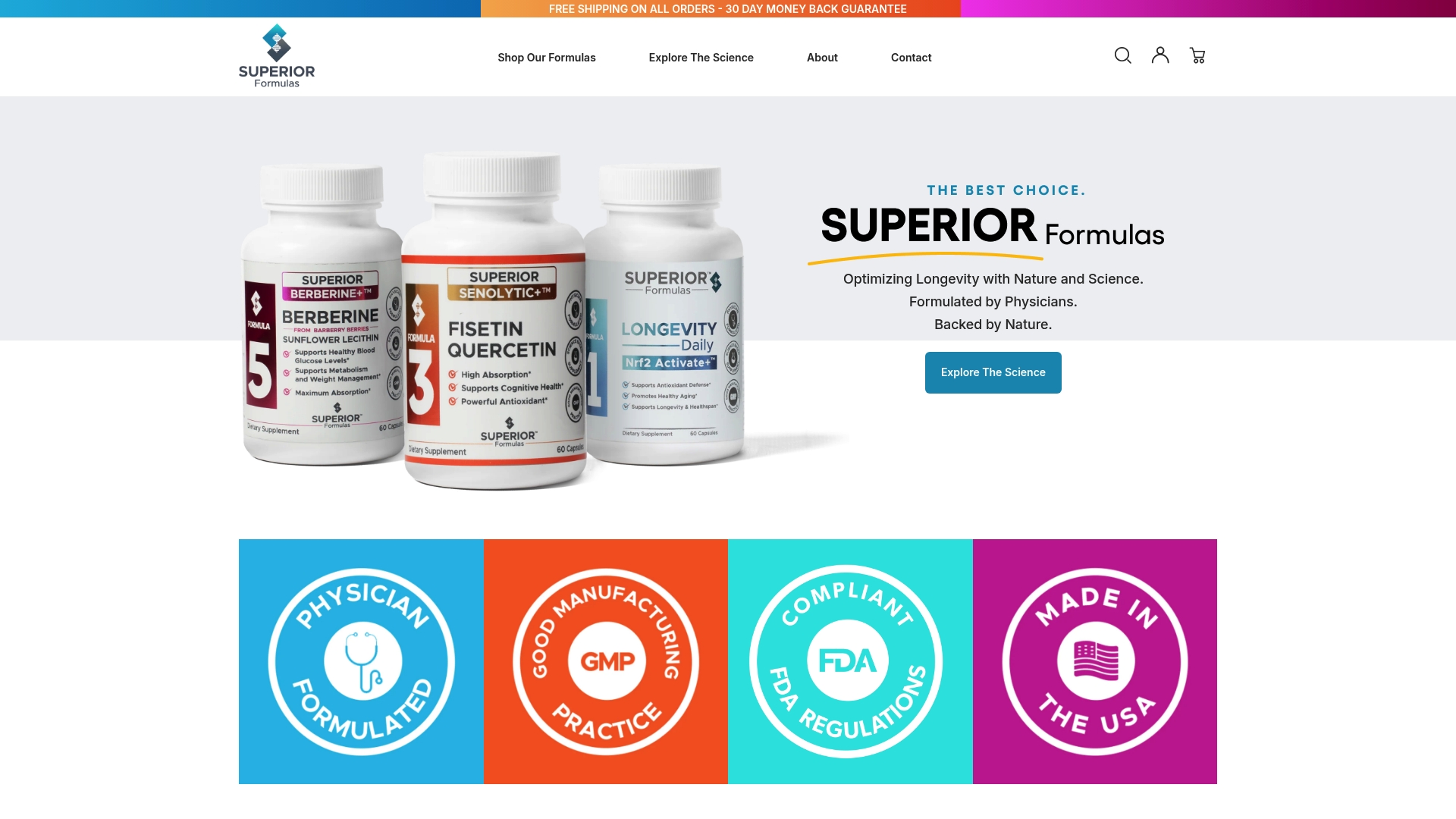
Formula 3 — Superior Senolytic+ combines fisetin and quercetin in a formulation developed by a physician-scientist and tested by a third-party laboratory for purity and potency. It is designed as cellular health support for adults who want to engage with the science of healthy aging without waiting for pharmaceutical approvals that may be years away. The brand’s science hub explains the formulation rationale in detail.
This is not a replacement for clinical care. It is a quality-controlled option for adults who have spoken with their clinician and want evidence-informed support for cellular resilience. Visit Superiorformulas to review the full ingredient profile, read the third-party testing documentation, and decide whether Formula 3 fits your health goals.
Authoritative sources for further reading
- The Clinical Potential of Senolytic Drugs — PMC (Kirkland et al.) — Peer-reviewed review from Mayo Clinic researchers; the foundational paper describing SCAP discovery, early senolytic agents, and animal model outcomes.
- Senolytic drugs: from discovery to translation — Journal of Internal Medicine (Kirkland et al.) — Comprehensive translational review covering mechanism, hit-and-run dosing, and the state of human trials.
- Senolytics: from pharmacological inhibitors to immunotherapies — npj Aging — Recent review covering next-generation approaches including CAR-T, ADCs, and vaccines; explains the field’s shift toward targeted biologics.
- Should I Take Senolytic Supplements? — Cedars-Sinai — Clinical expert guidance on OTC supplement caution; authoritative hospital source for practical consumer advice.
- ClinicalTrials.gov — Senolytic trials registry — The U.S. government’s official database of registered clinical trials; use to find active senolytic studies and eligibility criteria.
- Everything You Need to Know About Senolytics — Healthline — Accessible lay summary of senolytic classes, availability, and safety caveats; medically reviewed.
- Senolytic — Wikipedia — Useful overview of senolytic history, compound classes, and SASP biology; good starting point for general orientation.
- What Is Cellular Senescence and Why It Matters After 35 — Superiorformulas — Publisher’s educational resource on cellular senescence biology and its relevance to healthy aging.
This article is general educational information, not medical advice. Consult a qualified healthcare provider before changing medications or starting any new supplement regimen, and verify current trial eligibility and regulatory status with primary sources.


