


For longevity and cellular resilience, prioritize ingredients with human randomized trials, standardized forms, and doses matching the research. The evidence leaders include NR and NMN, resveratrol and pterostilbene, quercetin and fisetin, spermidine, omega-3 (EPA/DHA), PQQ, CoQ10, standardized curcumin, lutein and zeaxanthin, and butyrate (tributyrin).
The evidence varies by ingredient. Some have multiple human randomized controlled trials behind them. Others rest on preliminary human data or strong preclinical work with emerging human research catching up. Here’s the quick-scan version:
- Strong human trial evidence: NR, NMN, omega-3 EPA/DHA, lutein/zeaxanthin, standardized curcumin
- Preliminary human data, promising signals: resveratrol, pterostilbene, spermidine, PQQ
- Emerging research, encouraging early findings: fisetin, quercetin, CoQ10 (ubiquinol form), butyrate/tributyrin
Before buying anything, check the label for a standardized extract with a stated marker compound, a disclosed dose, and a link to a Certificate of Analysis (COA) as explained in Herbal Extracts for Skincare: The Formulator’s Guide. Those three details tell you more than any headline claim ever will.
Key Takeaways
Matching an ingredient’s studied form and dose to what’s actually in the bottle is the single factor that determines whether a “clinically studied” claim means anything at all.
| Point | Details |
|---|---|
| Evidence varies by ingredient | NR, omega-3, curcumin, and lutein/zeaxanthin have stronger human RCT support than fisetin or spermidine. |
| Form and dose must match | A studied claim only applies when the label uses the same form and dose as the trial. |
| COAs confirm potency | Third-party testing verifies what’s actually inside the capsule matches the label claim. |
| Proprietary blends hide dosing | Blends listing a total without individual amounts can’t be verified against any study. |
| Superiorformulas matches trial data | Formulations are built by matching studied ingredient forms and doses, backed by GMP manufacturing and third-party testing. |
Table of Contents
- What Does “Clinically Studied” Actually Mean for an Ingredient?
- Which Clinically Studied Ingredients Matter Most for Cellular Health?
- How Do You Verify a “Clinically Studied” Claim Before Buying?
- What Safety Risks and Interactions Should You Watch For?
- How Superiorformulas Applies Clinically Studied Ingredients
- Start With Formulations Built Around the Evidence
- Where to Verify Trials and Ingredient Research
- Frequently Asked Questions
- Sources
What Does “Clinically Studied” Actually Mean for an Ingredient?
“Clinically studied” means a specific ingredient, at a specific dose and in a specific form, has been tested in human beings and produced measurable results on a defined outcome, whether that’s a blood biomarker, a cognitive score, or a marker of mitochondrial function. It does not automatically mean the finished bottle on the shelf was tested. That distinction gets blurred constantly, and it’s the single biggest source of confusion in this category. Ingredient-level human research shows an active compound can do something in a controlled trial. Whether that finding applies to the product in front of you depends on whether the maker matched the studied form, dose, population, and delivery method.
A claim only transfers cleanly when four things line up:
- Same form: the exact salt, isomer, or standardized extract used in the trial, not a generic version of the same botanical
- Same dose: milligram for milligram, not “clinically studied ingredients” scattered at a fraction of the researched amount
- Similar population: healthy adults over 50, for instance, rather than data from a completely different age group or health status
- Same endpoint: the outcome measured in the trial matches what’s being claimed on the label
Look for randomized, placebo-controlled, blinded trials with a reasonable sample size and duration, ideally published in a peer-reviewed journal rather than announced only in a press release.
Pro Tip: Before trusting any “clinically studied” claim, search the ingredient name directly on PubMed or ClinicalTrials.gov. If a brand can’t point you to the same trial it’s referencing, treat the claim as unverified.
Which Clinically Studied Ingredients Matter Most for Cellular Health?
Here’s how the most-researched longevity ingredients stack up, ingredient by ingredient, in terms of form, dose, and what the human data actually shows.
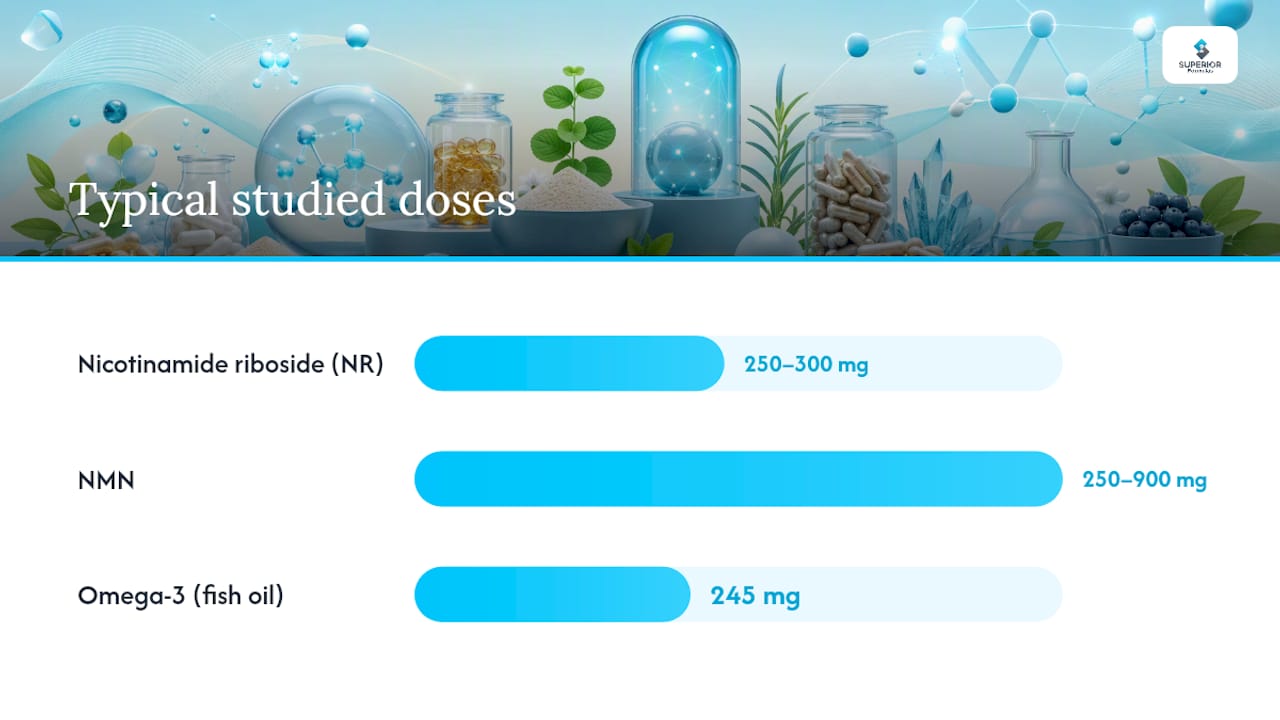
Nicotinamide riboside (NR) and nicotinamide mononucleotide (NMN) both raise NAD+ levels, a coenzyme cells need for energy production and DNA repair, but their evidence bases differ. NR has a longer track record of published human trials examining NAD+ metabolism and safety at doses around 250 to 300 mg daily. NMN research has expanded quickly, with human trials generally using 250 mg to 900 mg per day, though standardization across studies is still catching up to NR’s.
Resveratrol and pterostilbene are polyphenols studied for activating cellular stress-response pathways. Resveratrol suffers from a real bioavailability problem: the body clears it fast, which is why some formulations pair it with piperine or use micronized particles. Pterostilbene, a close chemical cousin, has better oral absorption and a longer half-life, though its human trial base is smaller.
Quercetin and fisetin are flavonoids drawing interest for their senolytic potential, meaning their ability to help clear aging cells. Most of this evidence is still early-stage in humans, built on a foundation of stronger preclinical work. Quercetin is often combined with dasatinib in trial protocols; fisetin has been tested as a standalone compound in a handful of small human studies.
Curcumin (standardized extracts) only work when bioavailability is addressed. Plain turmeric powder is poorly absorbed. Look for extracts standardized to a declared curcuminoid percentage, often paired with piperine, phospholipids, or nanoparticle delivery to boost absorption.
Spermidine, found naturally in wheat germ and aged cheese, has human data linked to autophagy, the cellular process that clears damaged components. Studied doses in trials have generally used wheat-germ-derived extracts rather than isolated spermidine.
Omega-3 fatty acids (EPA/DHA) carry some of the deepest human RCT evidence of anything on this list, with endpoints ranging from cardiovascular markers to cognitive function. One randomized trial is currently examining 245 mg of fish oil alongside lutein and zeaxanthin for cognitive and bone health outcomes over six months.
PQQ (pyrroloquinoline quinone) supports mitochondrial biogenesis in preclinical models, and human trials are starting to test it in multi-ingredient cognitive formulas, including one combining PQQ with GABA, caffeine, and B-vitamins in postmenopausal women.
CoQ10 exists in two forms: ubiquinone and ubiquinol. Ubiquinol is the reduced, more bioavailable form and tends to be preferred in formulations targeting older adults, since natural conversion of ubiquinone to ubiquinol declines with age.
Lutein and zeaxanthin have solid human trial support for eye health and are now being studied for cognitive benefits, using doses like the 7 mg lutein and 14 mg zeaxanthin tested in the ClinicalTrials.gov cognition and bone health trial.
Butyrate (tributyrin) is a short-chain fatty acid tied to gut barrier integrity and microbiome health. A randomized, double-blind, placebo-controlled trial is currently testing a butyrate-polyphenol combination on gastrointestinal symptoms and microbiome modulation.
| Ingredient | Evidence strength | Typical studied dose |
|---|---|---|
| NR / NMN | Human RCTs (NR more established) | Doses studied in trials vary within a range typically used in research |
| Resveratrol / pterostilbene | Preliminary human data | Varies widely; bioavailability-dependent |
| Quercetin / fisetin | Preliminary to preclinical | Small human pilot studies |
| Curcumin (standardized) | Human RCTs with bioavailable forms | Standardized extract, often with piperine |
| Omega-3 (EPA/DHA) | Strong human RCTs | 245mg+ fish oil in cognitive trials |
| PQQ | Emerging human data | Studied in multi-ingredient formulas |
| CoQ10 (ubiquinol) | Human data, form-dependent absorption | Varies by age and form |
| Lutein / zeaxanthin | Human RCTs | 7mg lutein / 14mg zeaxanthin |
| Butyrate / tributyrin | Emerging human RCTs | Under active clinical study |
How Do You Verify a “Clinically Studied” Claim Before Buying?
Run through this checklist before adding anything to your cart:
- Find the citation. Search the ingredient name on PubMed or ClinicalTrials.gov. A legitimate brand will make this easy, sometimes linking the trial directly on the product page.
- Confirm the exact form. Standardized extract? Specific salt or ester? Branded ingredient with a trademark name? Match it to what was studied.
- Compare the dose. If the label dose is a fraction of what the trial used, the “clinically studied” claim is decorative, not functional.
- Check the study population. A trial in young, healthy athletes doesn’t necessarily predict results in a 55-year-old managing metabolic concerns.
- Look for a COA. Third-party testing confirms the ingredient inside the capsule matches what the label says, at the potency claimed.
- Watch for proprietary blends. When a label lists a blend total without breaking out individual ingredient amounts, you cannot verify anything.
Red flags worth remembering: no dose disclosed anywhere, a single small pilot study propping up a big claim, or a press release referenced instead of an actual publication. Branded ingredients often simplify this entire process, since the ingredient developer typically funds and documents research tied to that exact material and dose, which is one reason trademarked, standardized ingredients tend to have cleaner paper trails than generic versions of the same compound.
If you’re on prescription medication, this is also the point to loop in a clinician before adding anything new. Our guide on assessing dietary supplements for real wellness gains walks through this same verification process in more depth.
What Safety Risks and Interactions Should You Watch For?
High-dose omega-3s and certain polyphenols can increase bleeding risk, which matters if you’re on anticoagulants or scheduled for surgery. Some longevity-focused actives, including berberine-adjacent compounds and certain polyphenols, affect blood sugar regulation, a real consideration if you take glucose-lowering medication. Anything with mild stimulant properties can compound with caffeine or other stimulants already in your routine.
Pregnancy, active cancer treatment, immunosuppression, and kidney impairment all warrant extra caution with senolytics like fisetin and quercetin, since human safety data in these populations is often thin or nonexistent. Stacking multiple studied actives at once introduces cumulative dosing risk that single-ingredient trials never tested.
Pro Tip: Keep a running list of everything you take, supplements included, and bring it to every clinician visit. It takes two minutes and prevents most interaction problems before they start.
How Superiorformulas Applies Clinically Studied Ingredients
Superiorformulas was founded by a physician-scientist, and that clinical background shapes how formulations get built from the ground up. Every ingredient decision starts with matching the studied form and dose from published human research, not settling for a diluted version that fits a lower price point.
Development follows a consistent path:
- Match the exact ingredient form and dose used in the relevant human trials
- Require supplier documentation and stability data before formulation begins
- Manufacture in GMP-certified facilities with third-party testing on finished batches
- Review every claim against the underlying research before it reaches a label
This is the same standard our guide on research-backed supplements for longevity encourages readers to apply to any brand they’re evaluating, including ours.
An Editorial Note on Choosing Evidence Over Hype
When I evaluate a new supplement, I compare the label dose against the trial dose first, before reading a single marketing claim. If a brand can’t produce a COA on request, that’s disqualifying, full stop. Evidence strength and personal goals don’t always point to the same product, and a good clinician can help you weigh both instead of chasing whichever ingredient trended last month.
Start With Formulations Built Around the Evidence
Superiorformulas exists because most supplement shelves are stacked with ingredients chosen for marketing appeal rather than matched doses and documented trials. Every formulation here starts from the same checklist this article just walked you through: standardized extract, disclosed dose, third-party COA on file.
If you want to see how that translates into an actual product, our evidence-based supplements for longevity page breaks down which studied ingredients appear in which formulations, at what dose. Customer service can also provide COAs or trial citations directly on request for anything you’re considering. Browse the current lineup at Superiorformulas and see which formulation matches the evidence you’ve just reviewed.
Where to Verify Trials and Ingredient Research
Start with PubMed for peer-reviewed studies on a specific ingredient, and ClinicalTrials.gov for trial registrations, including ongoing and completed research with full protocol details. Ingredient manufacturer pages can be useful when they’re transparent about dosing and link directly to published data rather than summarizing it secondhand. For a broader explanation of how to read supplement research, our clinical evidence guide breaks down the terminology in plain language.
Frequently Asked Questions
What does “clinically studied ingredients list” mean in practice? It refers to a compiled set of active ingredients that have documented human research behind them, at a specific form and dose, rather than compounds chosen purely for marketing appeal or based only on animal studies.
Are clinical trials for supplements the same as drug trials? No. Supplement trials typically test safety, bioavailability, and structure/function outcomes rather than disease treatment claims, and they don’t go through the same FDA approval pathway as pharmaceuticals.
How do I know if an ingredient efficacy study applies to the product I’m buying? Check that the form, dose, and study population match what’s on your label. A study using a branded, standardized extract doesn’t automatically validate a generic version of the same botanical at a different dose.
Is “clinically studied” a regulated term? No. The phrase isn’t regulated, which means a single small pilot study can technically support the claim. Always check study size, design, and whether independent research has replicated the finding.
Should I consult a clinician before starting a new evidence-based ingredient? Yes, particularly if you take prescription medication, are pregnant, or manage a chronic condition. Certain polyphenols and high-dose omega-3s can interact with blood thinners or blood sugar medications.
This article is general information, not a substitute for advice from a qualified doctor. Consult a qualified healthcare professional about your own circumstances before acting on anything here.
Sources
- Clinically Studied Ingredients In Supplements: What Brand Owners Should Know | NutraCap
- Choosing Branded Ingredients: A Guide for Supplement Brand Owners | Nutraceuticals World
- Clinicaltrials
- Supplementscience


