


, while anti-inflammatories calm down cytokine signaling. A handful of compounds, including curcumin and resveratrol, do ...&media=http://cdn//csuxjmfbwmkxiegfpljm.supabase.co/storage/v1/object/public/blog-images/organization-27528/1789370141168_Berries-greens-fish-and-turmeric-foods.jpeg)


Antioxidants and anti-inflammatories are not the same thing: antioxidants neutralize reactive oxygen species (ROS), while anti-inflammatories calm down cytokine signaling. A handful of compounds, including curcumin and resveratrol, do both jobs at once. High-dose supplementation of either kind still carries real risk when used without a clear reason, so the safest path runs through food first and clinical guidance second.
TL;DR:
- Combining antioxidant and anti-inflammatory effects requires compounds like curcumin, resveratrol, and quercetin, which modulate inflammatory pathways while scavenging ROS.
- High-dose supplementation carries risks, especially if doses exceed what can be achieved through diet or are taken without clinical guidance, due to potential suppression of necessary ROS signaling.
- Evidence supports omega-3 fatty acids for inflammatory markers in cardiovascular health, and NAC for conditions involving oxidative stress, but most polyphenol supplements lack conclusive human trial data.
- Food sources like berries, leafy greens, fatty fish, and spices should be prioritized over supplements to provide a broad spectrum of phytochemicals safely.
- Proper formulation, third-party testing, and clinical backing are crucial when choosing antioxidant or anti-inflammatory supplements to ensure safety and efficacy.
Table of Contents
- Antioxidant vs Anti-Inflammatory: How Do They Differ at the Cellular Level?
- Which Compounds Have Both Antioxidant and Anti-Inflammatory Effects?
- Does the Clinical Evidence Support Antioxidant Supplementation?
- How Should You Approach Antioxidants and Anti-Inflammatory Foods Safely?
- Why Targeted, Not Blanket, Antioxidant Support Matters
- Sources
- FAQ
Antioxidant vs Anti-Inflammatory: How Do They Differ at the Cellular Level?
Antioxidants and anti-inflammatories target two different problems inside your cells, even though those problems constantly feed into each other. An antioxidant’s job is chemical: it donates an electron to a reactive oxygen species, or ROS, and neutralizes it before that unstable molecule can damage a cell membrane, protein, or strand of DNA. An anti-inflammatory’s job is signaling: it interrupts the molecular messages that tell immune cells to ramp up an inflammatory response.
Your body makes its own antioxidant defenses, and they matter more than anything you could buy in a bottle. Superoxide dismutase (SOD), catalase, and glutathione peroxidase (GPx) are enzymes that patrol your cells and disarm ROS as a routine part of metabolism. Dietary antioxidants like vitamin C and vitamin E supplement this system, but they do not replace it. A Frontiers review on chronic inflammatory disease points out that many emerging therapies now aim to enhance these enzymatic defenses directly, rather than simply flooding the body with outside antioxidant compounds.
Anti-inflammatory action works through a different set of switches. Two pathways dominate the conversation among researchers: NF-κB and MAPK. When these pathways activate, they trigger production of pro-inflammatory cytokines, including TNF-α, IL-6, and IL-1β, along with enzymes like COX-2 and iNOS that amplify swelling, pain, and tissue changes. An anti-inflammatory compound or drug works by blocking one or more of these signals before the cytokine cascade gets rolling.
Here’s the part most explanations skip: ROS and inflammation are not separate stories. They are one feedback loop.
- Physiological ROS levels are not a defect. Your immune cells use bursts of ROS to kill bacteria, and low-level ROS acts as a signaling molecule that regulates normal cell growth and repair.
- Excess ROS, the kind driven by smoking, poor sleep, chronic stress, or metabolic dysfunction, overwhelms your antioxidant enzymes and starts damaging cellular structures. This is oxidative stress.
- Oxidative stress directly activates NF-κB and MAPK, the same pathways behind chronic inflammation. Higher inflammation, in turn, generates more ROS as immune cells respond, deepening the cycle.
This closed loop is why the two terms get used almost interchangeably in casual health writing, and why that habit causes confusion. A compound that only mops up ROS will not necessarily shut down an inflammatory cascade already in motion, and a compound that blocks cytokine production will not necessarily correct an underlying oxidative burden. Readers researching what oxidative stress actually does to your cells will find the ROS side of this story goes considerably deeper than “free radicals are bad.”
Which Compounds Have Both Antioxidant and Anti-Inflammatory Effects?
The compounds getting the most research attention right now are the ones that hit both problems at once. That dual action, ROS scavenging paired with pathway modulation, is exactly why polyphenols and a few other specific molecules keep showing up across longevity and inflammation research.
A PMC review on the interplay between oxidative stress and inflammation identifies curcumin, resveratrol, and quercetin specifically as compounds that modulate NF-κB signaling while also improving the activity of your endogenous antioxidant enzymes. That combination is rarer than marketing copy suggests. Here’s how the best-studied ones actually work.
- Curcumin. The active compound in turmeric scavenges ROS directly and inhibits NF-κB, which measurably reduces TNF-α, IL-6, and IL-1β production. It also stimulates Nrf2, the cellular pathway that switches on your body’s own antioxidant enzyme production. The catch: curcumin has notoriously poor bioavailability on its own. Formulations that pair it with piperine or use lipid-based delivery systems perform better in human trials than raw turmeric powder, according to mechanistic research on curcumin and resveratrol.
- Resveratrol. Found in grape skins and red wine, resveratrol increases SOD, catalase, and GPx activity while inhibiting COX-2 and iNOS, the enzymes that drive inflammatory tissue changes. Preclinical data is strong. Human dosing data is thinner, and most trials use doses far above what a typical serving of food provides.
- Quercetin. This flavonoid, common in onions and apples, scavenges ROS and dampens both MAPK and NF-κB signaling. Some research also points to mitochondrial benefits, meaning quercetin may support the energy-producing machinery inside cells rather than just cleaning up after damage occurs.
- Omega-3 fatty acids. EPA and DHA, found in fatty fish, get converted into resolvins and protectins, specialized lipid mediators that actively resolve inflammation rather than simply blocking it. Omega-3s have some of the more consistent clinical evidence of any compound in this category, particularly for cardiovascular inflammatory markers.
- N-acetylcysteine (NAC). NAC is not primarily an antioxidant itself. It is a precursor your body uses to manufacture glutathione, arguably the master antioxidant inside human cells. NAC has established clinical uses, most notably as the standard treatment for acetaminophen overdose, which tells you something about how directly it affects oxidative processes.
Formulation quality changes outcomes more than most people realize. Curcumin taken as a raw supplement can show blood levels many times lower than the same dose delivered with an absorption enhancer, which explains why some clinical trials of “the same compound” produce wildly different results depending on how it was manufactured.
The common thread across all five: none of them work as a pure antioxidant or a pure anti-inflammatory. They occupy the middle ground, and that middle ground is where most of the interesting longevity research is happening right now.
Does the Clinical Evidence Support Antioxidant Supplementation?
Evidence quality varies enormously depending on which compound and which health outcome you’re asking about, and pretending otherwise is where a lot of supplement marketing goes wrong. Omega-3s have relatively strong support for cardiovascular inflammatory markers. Most polyphenol supplements, taken in isolation at supplement doses, have weaker and more inconsistent human trial data than their impressive laboratory results would suggest.
This gap has a name: the antioxidant paradox. A PMC review on antioxidant paradox and clinical trial limitations explains why so many large antioxidant supplementation trials have produced null results or, in some cases, worse outcomes than placebo. The core issue is that ROS are not simply toxic byproducts. They serve necessary signaling functions in immune defense and normal cell regulation. Flooding the body with nonselective, high-dose antioxidants can suppress ROS signaling your cells actually need, not just the excess causing damage.
Trial design failures compound the problem in several specific ways:
- Dose mismatches. Many trials use doses far outside anything achievable through diet, which changes the biology entirely rather than simply amplifying a benign effect.
- Timing errors. Antioxidants given after tissue damage has already occurred behave differently than the same compound given preventively.
- Bioavailability gaps. A compound that performs beautifully in a test tube may barely reach target tissues in a human body, as the curcumin bioavailability problem illustrates.
- Population selection. A trial run in already-healthy people with normal oxidative status is unlikely to show benefit, because there is little excess ROS for the compound to address.
- Endpoint choice. Studies measuring broad mortality outcomes over studies measuring specific biomarker changes will naturally produce very different-looking results from the same intervention.
Not every finding here is discouraging. Preclinical research on combination approaches, such as pairing NAC with curcumin or resveratrol with omega-3s, shows synergistic reductions in oxidative damage and inflammatory markers in animal models. That is a meaningfully different evidence tier than a single-compound human trial, and it points toward where future research is headed rather than what’s proven today.
Pro Tip: When you read a supplement’s marketing claim, ask whether it cites a human trial or a cell-culture study. Laboratory results are a starting point, not proof of what happens once a compound is swallowed, digested, and diluted through your bloodstream.
The practical read: evidence justifies clinical use for omega-3s in specific cardiovascular contexts and for NAC in established medical settings. For most standalone polyphenol supplements, the honest label is “promising but still experimental,” not “proven.”
How Should You Approach Antioxidants and Anti-Inflammatory Foods Safely?
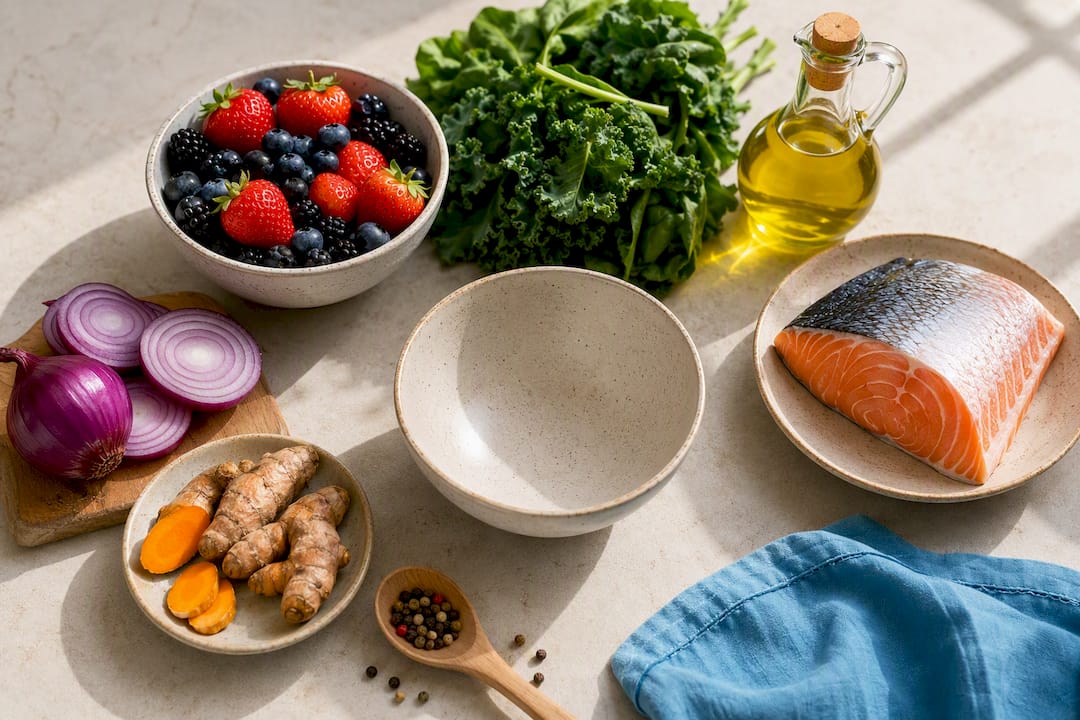
Food should be your first move, not your last resort. A food-first approach delivers a spectrum of phytochemicals working together rather than one isolated compound at an artificially high dose. Berries, leafy greens, olive oil, fatty fish, turmeric, and onions collectively supply antioxidant vitamins, polyphenols, and omega-3s in ratios your body evolved to handle.
That said, some situations genuinely call for targeted supplementation. NAC has established clinical applications tied to glutathione support. Omega-3s show consistent benefit for people whose diets run low in fatty fish. Curcumin or resveratrol formulations with enhanced bioavailability may make sense for someone specifically managing a diagnosed inflammatory condition, ideally under a clinician’s guidance rather than through trial and error.
Safety deserves equal weight here, because “natural” does not mean “risk-free.”
- Omega-3 supplements at higher doses can thin the blood meaningfully, which matters for anyone taking blood thinners or scheduled for surgery.
- High-dose vitamin E supplementation has been linked to increased bleeding risk and, in some trials, worse outcomes than placebo for certain populations.
- Antioxidant supplements can interact with chemotherapy regimens, since some cancer treatments work partly by generating ROS to damage tumor cells. Blanket antioxidant use during treatment should always go through an oncologist first.
- Anyone managing a chronic condition or taking prescription medication should talk to a clinician before adding a new supplement, particularly at doses above what a normal diet would provide.
When you’re evaluating a specific product, a short checklist keeps you from being swayed by marketing language alone:
| What to check | Why it matters |
|---|---|
| Third-party testing | Confirms the product contains what the label claims and nothing it doesn’t |
| GMP-certified manufacturing | Indicates consistent quality control during production |
| Transparent dosing | Lets you compare the actual dose against clinical trial doses, not just an ingredient name |
| Bioavailability enhancers | Curcumin and resveratrol specifically need these to perform in the body as they do in a lab |
| Clinical backing for that specific formulation | A compound’s general research does not guarantee a specific product’s version was tested |
Readers who want a deeper walkthrough of how to evaluate whether a specific antioxidant supplement is worth taking will find the reasoning holds for anti-inflammatory formulas too. The underlying question is always the same: does this specific dose, in this specific delivery form, match what was actually tested in humans?
Why Targeted, Not Blanket, Antioxidant Support Matters
The antioxidant paradox is the single most underappreciated finding in this entire field, and it deserves more attention than it gets in consumer health content. The instinct to treat oxidative stress and inflammation as enemies to be maximally suppressed is understandable, but it misreads the biology. ROS and inflammatory signaling are tools your body uses on purpose. The goal isn’t zero oxidative activity. It’s restoring balance when chronic stressors have pushed that activity into a damaging range.
That distinction shapes how physician-formulated supplements should be built. Rather than chasing the highest possible antioxidant dose, the more defensible approach targets specific pathways, Nrf2 activation among them, with compounds that have mechanistic and clinical support behind that specific action. The approach to formulation should favor dual-action, evidence-backed compounds over indiscriminate megadosing, and manufacturing should be done in GMP-certified facilities with third-party testing to confirm what’s actually in the bottle.
None of this replaces a conversation with your doctor, especially if you’re managing a chronic condition or taking medication that could interact with a new supplement. The science here is genuinely promising. It’s also genuinely nuanced, and nuance is exactly what gets lost when a compound gets marketed as a cure-all.
— cristopher
This article is general information, not a substitute for advice from a qualified doctor. Consult a qualified healthcare professional about your own circumstances before acting on anything here.
Sources
- Antioxidant paradox and clinical trial limitations (PMC review)
- Exploring the interplay of antioxidants, inflammation, and oxidative stress (PMC review)
- Dual-action polyphenols: curcumin, resveratrol mechanisms (Griffith research repository)
- Food micronutrients explained — Antioxidants, anti-inflammatories and phytochemicals (MSU Extension)
FAQ
Is Turmeric an Antioxidant or an Anti-Inflammatory?
Turmeric’s active compound, curcumin, is both. It scavenges reactive oxygen species directly and inhibits the NF-κB pathway that drives cytokine-based inflammation.
What Is the Most Powerful Natural Anti-Inflammatory?
There is no single strongest compound across all conditions, but omega-3 fatty acids have some of the most consistent human clinical evidence, particularly for cardiovascular inflammatory markers, through their conversion into resolvins.
Is There a Downside to Taking Antioxidant Supplements?
Yes. High-dose, nonselective antioxidant supplementation can suppress reactive oxygen species that your body needs for normal immune signaling, an effect known as the antioxidant paradox, and some trials have shown null or worse outcomes than placebo.
Which Antioxidant Is Best for Inflammation?
Curcumin, resveratrol, and quercetin stand out because they combine ROS scavenging with direct modulation of the NF-κB and MAPK inflammatory pathways, rather than acting on oxidative stress alone.


