


. But th...&media=http://cdn//csuxjmfbwmkxiegfpljm.supabase.co/storage/v1/object/public/blog-images/organization-27528/1785646898588_Vitamin-E-supplements-with-comparison-chart-on-table.jpeg)


Common vitamin E brand names sold in U.S. pharmacies include Aquasol E, Alpha-E, E-Gems, and Key-E on the pharmaceutical side, alongside retail supplement lines such as Life Extension, Nordic Naturals, and A.C. Grace (Unique E). But the vitamin E brand name on the front of the bottle matters far less than the chemical form listed in the Supplement Facts panel. Natural-source alpha-tocopherol (labeled “d-alpha-tocopherol”) and synthetic alpha-tocopherol (“dl-alpha-tocopherol”) are not equivalent in bioavailability, and a product with “mixed tocopherols” delivers a broader antioxidant profile than one with a single form.
Key facts before you buy:
- Pharmaceutical/clinical brands: Aquasol E, Alpha-E, E-Gems, Key-E are names you will see in medical references and hospital formularies.
- Retail supplement lines: Life Extension, Nordic Naturals, and A.C. Grace (Unique E) appear consistently in dietitian-reviewed roundups for ingredient quality and third-party testing.
- Form matters most: Confirm “d-alpha” (natural) vs. “dl-alpha” (synthetic) and check for “mixed tocopherols” before any other label detail.
- Third-party seals: USP, NSF International, and Informed Choice indicate independent potency and purity verification.
- Safety caveat: If you take blood thinners, have a bleeding disorder, or are scheduled for surgery, consult your clinician before starting vitamin E supplements.
Pro Tip: Scan the Supplement Facts panel first, not the front label. The front is marketing; the panel is the actual product.
Table of Contents
- What does “vitamin E” mean on a supplement label?
- Common vitamin E brand names and formulations sold in the U.S.
- How do you choose the right vitamin E supplement?
- Dosage, safety, and drug interactions you need to know
- How to read a vitamin E label in under two minutes
- When should you talk to your healthcare provider first?
- Key Takeaways
- The label is the product — not the brand name
- Superiorformulas: physician-formulated supplements built for this standard
- Useful sources and further reading
What does “vitamin E” mean on a supplement label?
Alpha-tocopherol is the generic clinical name for the most biologically active form of vitamin E, and it is the form your body preferentially uses. The broader vitamin E family splits into two structural groups: tocopherols (alpha, beta, gamma, delta) and tocotrienols. Most supplements on U.S. shelves contain alpha-tocopherol alone, but whole-food sources of vitamin E deliver all eight forms together.
The d- vs. dl- distinction is one of the most consequential label details in the supplement aisle:
- d-alpha-tocopherol: — Derived from natural plant sources (typically soy or sunflower oil). Higher bioavailability and the form your body retains longer.
- Tocotrienols: — Less common in standard supplements but increasingly studied for advanced antioxidant and cellular health applications. Some physician-formulated lines include them specifically for this reason.
Common vitamin E brand names and formulations sold in the U.S.
Mayo Clinic and RxList both list recognized vitamin E preparations used in clinical contexts. Here is a practical breakdown:
Pharmaceutical and clinical brands:
- Aquasol E: A water-miscible oral solution used in clinical settings, particularly when fat absorption is compromised.
- Alpha-E (Alph-E): A clinical formulation of alpha-tocopherol referenced in medical drug databases.
- E-Gems: Softgel capsules containing d-alpha-tocopherol; frequently cited in clinical references for general supplementation.
- Key-E: Available as capsules and suppositories; used in both oral and topical clinical applications.
Retail supplement brands (editorial roundups and dietitian recommendations):
- Life Extension: Known for mixed-tocopherol formulations and transparent labeling; a consistent presence in dietitian-reviewed roundups for adults seeking broad antioxidant support.
- Nordic Naturals: Emphasizes natural-source ingredients and third-party testing; appeals to those prioritizing clean-label products.
- A.C. Grace (Unique E): One of the longest-standing natural vitamin E brands in the U.S., formulated with high-potency d-alpha-tocopherol and mixed tocopherols, and frequently cited by physicians.
Formulation category comparison:
| Formulation type | Common form | Best for | Notes |
|---|---|---|---|
| Alpha-tocopherol only | Softgel, liquid | Basic deficiency correction | Check d- vs. dl- on label |
| Mixed tocopherols | Softgel | Broad antioxidant support | Closer to whole-food vitamin E profile |
| Tocotrienol-rich | Softgel | Advanced cellular antioxidant strategies | Less common; often in specialty lines |
| Topical oil/cream | Oil, serum | Skin hydration and barrier support | Look for d-alpha-tocopherol or tocopheryl acetate |
How do you choose the right vitamin E supplement?

The best vitamin E supplement depends on your health goal and the form you actually need. Brand reputation is a starting point, not a finish line. Work through these four label priorities in order:
Step-by-step selection checklist:
- Confirm the chemical form. Look for “d-alpha-tocopherol” (natural) rather than “dl-alpha-tocopherol” (synthetic).
- Check for mixed tocopherols. If broad antioxidant coverage is your goal, the label should list gamma- and delta-tocopherol alongside alpha.
- Look for a third-party seal. USP, NSF International, or Informed Choice seals confirm that the product was independently tested for potency and contaminants.
- Scan inactive ingredients. Gelatin capsules are not vegan; soy-derived tocopherols may matter if you have soy sensitivity. Sunflower-derived options are widely available.
Pro Tip: A USP or NSF seal reduces the need to trust brand marketing alone. It means an independent lab confirmed the product contains what the label claims.
| Label priority | What to look for | Selection action |
|---|---|---|
| Chemical form | d-alpha vs. dl-alpha | Choose d-alpha for higher bioavailability |
| Tocopherol breadth | Mixed tocopherols listed | Prefer mixed for food-like antioxidant profile |
| Third-party testing | USP, NSF, or Informed Choice seal | Reject products with no independent verification |
| Inactive ingredients | Gelatin, soy oil, fillers | Match to dietary needs and allergy profile |
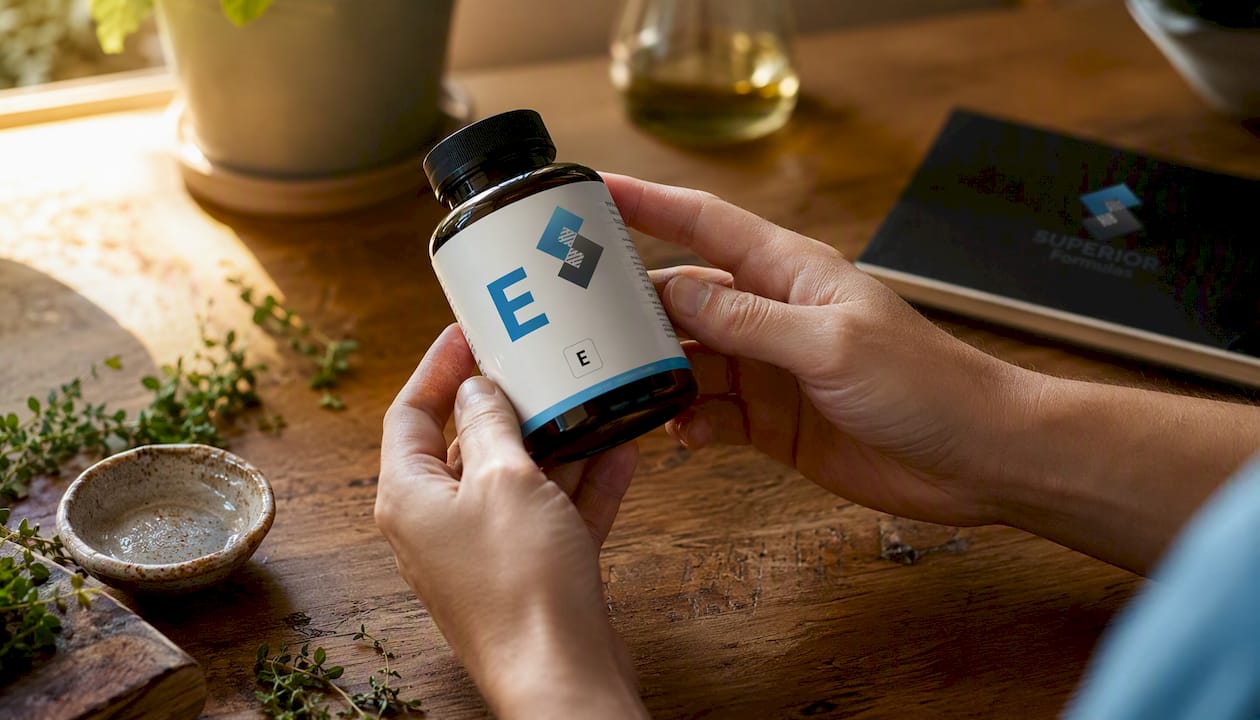
For a structured approach to antioxidant supplement selection, matching the form to your specific cellular health goals matters as much as the brand.
Dosage, safety, and drug interactions you need to know
Clinical sources including the Cleveland Clinic and MedlinePlus reference a general adult dietary reference intake for vitamin E of 15 mg (22.4 IU) of natural alpha-tocopherol daily, with a tolerable upper intake level of 1,000 mg per day for adults. Supplemental doses in retail products vary widely, and some clinical formulations offer higher doses. Needs vary by age, diet, and clinical context, so these figures are reference points, not personal prescriptions.
Safety warnings you should not skip:
- Anticoagulants and antiplatelet drugs: Vitamin E can increase bleeding risk when combined with warfarin, aspirin, or other blood thinners. High-dose use requires clinician oversight in these cases.
- Pre-surgery: Most surgical guidelines recommend stopping vitamin E supplements at least two weeks before any elective procedure due to bleeding risk.
- High-dose risks: Doses above the tolerable upper limit have been associated with adverse effects in some populations, including increased all-cause mortality in certain meta-analyses.
- Fat-soluble accumulation: Unlike water-soluble vitamins, vitamin E is stored in fat tissue and the liver. Excess accumulates rather than being excreted.
- Pregnancy and lactation: Needs change during pregnancy; supplementation beyond dietary amounts should be discussed with an OB-GYN or midwife.
This article provides general information, not medical advice. Confirm current dosing and safety guidance with your clinician or pharmacist before changing your supplement regimen.
How to read a vitamin E label in under two minutes
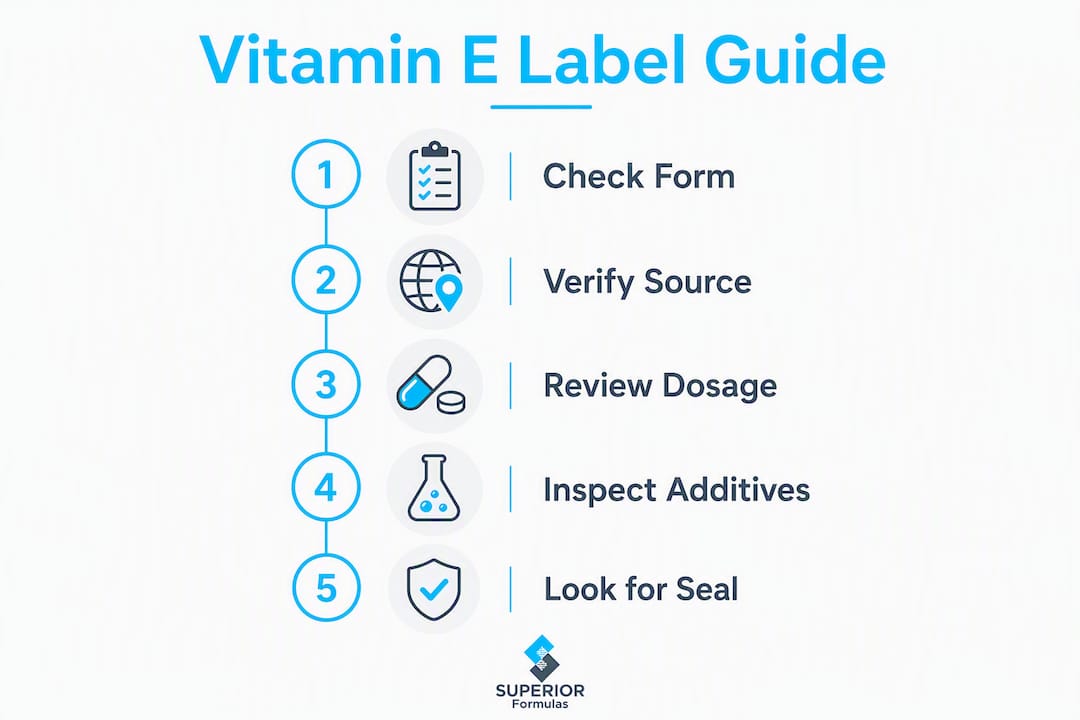
Retail vitamin E products in the U.S. still commonly list potency in IU (International Units) rather than milligrams, though FDA labeling updates have shifted newer products toward mg. The conversion differs by form: 1 IU of natural d-alpha-tocopherol equals approximately 0.67 mg, while 1 IU of synthetic dl-alpha-tocopherol equals approximately 0.45 mg. The practical takeaway: IU values are not directly comparable between natural and synthetic forms.
Exact label terms to look for:
- ✓ “d-alpha-tocopherol” or “d-alpha-tocopheryl acetate/succinate” — natural source
- ✗ “dl-alpha-tocopherol” — synthetic; lower biological activity per IU
- ✓ “mixed tocopherols” — includes gamma and delta forms
- ✓ “tocotrienols” — advanced antioxidant forms; check if from palm or annatto source
- ✓ USP or NSF seal on the label or packaging
| Label term | What it means | Action |
|---|---|---|
| d-alpha-tocopherol | Natural-source vitamin E | Preferred for bioavailability |
| dl-alpha-tocopherol | Synthetic vitamin E | Lower retention; check dose carefully |
| Mixed tocopherols | Multi-form vitamin E blend | Preferred for broad coverage |
| Tocotrienols | Advanced vitamin E family | Seek in specialty or physician-formulated lines |
| USP/NSF seal | Third-party verified potency and purity | Strong trust signal; prioritize |
Scan the ingredient list below the Supplement Facts panel for inactive additives. Soy oil, gelatin, and artificial colors are common in mass-market softgels. Sunflower-derived tocopherols and vegetarian capsules are available if those matter to you. For a broader look at supplement forms and their uses, understanding delivery format helps match the product to your actual need.
When should you talk to your healthcare provider first?
Some situations call for a clinician conversation before you open the bottle. These are not edge cases.
- You take warfarin, heparin, aspirin, clopidogrel, or any other anticoagulant or antiplatelet medication.
- You have a scheduled surgery or invasive procedure within the next four weeks.
- You have a bleeding disorder or a history of hemorrhagic stroke.
- You are pregnant, trying to conceive, or breastfeeding.
- You already take other fat-soluble vitamins (A, D, K) in supplemental doses, since interactions among fat-soluble nutrients are real.
- You are considering doses above 200 mg daily for an extended period.
When you speak with your clinician, bring your full medication list, note the specific form and dose you are considering, and explain your reason for supplementing. A clinician may order a serum alpha-tocopherol test to confirm whether supplementation is actually needed, or recommend a dietary approach first. For a step-by-step supplement selection framework designed for adults 35 and older, the same principle applies: clinical context shapes the right choice.
Key Takeaways
The chemical form of vitamin E on the label predicts bioavailability and breadth of antioxidant coverage more reliably than any brand name alone.
| Point | Details |
|---|---|
| Prioritize chemical form | Choose d-alpha-tocopherol (natural) over dl-alpha-tocopherol (synthetic) for better bioavailability. |
| Mixed tocopherols add coverage | Products listing gamma and delta tocopherols more closely mirror the vitamin E profile in whole foods. |
| Third-party seals verify claims | USP, NSF International, or Informed Choice seals confirm independent potency and purity testing. |
| Safety check before starting | Consult your clinician if you take blood thinners, have a bleeding disorder, or plan surgery. |
| Superiorformulas approach | Physician-formulated, GMP-manufactured, and third-party tested — the standard this article recommends applying to any vitamin E purchase. |
The label is the product — not the brand name
Most people shopping for vitamin E spend their attention on the front of the bottle. The brand name, the design, the marketing claim. That instinct is understandable, but it is the wrong place to look.
The real product is the Supplement Facts panel. A mass-market brand with a recognizable name can sell you dl-alpha-tocopherol in a soy-oil gelatin capsule with no third-party verification, while a less-familiar physician-formulated line delivers natural mixed tocopherols with a USP seal. Those two products are not the same thing, regardless of what the front label says.
The vitamin E category is particularly prone to this gap because the nutrient itself is so well-known that consumers assume any product labeled “vitamin E” is equivalent. It is not. The d- vs. dl- distinction alone changes how efficiently your body retains the vitamin. Adding mixed tocopherols changes the breadth of antioxidant activity. Third-party testing changes whether you can trust the dose at all.
Brand reputation is a reasonable starting filter. But the readers who get the most from their supplements are the ones who treat the Supplement Facts panel as the actual product specification, and the brand name as context.
Superiorformulas: physician-formulated supplements built for this standard
Superiorformulas was founded by a physician-scientist specifically to close the gap between what clinical research recommends and what most supplement brands actually deliver. Every formulation is produced in a GMP-certified facility and subject to third-party testing for potency and purity — the same standard this article recommends you apply to any vitamin E product you consider.
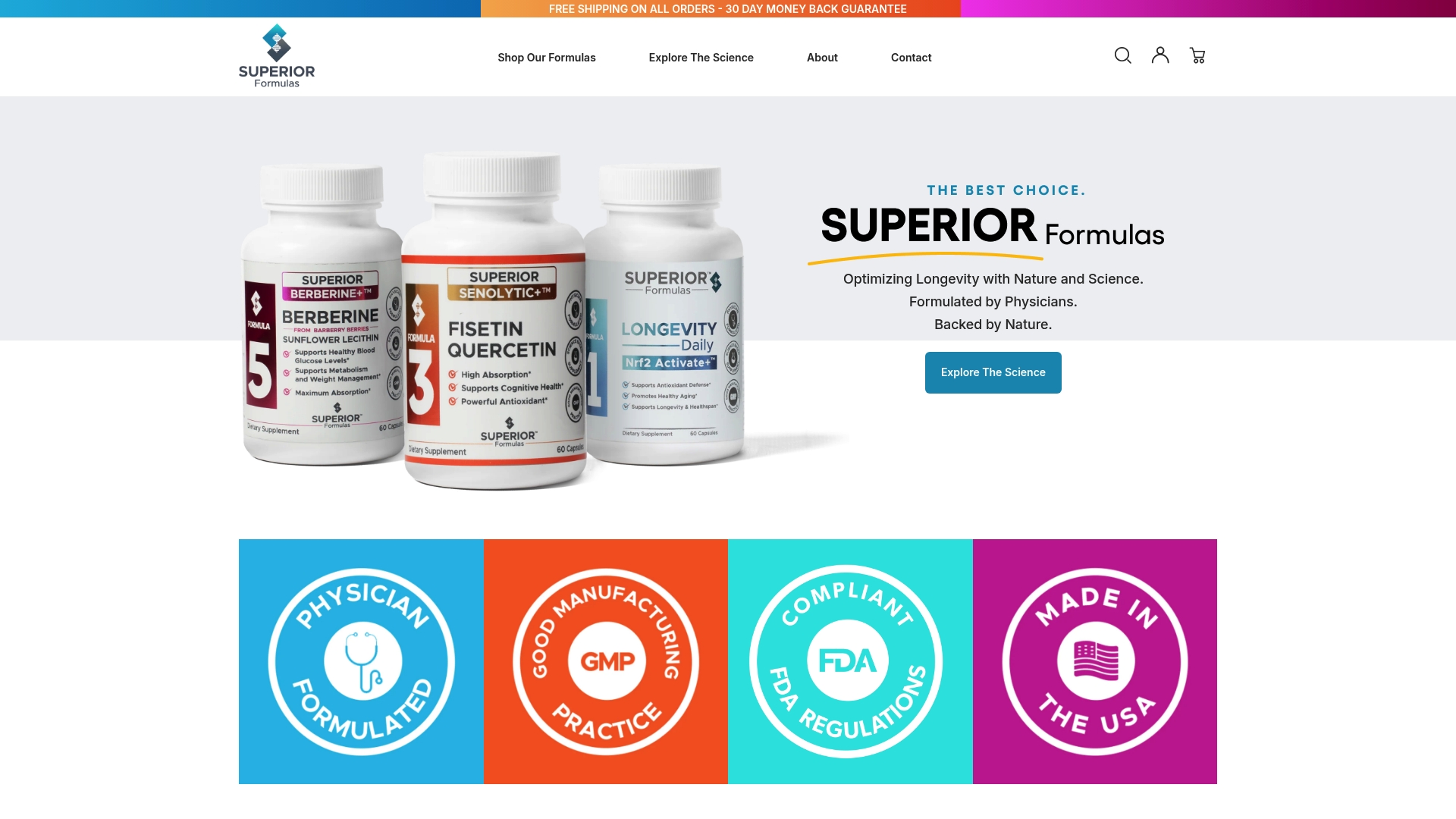
For readers who have worked through this article and want a supplement line that already meets the label criteria outlined here — natural-source ingredients, transparent Supplement Facts, no unnecessary fillers, physician-level formulation logic — Superiorformulas is built for exactly that. The product catalog includes antioxidant-focused formulations designed for cellular resilience and healthy aging, grounded in the same ingredient-first thinking described above. Browse the full range and review the Supplement Facts panels yourself at Superiorformulas.
Useful sources and further reading
These are the clinical and editorial sources used in this article. Each is worth bookmarking if you want to go deeper on dosing, safety, or brand evaluation:
- MedlinePlus: Vitamin E (Alpha-Tocopherol) Drug Information — NIH-maintained clinical reference for generic name, forms, dosing, and interactions.
- Mayo Clinic: Vitamin E Oral Route — Lists U.S. brand names, clinical dosing, and safety guidance.
- Cleveland Clinic: Vitamin E Capsules — Practical clinical overview of uses, side effects, and dosing.
- RxList: Vitamin E — Drug database listing pharmaceutical preparations including Aquasol E.
- Healthline: Best Vitamin E Supplements — Editorial roundup covering third-party testing criteria and form selection.
- Yahoo Health: Best Vitamin E Supplements, According to Dietitians — Dietitian-reviewed picks with notes on mixed tocopherols and ingredient quality.
- NIH Office of Dietary Supplements: Vitamin E Fact Sheet — Authoritative reference for dietary reference intakes, upper limits, and research summaries.
For skin-focused applications, the evidence on antioxidants for skin health covers topical vitamin E alongside other evidence-backed antioxidants worth knowing about.


