


Spermidine promotes autophagy, the cellular cleanup process that declines with age, and higher intake correlates with better cardiovascular outcomes, sharper cognitive markers, and lower mortality in some population studies. Animal research indicates potential longevity and healthspan gains through the same mechanism. Human clinical trials remain early-stage but consistent with those signals. Talk to your physician before starting any new supplement, especially if you have a history of cancer.
TL;DR:
- Human cohort studies show higher dietary spermidine intake is associated with lower mortality, improved cardiovascular health, and better cognitive markers, but causality is not proven.
- Spermidine levels vary greatly based on food ripeness, processing, and storage, making it hard to determine precise daily intake from diet alone.
- Supplement doses in trials are generally mild to moderate and well tolerated, but circulating levels do not respond linearly, and safety in cancer contexts remains cautious.
- High-quality supplements should be standardized, third-party tested, and produced under GMP to ensure consistent dosing and safety.
- Relying solely on food sources for spermidine provides inconsistent exposure; supplementation offers a more predictable way to support autophagy and cellular health.
Table of Contents
- How Spermidine Supports Autophagy, Mitochondria, and Cellular Repair
- What Human Studies Show: Cohorts, Trials, and Real Limitations
- Which Foods Contain Spermidine, and Why Levels Vary So Much
- Spermidine Supplements: Dosing, Safety, and How to Choose One
- How Superiorformulas Approaches the Evidence
- Where the Conventional Advice on Spermidine Falls Short
- Ready to Add Spermidine to Your Longevity Routine?
- Sources
How Spermidine Supports Autophagy, Mitochondria, and Cellular Repair
Spermidine is a polyamine, a small, naturally occurring molecule your body produces from the amino acid ornithine and also absorbs through food and gut bacteria. Every cell in your body uses polyamines to stabilize DNA, support protein synthesis, and regulate cell growth. Spermidine’s standout role, though, is switching on autophagy, the process your cells used to break down and recycle damaged proteins, worn-out organelles, and cellular debris.
Think of autophagy as your body’s internal janitorial staff. When it works well, cells stay lean and functional. When it slows down, which it tends to decline with age, damaged components can pile up and contribute to inflammation and dysfunction associated with aging tissue. Spermidine appears to help keep that cleanup crew more active, and preclinical research links this mechanism to improvements in cardiac, cognitive, and metabolic function in animal models.
The effects extend beyond autophagy alone. Spermidine also appears to:
- Protect mitochondrial membranes and support the energy-producing function cells rely on
- Reduce markers of chronic low-grade inflammation, a driver of many age-related conditions
- Improve proteostasis, the balance between building and clearing proteins, which helps prevent the misfolded-protein buildup seen in neurodegenerative disease
- Mimic aspects of caloric restriction, a well-studied longevity intervention, without requiring actual food restriction
That caloric-restriction parallel matters. Longevity researchers have described spermidine as a caloric restriction mimetic, meaning it can trigger some of fasting’s protective cellular signals through protein deacetylation and autophagy induction, even when caloric intake stays normal. Tissue-level spermidine concentrations drop as we age, which is one reason researchers have taken a serious interest in whether restoring intake, through diet or supplementation, can partially offset that decline.
What Human Studies Show: Cohorts, Trials, and Real Limitations
The strongest human evidence for spermidine comes from long-running cohort studies, not randomized trials, and that distinction matters for how confidently you should read the results. The Bruneck Study, an epidemiological cohort tracking dietary patterns and health outcomes over years, found that participants with higher dietary spermidine intake had lower all-cause, cardiovascular, and cancer-related mortality in observational studies. Researchers also observed associations with reduced heart failure risk and better cognitive performance in the same population.
Key data point: In the Bruneck cohort, higher dietary spermidine intake was linked to reduced overall mortality and improved markers of cardiovascular health over the study period, a pattern that has since been echoed in broader nutritional reviews of polyamine intake and healthspan.
Cohort data like this is compelling, but it shows association, not proof of cause. People who eat more spermidine-rich foods, wheat germ, legumes, aged cheese, also tend to have different overall dietary patterns, activity levels, and health behaviors that could independently explain better outcomes. Researchers control for many of these variables statistically, but no epidemiological study can fully rule out confounding.
Randomized controlled trials fill that gap, at least partially, and they’re smaller and earlier in development than most readers expect. A pharmacokinetic and metabolomic study testing high-dose spermidine supplementation found the compound was generally well tolerated, but circulating spermidine levels didn’t always rise as much as researchers anticipated, even at higher doses. That’s a meaningful finding: it suggests the body regulates spermidine tightly, and oral supplementation doesn’t necessarily translate into a straightforward dose-response increase in the bloodstream.
Trials with hard clinical endpoints, actual reductions in heart attacks, dementia diagnoses, or mortality, are still sparse. Most current human data tracks biomarkers and short-term tolerability rather than long-term disease outcomes. That gap between epidemiological association and controlled clinical proof is the honest state of the science right now. Spermidine’s human evidence base is supportive and biologically plausible, not definitive. It should inform how you think about diet and supplementation, not serve as a promise of a specific health outcome.
Which Foods Contain Spermidine, and Why Levels Vary So Much
Spermidine shows up across a surprisingly wide range of foods, but the amount in any given serving depends heavily on how that food was grown, processed, aged, and stored. A food polyamine database analysis cataloging spermidine content across hundreds of foods found consistently high concentrations in a handful of categories:
- Wheat germ, one of the most concentrated natural sources available
- Soy products, including tofu, edamame, and fermented soy foods like natto
- Mushrooms, particularly varieties like shiitake
- Green peas and other legumes
- Aged cheeses, where fermentation time correlates with higher polyamine content
- Whole grains and certain nuts, in more moderate concentrations
The variability is the part most people underestimate. Lab analyses of food polyamine content show measured spermidine levels for the same food can vary greatly depending on ripeness, fermentation duration, storage time, and regional growing conditions. A wedge of aged cheddar and a wedge of young cheddar are not nutritionally interchangeable when it comes to polyamine content, even though they’re the same cheese.
That variability makes it hard to calculate a precise daily spermidine intake from diet alone, and it’s worth setting expectations accordingly. If you want to lean into food sources, rotate wheat germ into smoothies or oatmeal, add mushrooms and legumes to regular meals, and treat aged cheeses as a flavorful bonus rather than a dosing strategy. It’s a reasonable foundation, but not a precise one.
Spermidine Supplements: Dosing, Safety, and How to Choose One
Most studied supplements use either wheat germ extract or standardized, purified spermidine concentrates, both designed to deliver more consistent amounts than food alone can guarantee. That consistency is the entire value proposition of supplementation: instead of guessing whether your cheese was aged long enough, you get a measured dose.
Human trials have tested a range of doses, generally in the single-digit to low double-digit milligram range daily, with pharmacokinetic studies reporting good tolerability even at higher amounts. Side effects reported across trials have been mild and infrequent, mostly limited to occasional digestive discomfort. What the same research also shows is that oral supplementation doesn’t always produce a durable, linear rise in circulating spermidine, likely because gut microbiota activity and intestinal transport systems shape how much actually reaches your bloodstream. In practice, that means individual responses vary, and more isn’t automatically better.
There’s a nuance worth taking seriously: polyamines, including spermidine, play a role in cell proliferation. Comprehensive safety reviews note this creates a theoretical consideration in cancer biology, since rapidly dividing cells rely on polyamine pathways too. If you have a personal or family history of cancer, or are currently undergoing treatment, talk with your oncology provider before adding spermidine supplementation to your routine.
Here’s how to evaluate a product before buying:
- Check the source. Confirm whether it’s wheat germ extract or a purified concentrate, and verify the spermidine content is standardized, not just listed as a blend.
- Look for third-party testing. Independent verification of purity and potency matters more than marketing claims on the label.
- Confirm GMP manufacturing. Good Manufacturing Practice certification is a baseline quality signal, not a luxury feature.
- Talk to your clinician, especially if you take other medications or have underlying health conditions.
Pro Tip: Don’t judge a spermidine supplement by dose alone. A lower-dose, well-absorbed formulation with verified purity is often a better bet than a high-dose product with no third-party testing behind it.
How Superiorformulas Approaches the Evidence
Superiorformulas was founded by a physician-scientist who treats the gap between promising research and reliable product quality as the core problem worth solving. Every formulation reflects that starting point: clinical training applied to ingredient selection, not just trend-chasing.
That matters specifically because of the variability problem described above. Food-based spermidine intake is inconsistent by nature, shaped by aging, storage, and processing you can’t control from your kitchen. A physician-formulated approach to supplementation exists to address exactly that gap, using standardized dosing and third-party verified potency rather than hoping your groceries happened to be optimally aged.
Superiorformulas’s process includes:
- GMP-certified manufacturing for every product batch
- Third-party testing to confirm purity and label accuracy
- Formulations grounded in clinically studied ingredients and mechanisms, including Nrf2 activation pathways relevant to cellular resilience
None of this replaces a conversation with your own doctor, particularly if you’re managing a chronic condition or take prescription medication. Supplements are an adjunct to diet and lifestyle, not a substitute for either.
Where the Conventional Advice on Spermidine Falls Short
Most coverage of spermidine benefits either overhypes it as an anti-aging miracle or buries the genuinely interesting findings under too much hedging. Neither is useful. The honest read is that spermidine has one of the more biologically coherent longevity stories going: a documented mechanism, animal data that lines up with that mechanism, and human cohort evidence that points the same direction. That’s a better evidence stack than most trending supplements can claim.
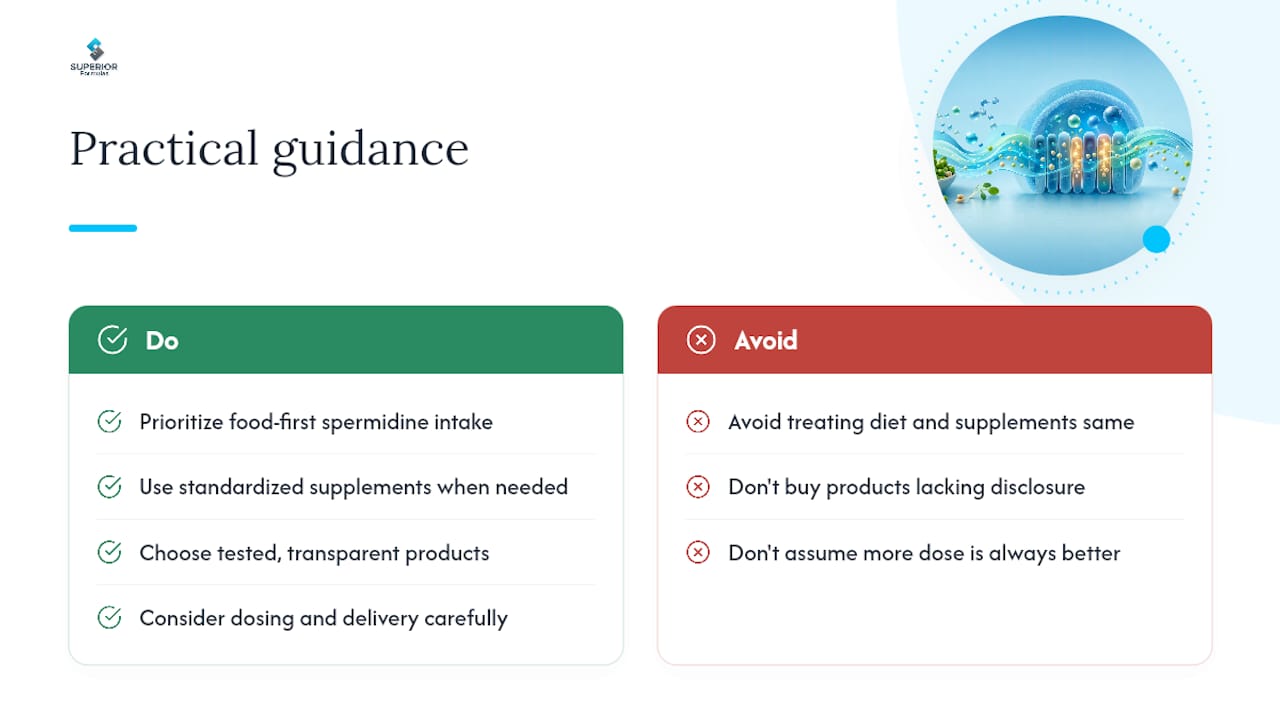
Where the popular narrative goes wrong is treating dietary intake and supplementation as interchangeable. They’re not. Diet gives you inconsistent, unmeasured exposure. A standardized supplement gives you a known quantity, which is precisely why the pharmacokinetic data showing muted blood-level increases at certain doses deserves more attention than it gets. It’s a signal that dosing and delivery format genuinely matter, not a footnote.
If you’re 35 or older and interested in this space, prioritize the food-first foundation, then treat supplementation as a deliberate, informed addition rather than a shortcut. Skip products that won’t disclose sourcing or testing. That’s not caution for its own sake. It’s just matching your standards to what the science can currently support.
— cristopher
Ready to Add Spermidine to Your Longevity Routine?
Superiorformulas exists for exactly the moment you’ve reached after reading this far: you understand the mechanism, you’ve seen the human evidence, and you want a product built around that same standard of rigor rather than marketing shortcuts. Where food-based spermidine intake is inconsistent and hard to dose, Superiorformulas formulates with clinically studied ingredients, verified through third-party testing and produced in GMP-certified facilities, so what’s on the label matches what’s in the capsule.
Its formulations come from physician-led research into cellular resilience and healthy aging pathways, including Nrf2 activation, the same territory spermidine’s autophagy-driven benefits sit within. If you’re building a longevity plan and want to compare where spermidine fits alongside other evidence-based interventions, review the broader science behind Superiorformulas’s approach and see which formulations align with your health goals. That page walks through the clinical reasoning behind each ingredient choice, so you can make an informed decision rather than a guess.
Sources
- Spermidine review — PMC
- Comprehensive review of spermidine: safety, health effects, absorption and metabolism — PubMed


