


Urolithin A itself isn’t in any food. Your gut bacteria produce it from ellagitannins found in foods like pomegranate, raspberries, walnuts, and almonds, but only a portion of people convert those precursors reliably. Whole pomegranate arils, berries, and walnuts remain the highest-yield precursor sources, yet without the right gut bacteria, that conversion can stall entirely.
TL;DR:
- Most people produce urolithin A only if their gut bacteria can convert ellagitannins from foods like pomegranates, berries, and walnuts, which varies widely among individuals.
- Consuming a diverse range of precursor foods and rotating sources weekly can maximize ellagitannin intake and support gut microbial conversion.
- Synbiotic supplements pairing probiotics with polyphenol-rich foods significantly increase urolithin A production in about 100% of participants, unlike diet alone or probiotic-only approaches.
- Direct urolithin A supplementation offers the most consistent and immediate effect, bypassing gut microbiome variability and quickly improving mitochondrial biomarkers.
- Gut microbial diversity, age, antibiotic use, and diet influence urolithin A production, making supplementation preferable for older adults or those with low microbiome diversity aiming for reliable benefits.
Table of Contents
- What Foods Contain Urolithin A Precursors?
- How Does Your Gut Turn Food Into Urolithin A?
- Diet vs. Synbiotics vs. Direct Supplementation: What the Trials Show
- Building a Weekly Diet Around Urolithin A Precursors
- Can You Train Your Microbiome to Produce More Urolithin A?
- Diet, Microbiome Support, or Supplement: How to Decide
- How Superiorformulas Approaches Urolithin A Support
- Sources
What Foods Contain Urolithin A Precursors?
No food contains urolithin A in preformed, ready-to-absorb quantities. What foods actually deliver are ellagitannins and ellagic acid, the raw material your gut microbiome converts into urolithin A through a multistep fermentation process. That distinction matters for anyone searching for “urolithin A foods” expecting a simple grocery list, because the real question is which foods carry the highest precursor load, not which foods carry the compound itself.
Reviews on urolithin A’s mechanisms and clinical relevance consistently point to the same short list of ellagitannin-rich foods: pomegranates, walnuts, and a handful of berries. Here’s how they rank by practical usefulness and available concentration data.
- Pomegranate (arils, juice, and peel): The most studied precursor source by a wide margin. The fruit’s peel carries the densest ellagitannin concentration, but most people don’t eat the peel, so the arils and pressed juice do the practical work. Pure, unsweetened pomegranate juice concentrates ellagitannins more efficiently per serving than eating the arils alone, since juicing extracts compounds bound in the pith and membrane.
- Raspberries and blackberries: Both carry meaningful ellagitannin content in their seeds, which is why whole berries outperform seedless purees or strained juices. A cup of fresh raspberries or blackberries delivers a reasonable precursor dose, though exact milligram-level data per serving isn’t well standardized across cultivars.
- Strawberries: Lower ellagitannin density than raspberries or blackberries, but still a contributor, especially when eaten in volume or combined with other precursor sources in a single meal.
- Walnuts: The standout among tree nuts. Walnuts contain both ellagitannins and free ellagic acid, and unlike fruit-based sources, they hold up well to storage without major polyphenol loss. A small daily handful (roughly one ounce) is a realistic, sustainable habit.
- Pecans and almonds: Secondary contributors. Almonds, particularly with the skin intact, add modest ellagitannin content; pecans trail walnuts but still beat most other nuts.
- Muscadine grapes: A less commonly discussed source in the U.S., muscadine grapes (especially the skin) carry ellagitannins comparable to some berry varieties, though they’re regionally limited and harder to find outside the Southeast.
- Oak-aged foods and beverages: Certain oak-aged wines and spirits pick up ellagitannins from the wood itself, but this is a minor, inconsistent contributor and not something to rely on for meaningful precursor intake.
Concentration varies enormously depending on which part of the plant you eat. Peels and seeds typically carry more ellagitannins than flesh or juice alone, which is why whole fruit with edible seeds (raspberries, blackberries) or minimally processed products (cold-pressed pomegranate juice, whole walnuts) generally outperform heavily processed alternatives like fruit-flavored snacks or filtered juice blends stripped of pulp.
Juice offers convenience and a concentrated dose in a single serving, but it also delivers more sugar per gram of precursor than whole fruit, and some commercial pomegranate juices are diluted or blended with cheaper juices. Extracts, meanwhile, standardize the ellagitannin content, which whole foods don’t, making them useful for anyone tracking intake more precisely, though they still depend on your gut microbiome to do the actual conversion work.
On serving sizes, the honest answer is that precise per-serving urolithin A yield data for whole foods remains limited. What the evidence pool supports is a directional claim: consuming pomegranate arils or juice, a serving of mixed berries, and a small handful of walnuts on the same day maximizes your ellagitannin exposure across multiple precursor types, which may matter more than any single food eaten in isolation.
A few preparation habits preserve more of the polyphenol content. Eat fruit fresh rather than cooked, since heat degrades some ellagitannins over time. Choose whole seeds when they’re edible, as in raspberries and blackberries, rather than seedless versions. And favor cold-pressed or minimally processed pomegranate juice over heavily filtered commercial versions, which often lose polyphenol content during clarification.
Pro Tip: Rotate your precursor sources across the week rather than relying on one food. Pomegranate, berries, and walnuts each bring a slightly different ellagitannin profile, and variety gives your gut bacteria more substrate diversity to work with.
How Does Your Gut Turn Food Into Urolithin A?
Urolithin A production happens in two distinct microbial steps, and both steps depend on bacteria you may or may not have in adequate numbers. First, tannase-producing bacteria break down dietary ellagitannins into ellagic acid. Second, a separate group of bacteria, most notably Gordonibacter and related genera like Ellagibacter and Entercloster, convert that ellagic acid into urolithin compounds, ultimately producing urolithin A as an intermediate or endpoint depending on your individual microbial makeup.
This two-step dependency is why researchers classify people into distinct metabotypes based on what they actually produce after eating ellagitannin-rich foods. Metabotype UM-A produces urolithin A as the dominant metabolite. Metabotype UM-B produces urolithin A along with isourolithin A and urolithin B. Metabotype UM-0 produces none of these urolithins at all, regardless of how much pomegranate or walnut they eat.
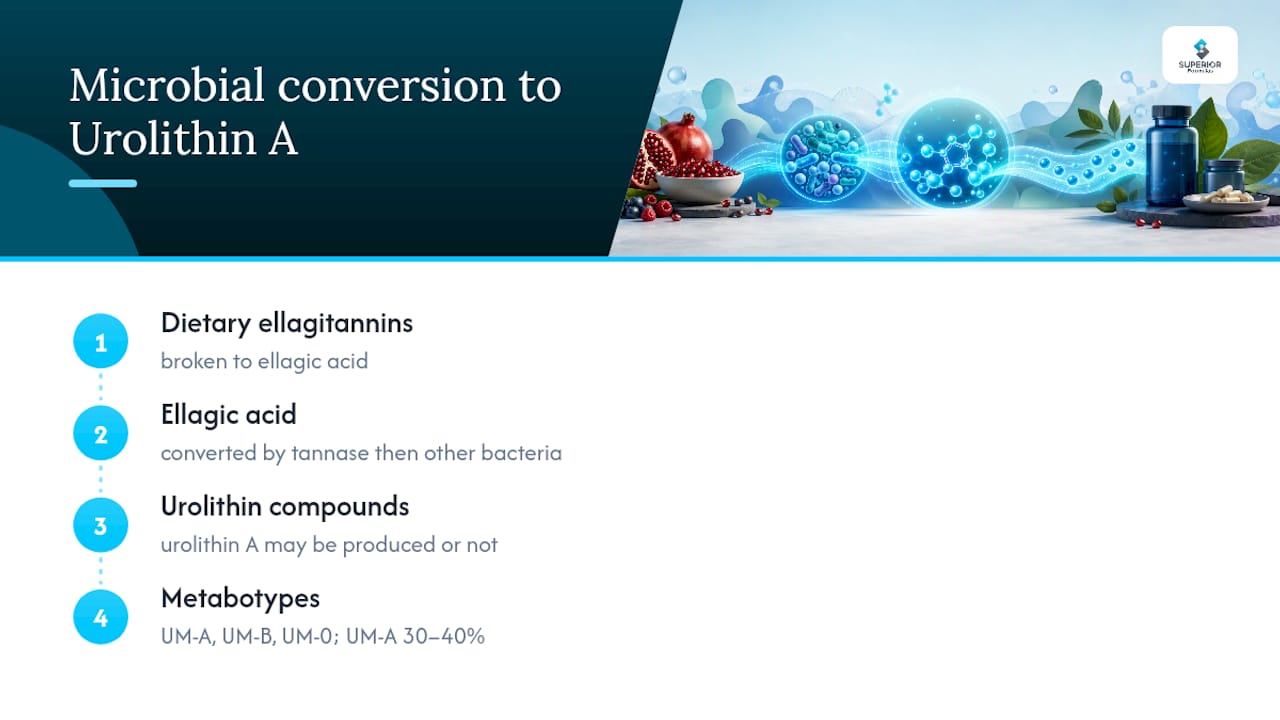
Reviews on urolithin A’s pharmacology estimate that only a minority of people fall into the efficient UM-A producer category, with producer rates commonly cited in the 30 to 40 percent range, though this varies by cohort, age, and geography. That means a meaningful share of health-conscious adults eating textbook-perfect ellagitannin-rich diets are still producing little to no urolithin A, simply because they lack the right bacterial community.
Several factors shift where you land on this spectrum. Age plays a role, since gut microbial diversity tends to decline over time, and older adults often show reduced conversion capacity compared to younger cohorts. Recent or repeated antibiotic use can wipe out the specific bacterial populations responsible for both conversion steps, sometimes for months. Baseline gut diversity matters too. A microbiome that’s already diverse and resilient tends to include the niche bacteria needed for this specific pathway, while a low-diversity gut, common with chronic low-fiber diets, often lacks them entirely.
This variability explains a pattern that puzzles a lot of people reading nutrition research: two people can eat identical pomegranate servings and show completely different urinary urolithin A levels afterward. It’s not a measurement error. It’s a direct consequence of who’s hosting the right bacteria and who isn’t. That single fact is also the reason dietary intervention trials show such inconsistent results, and it’s the biological rationale behind microbiome-targeted approaches and direct supplementation, both of which sidestep the conversion bottleneck in different ways.
Diet vs. Synbiotics vs. Direct Supplementation: What the Trials Show
The clinical evidence on urolithin A splits into three distinct approaches, and they are not remotely equal in reliability.
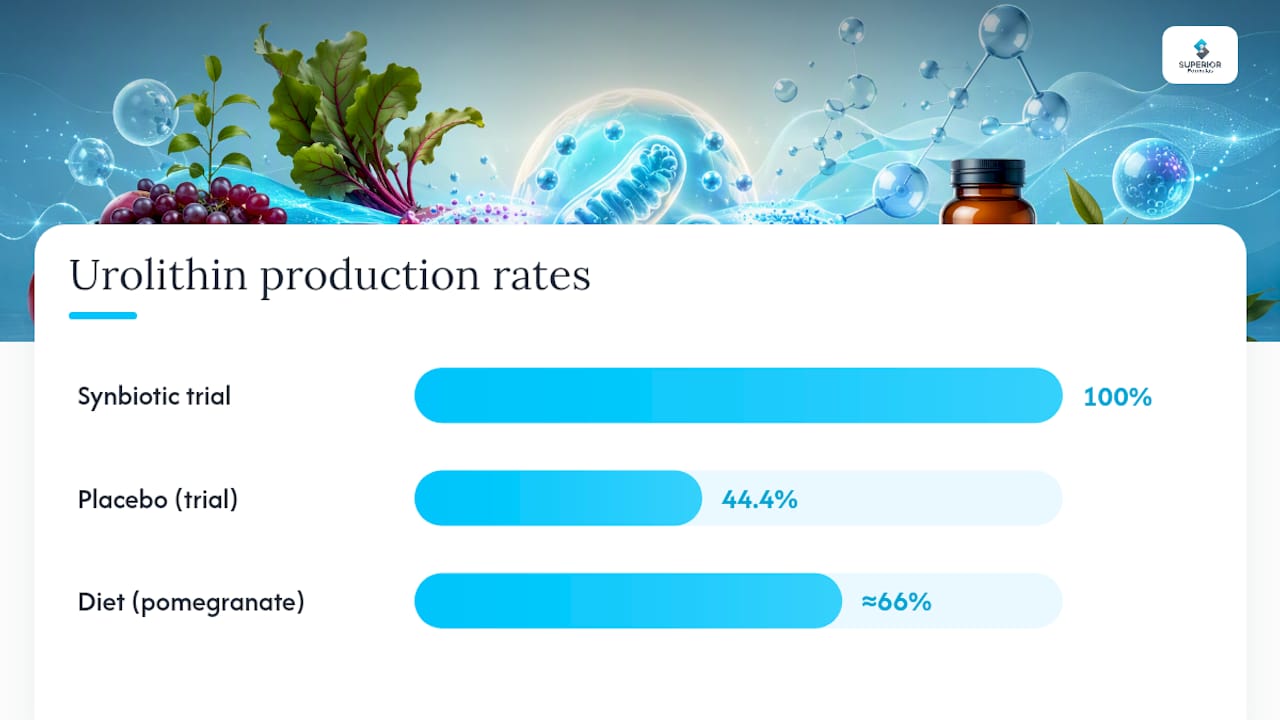
Dietary interventions show the most inconsistent results of the three. Some trials measuring urolithin outcomes after pomegranate juice intake found that a majority of participants, roughly two-thirds in one commonly cited study, showed detectable urolithin conversion within 24 hours, but conversion was frequently partial and varied widely in magnitude across individuals. Other cohorts show lower conversion rates. The pattern holds across pomegranate and berry-based interventions alike: some people respond well, some respond weakly, and a meaningful subset don’t respond at all, consistent with the metabotype variability described above.
Synbiotic supplementation performed dramatically better in the strongest trial available. A randomized, placebo-controlled study tested a multi-species synbiotic combining 53.6 billion AFU of probiotic strains with 400 mg of Indian pomegranate extract over 91 days.
By Day 91, 100% of participants in the synbiotic arm had become urolithin A producers, compared to 44.4% in the placebo group — and urinary urolithin A had risen 49-fold from baseline, with a 12-fold increase already visible at Day 7.
The same trial also found meaningful increases in fecal butyrate, a short-chain fatty acid linked to gut barrier health, and a measurable reduction in serum CRP, a marker of systemic inflammation. This design worked because it paired probiotic strains with a polyphenol prebiotic in the same formula, effectively building the ecological niche that Gordonibacter-type bacteria need to thrive. Notably, probiotic supplementation alone rarely produces this effect. Without the polyphenol substrate to ferment, added bacterial strains often don’t establish themselves well enough to shift urolithin production.
Direct urolithin A supplementation sidesteps the entire conversion question. Because the compound is administered directly rather than produced through fermentation, trials report consistent, predictable increases in blood urolithin A regardless of a participant’s metabotype. Human trials have linked direct supplementation to measurable improvements in mitochondrial biomarkers and muscle-related endpoints, an effect researchers attribute to urolithin A’s role in promoting mitophagy, the cellular process that clears out damaged mitochondria and supports the growth of healthier ones.
Lined up side by side, the three approaches differ on reliability, timeline, and what they actually measure:
- Diet alone: Unreliable across individuals; effects depend entirely on metabotype; onset ranges from hours to inconsistent non-response.
- Synbiotic supplementation: High reliability in the one strong randomized trial available; onset visible within a week, full conversion by around three months; secondary benefits to inflammation and gut metabolites.
- Direct urolithin A supplementation: Most consistent option regardless of individual microbiome; onset is immediate at the blood level since no bacterial conversion step is required; strongest evidence for mitochondrial and muscle biomarker changes.
If your goal is measurable, dependable urolithin A exposure, that ranking runs from direct supplementation as the most reliable, synbiotics as a strong second option with added microbiome benefits, and diet alone as the least predictable, though still a reasonable foundation for general polyphenol intake.
Building a Weekly Diet Around Urolithin A Precursors
Turning the food list into a habit is where most people stall out, so here’s a workable weekly structure rather than an abstract nutrient target from From Within’s supplement collection.
- Pomegranate arils or juice, three to five times per week. A half cup of arils or four ounces of unsweetened juice counts as a solid serving. Toss arils into a salad or yogurt bowl rather than eating pomegranate as a standalone snack, since it’s easier to sustain as a habit that way.
- Mixed berries, most days of the week. A cup of raspberries or blackberries, fresh or frozen, works equally well nutritionally. Frozen berries actually hold their polyphenol content reasonably well and solve the spoilage problem fresh berries create.
- Walnuts, daily if possible. A small handful, roughly one ounce, added to oatmeal, salads, or eaten plain covers a daily baseline. Buy raw or dry-roasted walnuts rather than heavily processed candied versions, which dilute the nutritional value with added sugar.
- Rotate in almonds, pecans, and strawberries as variety pieces rather than primary sources, since they contribute smaller but still additive ellagitannin amounts.
On portions, don’t overthink precision here. A half cup of pomegranate arils, a cup of berries, and an ounce of walnuts are realistic, sustainable serving sizes that fit into normal meals rather than requiring a dedicated supplement-style ritual. Frozen berries, pre-packaged nut mixes, and shelf-stable pomegranate juice solve the convenience problem for anyone who doesn’t want to shop for fresh produce multiple times a week.
Pairing matters more than people expect. Eating these precursor foods alongside fiber-rich foods and a diverse range of plants supports the broader gut environment those conversion bacteria need to function. A pomegranate-and-walnut oatmeal bowl with a scoop of ground flaxseed does more for your microbiome than pomegranate juice consumed alone. Watch out for juice products marketed as “pomegranate blends,” which often dilute the actual pomegranate content with apple or grape juice and add sugar without adding precursor value.
Pro Tip: If you want more precision than whole foods can offer, look for ellagitannin-standardized extracts that list a specific milligram dose per serving on the label, rather than proprietary blends that hide the actual precursor content behind a single “polyphenol complex” number.
For a broader look at polyphenol-rich foods that support healthy aging beyond just urolithin A precursors, this breakdown of top science-backed polyphenols covers additional compounds worth adding to a longevity-focused diet.
Can You Train Your Microbiome to Produce More Urolithin A?
The strongest evidence for shifting your gut toward urolithin A production comes from the same multi-species synbiotic trial referenced earlier. Over 91 days, the intervention increased overall microbial diversity, drove urinary urolithin A up 49-fold, converted the entire treatment group into producers by the study’s end, and lowered inflammatory markers alongside a rise in fecal butyrate. That combination of outcomes, diversity, conversion, and inflammation, is what makes this trial the clearest signal available that microbiome composition can be deliberately shifted toward better urolithin A output.
What hasn’t worked nearly as well is probiotics used in isolation. Adding bacterial strains without a matching polyphenol substrate tends to produce weak or short-lived changes, because the introduced bacteria have nothing to ferment and no ecological advantage to establish themselves. The synbiotic approach works precisely because it feeds the bacteria it’s trying to introduce, giving Gordonibacter-type organisms the substrate they need to compete and persist in the gut environment.
Outside of formal synbiotic products, general microbiome-supportive habits still matter. A high-fiber diet with a wide variety of plant foods, avoiding antibiotics unless medically necessary, adequate sleep, and regular exercise all support the kind of diverse, resilient gut environment where beneficial bacteria, including ellagitannin-converting species, are more likely to thrive.
It’s worth being honest about the limits here too. The synbiotic evidence comes from a single strong randomized trial, not a body of replicated studies across different populations and formulations. Strain-specific data on exactly which bacterial combinations work best is still thin, and larger trials are needed before synbiotic protocols can be considered a fully established strategy rather than a promising early result.
Diet, Microbiome Support, or Supplement: How to Decide
For general health and low-risk goals, food-first makes sense: pomegranate, berries, and walnuts support broader polyphenol intake regardless of your metabotype. But if you’re specifically targeting mitochondrial or muscle outcomes, particularly past your mid-thirties when natural muscle maintenance becomes harder, relying on conversion you can’t control is a gamble. Prior antibiotic use, older age, or a documented low-diversity gut all tip the decision toward supplementation, since these factors predict poor conversion regardless of diet quality. When consistent exposure is the actual goal, not just healthy eating, supplementation removes the guesswork entirely. Talk to a clinician about your specific situation before making changes.
— cristopher
How Superiorformulas Approaches Urolithin A Support
Diet gives you precursors. It doesn’t guarantee conversion, and that gap is exactly why Superiorformulas built its approach around direct urolithin A supplementation rather than hoping your microbiome cooperates. Because the compound bypasses the two-step bacterial pathway entirely, you get consistent exposure regardless of whether you’re a UM-A producer or fall into the UM-0 category that never converts ellagitannins at all.
Superiorformulas formulates its products under physician-scientist oversight, manufactures in GMP-certified facilities, and verifies every batch through third-party testing, the same rigor you’d expect from a clinical research team rather than a typical supplement label. If you want the trial-level detail behind dosing decisions, this breakdown of urolithin A dosing evidence walks through what human studies actually measured. For a fuller look at the clinical rationale behind the formulation, visit Explore the Science to see the research Superiorformulas built its urolithin A product on, and decide whether direct supplementation fits your goals better than betting on conversion.
Sources
- Pharmacological Effects of Urolithin A and Its Role in Muscle Health and Performance: Current Knowledge and Prospects
- Impact of the Natural Compound Urolithin A on Health, Disease, and Aging
This article is general information, not a substitute for advice from a qualified doctor. Consult a qualified healthcare professional about your own circumstances before acting on anything here.


