


Yes, eating a variety of polyphenol-rich plant foods supports heart and metabolic health, and the biggest wins come from a handful of accessible groups: spices and dried herbs, berries, cocoa and dark chocolate, tea and coffee, extra virgin olive oil, legumes, nuts, and colorful vegetables. Rather than hunting for the single highest concentration per gram, prioritize what you actually eat in normal servings, and rotate widely across categories instead of leaning on one “miracle” food.
TL;DR:
- Consuming typical servings of berries, legumes, and dark chocolate provides meaningful polyphenol intake, while highly concentrated sources like cloves are less relevant practically.
- Including diverse polyphenol-rich foods in everyday meals enhances absorption, especially when paired with fats or eaten in minimally processed forms.
- Cooking, fermentation, and the food matrix significantly influence how well your body absorbs polyphenols, making variety and processing methods important.
- Large intakes from supplements are generally unnecessary and should be approached with caution, emphasizing whole foods first, especially for those on medication or with health concerns.
- Adopting simple swaps like adding berries to breakfast or using olive oil as default fat can significantly increase daily polyphenol intake over time.
Table of Contents
- What Are Polyphenols and What Do They Do for Your Health?
- Which Foods Have the Most Polyphenols?
- How Do You Add More Polyphenols to Your Daily Meals?
- Does Cooking or Processing Change How Well Your Body Absorbs Polyphenols?
- Are There Any Risks to Eating a Lot of Polyphenol-Rich Foods?
- When Do Polyphenol Supplements Actually Make Sense?
- The One Habit That Actually Moves the Needle
- A Simple Next Step When Food Alone Isn’t Enough
- Sources
What Are Polyphenols and What Do They Do for Your Health?
Polyphenols are plant compounds responsible for much of the color, bitterness, and astringency in fruits, vegetables, spices, and beverages. Researchers have identified more than 8,000 distinct polyphenols, grouped into four main families:
- Flavonoids — the largest group, found in berries, tea, onions, and citrus
- Phenolic acids — abundant in coffee, whole grains, and many vegetables
- Stilbenes — best known from resveratrol in red wine and grapes
- Lignans — concentrated in flaxseed, sesame seeds, and whole grains
The strongest human evidence doesn’t come from isolated compounds. It comes from whole dietary patterns. Clinical research on Mediterranean-style eating, built around olive oil, legumes, fruit, vegetables, and moderate wine, shows modest but consistent improvements in cardiometabolic markers like blood pressure and insulin sensitivity. That distinction matters more than most headlines suggest: a diet rich in polyphenols works because of the combination and consistency of foods, not because any one ingredient delivers a knockout dose.
Which Foods Have the Most Polyphenols?
Some foods are polyphenol powerhouses gram for gram. Others earn their place because you eat enough of them to matter. Both deserve a spot in your kitchen.
Spices and dried herbs top the charts by weight. Cloves, dried oregano, and dried peppermint carry extraordinary concentrations, though you use only a pinch at a time. Cocoa and dark chocolate (70% cacao or higher) bring flavonoids in a form people actually enjoy eating regularly. Berries, especially wild blueberries, blackberries, and black chokeberries, combine solid concentration with servings large enough to count. Non-berry fruits like plums, cherries, and apples (skin on) add variety and fiber. Beans and legumes, including black beans and lentils, quietly contribute meaningful polyphenol totals across a week of meals. Nuts and seeds, particularly chestnuts, walnuts, and flaxseed, pair polyphenols with healthy fats. Vegetables like artichokes, red onion, and spinach round things out. Tea, coffee, and olive oil deliver polyphenols in liquid form, often multiple times a day.
The gap between concentration and real-world contribution is the detail most food lists gloss over. A Phenol-Explorer database analysis found cloves pack roughly 15,000 mg of polyphenols per 100 grams, dwarfing almost anything else measured. But nobody eats 100 grams of cloves. Wild blueberries, by contrast, provide about 1,237 mg per typical serving, and chestnuts around 1,215 mg per serving, both numbers people can realistically hit on a given day.
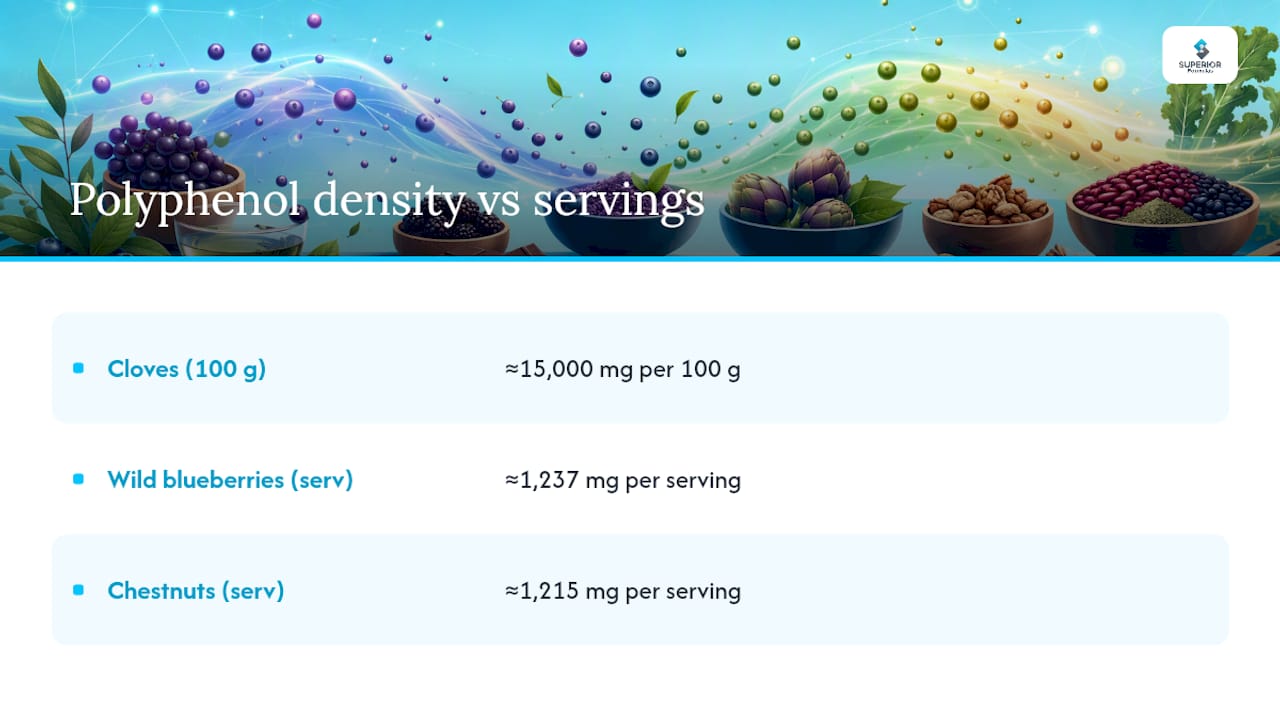
Reading this table correctly means separating two questions: which food is densest, and which food actually shows up in your daily intake. Cloves win the density contest and lose the relevance contest. A cup of black tea, sipped once or twice a day, adds up in a way a spice jar never will. That’s the practical logic behind choosing best foods for polyphenols based on your actual eating pattern, not a spreadsheet of per-gram maximums.
How Do You Add More Polyphenols to Your Daily Meals?
You don’t need to overhaul your diet. Small, repeatable swaps compound over weeks.
- Start breakfast with berries. Frozen wild blueberries or blackberries stirred into oatmeal or yogurt work as well as fresh.
- Cook beans into lunch or dinner twice a week. Black beans in a grain bowl or lentils in soup add fiber alongside polyphenols.
- Use extra virgin olive oil as your default fat. Drizzle it on vegetables, salads, and finished dishes rather than reaching for butter.
- Add one dried herb or spice to two dinners a week. Oregano on roasted vegetables or cinnamon in coffee counts.
- Brew loose-leaf tea instead of grabbing a sugary drink to enjoy herbal teas with real health benefits. Green or black tea, unsweetened, is an easy daily habit.
- Keep skins and edible seeds on produce. Apple skin, grape skin, and berry seeds concentrate polyphenols that peeling removes.
- Choose dark chocolate with minimal added sugar. Look for 70% cacao or higher on the label.
Pro Tip: Buy frozen fruit in bulk during off-season months. Produce flash-frozen at peak ripeness often holds onto its phytochemical content better than fresh fruit that traveled and sat for a week before landing in your cart.
Does Cooking or Processing Change How Well Your Body Absorbs Polyphenols?
A high polyphenol number on a label doesn’t guarantee your body uses all of it. Absorption varies dramatically by compound class, and several factors decide how much actually reaches your bloodstream in an active form.
- Food matrix matters. Polyphenols bound to fiber in whole fruit behave differently than the same compound isolated in a supplement.
- Cooking and processing shift availability. Some methods break down cell walls and release more polyphenols; others degrade heat-sensitive compounds.
- Fermentation can help. Fermented foods sometimes convert polyphenols into more absorbable forms.
- Your gut microbiome does real work here. Certain polyphenols require microbial conversion before your body can use them, meaning two people eating identical meals may absorb different amounts.
- Pairing with fat can improve absorption of certain fat-soluble polyphenol compounds.
The practical takeaway: eat polyphenols in varied forms, fresh, frozen, and occasionally fermented, and don’t assume the highest mg figure on a chart automatically means the biggest benefit in your body.
Are There Any Risks to Eating a Lot of Polyphenol-Rich Foods?
Whole-food polyphenol sources are safe for most people, but a few interactions are worth knowing.
- Tea and coffee can reduce non-heme iron absorption, so space them away from iron-rich meals if you’re iron-deficient or anemic.
- People on anticoagulants or with complex medication regimens should be cautious about large, sudden shifts in polyphenol intake, particularly from concentrated sources.
- High-dose concentrated extracts and supplements carry more risk than food does, including possible interactions with medications, and deserve extra caution during pregnancy, while breastfeeding, or before surgery.
- If caffeine sensitivity or reflux is an issue, moderate tea and coffee intake rather than cutting polyphenols entirely, since plenty of other sources exist.
When Do Polyphenol Supplements Actually Make Sense?
Whole foods should always come first. They deliver polyphenols alongside fiber, vitamins, and minerals in ratios your body recognizes, and the clinical evidence for benefit is strongest for dietary patterns, not isolated pills. Supplements become reasonable adjuncts when diet is genuinely limited, whether from access, appetite, or medical restrictions, or when a clinician recommends targeted support.
Superiorformulas builds its formulations around that same principle. Its supplements are physician-formulated, manufactured in GMP-certified facilities, and third-party tested for purity, with a focus on clinically studied polyphenol compounds rather than proprietary blends of unclear dosage. If you’re evaluating any polyphenol supplement, look for the same markers:
- Named, dosed ingredients rather than vague “polyphenol complex” labels
- Third-party testing for purity and potency
- Manufacturing under GMP standards
- A clear reason to supplement, ideally discussed with a clinician if you take other medications
The One Habit That Actually Moves the Needle
Chasing the single highest-polyphenol food is a waste of energy. Pick one new source this week, whether that’s swapping your afternoon soda for green tea or adding lentils to a soup, and let variety do the rest of the work over time.
Try this for seven days: add berries to two meals, cook with extra virgin olive oil at two meals, and stir one new spice into two dinners. That’s it. No tracking mg totals required.
— cristopher
A Simple Next Step When Food Alone Isn’t Enough
Whole foods remain the foundation, but travel, appetite changes, or a clinician-set target sometimes make it hard to hit consistent polyphenol intake through diet alone. That’s where a physician-formulated supplement earns its place, as a backup, not a replacement.
Superiorformulas designs its polyphenol formulations around dosed, clinically studied compounds rather than vague plant blends, manufactured in GMP-certified facilities and third-party tested for purity. If your diet has gaps you can’t consistently close with food, or your clinician has recommended targeted antioxidant support, explore the longevity-focused polyphenol formulations Superiorformulas offers and see which one fits your specific health goals.
This article is general information, not a substitute for advice from a qualified doctor. Consult a qualified healthcare professional about your own circumstances before acting on anything here.
Sources
- Identification of the 100 richest dietary sources of polyphenols: An application of the Phenol-Explorer database
- Clinical studies linking polyphenol-rich dietary patterns to cardiometabolic markers
- Review: dietary polyphenols and health (variety and practical guidance)


