


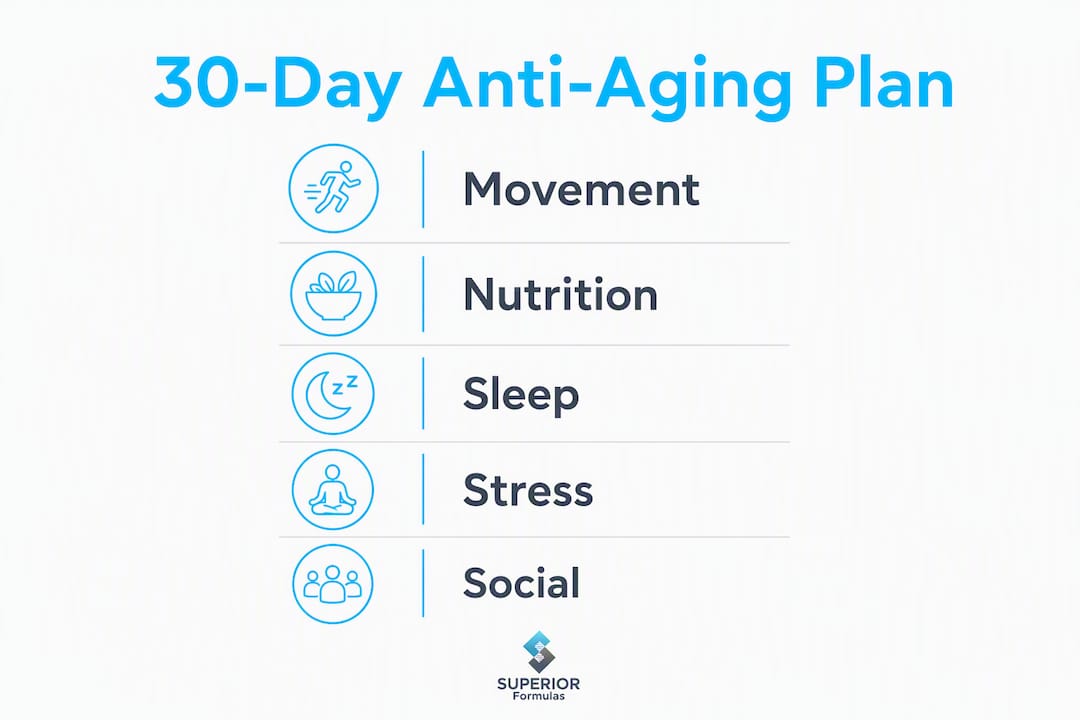
The five evidence-backed habits that slow biological aging are resistance training combined with daily movement, Mediterranean-style nutrition with adequate protein, consistent sleep of recommended duration, physical stress reduction (movement and time in nature), and regular social connection. You can start all five today. Right now: take a 10-minute walk, then text a friend to schedule dinner this week.
- Move daily + resistance train twice weekly. The U.S. DHHS 2018 guidelines recommend weekly moderate aerobic activity together with muscle-strengthening activities at least twice weekly.
- Eat Mediterranean-style, prioritize protein. Target protein intake in the range recommended for midlife adults, per Harvard Health guidance.
- Sleep the recommended amount on a fixed schedule. Deep sleep drives glymphatic clearance of metabolic waste linked to cognitive decline.
- Reduce stress physically. Movement and nature walks lower inflammation more reliably than mental techniques alone.
- Stay socially connected. Social isolation raises the risk of premature death by roughly 30% — a magnitude comparable to smoking 15 cigarettes per day.
Table of Contents
- Why do lifestyle habits actually slow biological aging?
- What are the five core anti-aging pillars, and where do you start?
- How do you build a realistic 30-day starter plan?
- What safety checks should you do before starting?
- How do supplements fit into an anti-aging plan?
- Which metrics and tools actually help you track progress?
- Key Takeaways
- Why an integrated lifestyle-first approach is the only honest starting point
- Superiorformulas: clinician-formulated support for your anti-aging plan
- Useful sources and further reading
Why do lifestyle habits actually slow biological aging?
Lifestyle changes measurably reduce inflammation, preserve muscle mass, improve cardiometabolic health, and support the brain’s overnight waste-clearance system. These are not minor benefits. Harvard Health’s five-pillar framework identifies movement, nutrition, sleep, stress reduction, and social connection as the habits with the highest population-level impact on healthy life expectancy.
Social isolation raises the risk of premature death by roughly 30% — a magnitude comparable to smoking 15 cigarettes per day. That single statistic reframes “staying connected” from a soft lifestyle preference into a clinical priority.
Starting in your 30s or 40s gives you the longest preventive runway. But longevity experts confirm that meaningful improvements in independence, cognitive function, and quality of life are achievable even when you begin in your 60s or 70s. The biology responds at any age. For a deeper look at proven habits after 35, Superiorformulas has compiled the most practical starting points.
What are the five core anti-aging pillars, and where do you start?
Each pillar below opens with a single-sentence claim and one micro-habit you can execute today.
Movement
Resistance training twice weekly, combined with 150 minutes of moderate aerobic activity, preserves muscle, bone density, and cardiometabolic health. Chair squats, wall push-ups, and resistance bands all count. First action: a 10–15 minute bodyweight routine immediately after your morning coffee.
Nutrition
A Mediterranean-style diet centered on plants, whole grains, healthy fats, and lean protein reduces chronic disease risk and supports metabolic health. Aim for 20–30 g of protein per meal. First action: add Greek yogurt, eggs, or cottage cheese to breakfast today.
Sleep
Seven to eight hours on a consistent wake time supports glymphatic clearance and reduces dementia risk. Irregular sleep schedules undermine even adequate total duration. First action: set a fixed wake alarm and cut screens 30 minutes before bed tonight.

Stress reduction
Physical interventions — movement, sleep, and time in nature — lower inflammation and protect telomeres more effectively than cognitive relaxation techniques alone. First action: a 20-minute nature walk or 10 minutes of light movement the next time stress spikes.
Social connection
Recurring, low-pressure social contact is one of the most protective actions for long-term brain and emotional health. First action: schedule one brief weekly check-in with a friend or family member, starting this week.
Pro Tip: Link each new habit to something you already do — this is habit stacking. Bodyweight squats after brushing teeth, a protein-rich breakfast right after your morning coffee, a nature walk at the same time you’d normally scroll your phone. Consistency built on existing routines outlasts motivation every time.
How do you build a realistic 30-day starter plan?
You can adopt high-impact habits by focusing on micro-changes across 30 days, adding one layer per week rather than overhauling everything at once.
- Week 1 — Base movement + protein focus. Walk 20–30 minutes daily. Add a protein source (20–30 g) to every meal. Track steps with a phone or wearable.
- Week 2 — Add resistance training. Two bodyweight or band sessions per week. Keep the daily walk. Maintain protein targets.
- Week 3 — Optimize sleep. Fix your wake time. Start a 30-minute screen-free wind-down. Note sleep duration in a simple log.
- Week 4 — Social and nature commitments. Schedule one recurring social contact. Add a weekly 20-minute outdoor walk. Review your tracker and set Month 2 targets.
Flexible backup habits prevent derailment: a 10-minute home workout replaces a missed gym session; a protein bar covers a skipped meal. Expect early mood and energy improvements within the first two to three weeks. Measurable strength and cardiometabolic changes typically emerge over two to four months.
| Day | Movement | Protein at Breakfast | Sleep Log | Nature/Stress | Social Check-in |
|---|---|---|---|---|---|
| 1–7 | Daily walk | Yes / No | Hours | Yes / No | Scheduled? |
| 8 | Walk + 2x resistance | Yes / No | Hours | Yes / No | Done? |
| 15 | Walk + 2x resistance | Yes / No | Hours + wake time | Yes / No | Done? |
| 20–30 | Walk + 2x resistance | Yes / No | Hours + wake time | Weekly outdoor walk | Weekly contact |
What safety checks should you do before starting?
Do basic safety checks before major exercise changes or restrictive diets, and consult a clinician when any of the following apply.
- Baseline checks for adults 30+: blood pressure, fasting glucose or A1C if you have risk factors, a lipid panel, vitamin D when indicated, and a medication review for exercise or drug interactions.
- Seek care before starting if you have: unexplained weight loss, new chest pain, syncope, significant shortness of breath, or signs of depression affecting daily functioning.
- Cardiac risk: get exercise clearance from your physician and scale intensity gradually, especially if you take medications that affect heart rate or blood pressure.
- Screenings: the U.S. Preventive Services Task Force recommends age-appropriate screenings; annual physicals with your primary care provider remain the foundation for tracking personal health risks.
For clinician-oriented screening checklists, Superiorformulas’s 2026 clinical longevity guide provides practitioner-level context.
This article is general health information, not medical advice. Confirm current guidelines and your personal situation with a qualified clinician.
How do supplements fit into an anti-aging plan?
Supplements support nutrition and cellular pathways, but they are adjuncts to core lifestyle changes, not replacements for them. Once your foundational habits are established, targeted formulations can help fill specific gaps: antioxidant support, mitochondrial energy pathways, and nutrient repletion for deficiencies common in midlife adults (vitamin D, magnesium, omega-3s).
Quality checklist before buying any supplement:
- Manufactured in a GMP-certified facility
- Third-party tested for purity and potency
- Transparent ingredient labeling with clinically studied doses
- Formulated or reviewed by a clinician
- No proprietary blends that obscure individual ingredient amounts
Questions to ask your clinician first:
- Does this interact with any medication I currently take?
- Do I have a documented deficiency this would address?
- Is this safe given my liver, kidney, or thyroid status?
For a deeper look at how to evaluate supplement quality, Superiorformulas’s guide on research-backed supplements for longevity walks through the evidence by category.
| Supplement Goal | Common Adjuncts | Evidence Level |
|---|---|---|
| Antioxidant support | Polyphenols, resveratrol, quercetin | Moderate (cellular studies) |
| Mitochondrial support | CoQ10, NAD+ precursors | Moderate (clinical trials ongoing) |
| Nutrient repletion | Vitamin D, magnesium, omega-3s | Strong for deficiency correction |
| Cellular resilience | Nrf2-activating phytonutrients | Emerging (preclinical + early clinical) |
Which metrics and tools actually help you track progress?
Tracking turns abstract goals into measurable behavior and increases long-term adherence. The key is tracking what you can act on, not every data point your wearable can generate.
| Metric | Why It Matters | Low-Tech Option |
|---|---|---|
| Daily steps / movement minutes | Confirms activity baseline | Phone pedometer or tally |
| Weekly resistance sessions | Tracks muscle-preservation habit | Calendar checkmark |
| Nightly sleep duration | Flags chronic shortfall | Notes app or sleep diary |
| Protein intake frequency | Monitors muscle-support nutrition | Meal log (3 meals/day) |
| Mood / stress rating (1–5) | Correlates lifestyle changes with wellbeing | Paper journal |
Wearables like the Oura Ring or a Fitbit make sleep stages and activity data tangible, which improves habit persistence. A paper habit tracker on the refrigerator works just as well for people who prefer low-friction options. The rule: track three to five metrics consistently rather than ten metrics sporadically.
- Prioritize sleep duration and resistance session frequency above all others in Month 1.
- Add protein tracking in Month 2 once movement is automatic.
- Review weekly, not daily, to avoid over-monitoring anxiety.
Key Takeaways
Starting anti-aging habits requires five evidence-backed pillars — movement, nutrition, sleep, stress reduction, and social connection — applied consistently through micro-habits, a 30-day progressive plan, and clinician-grade safety checks before major changes.
| Point | Details |
|---|---|
| Start with movement | 150 min moderate activity + 2x resistance weekly; begin with a 10-min walk today. |
| Prioritize protein | Target 1.0–1.2 g/kg daily; add 20–30 g to breakfast as the first step. |
| Fix your sleep schedule | Consistent wake time and a 30-min screen-free wind-down drive the biggest gains. |
| Use physical stress relief | Movement and nature walks reduce inflammation more reliably than mental techniques alone. |
| Superiorformulas as adjunct support | Physician-formulated, GMP-certified, third-party tested supplements fill specific gaps after core habits are established. |
Why an integrated lifestyle-first approach is the only honest starting point
The supplement industry has a credibility problem, and it is worth naming directly. Too many products are marketed as shortcuts to outcomes that only consistent lifestyle habits can produce. The evidence is unambiguous: no supplement replaces the cardiometabolic and neuroprotective effects of regular movement, adequate protein, quality sleep, and genuine social connection.
What supplements can do, when formulated with clinical rigor, is address specific cellular and nutritional gaps that lifestyle alone may not fully close — particularly Nrf2 pathway activation, mitochondrial support, and targeted nutrient repletion. Superiorformulas was built on exactly that premise: physician-formulated, GMP-manufactured, third-party tested formulations designed as precision adjuncts, not magic bullets. The brand’s commitment to ingredient transparency and clean formulations reflects what the evidence actually supports, not what sells best.
The most important thing you can do today is start the habits. Add clinically sound supplementation once the foundation is real.
Superiorformulas: clinician-formulated support for your anti-aging plan
Once your core habits are in place, clinically formulated supplements can help address the gaps that diet and exercise alone may not fully cover.
Superiorformulas offers physician-formulated, GMP-certified, third-party tested supplements targeting longevity, cellular health, and antioxidant support — built on the same evidence-first principles this article applies to lifestyle habits. Every formulation uses clinically studied polyphenols, adaptogens, and phytonutrients at transparent doses, with no unnecessary fillers.
- Look for: clinician formulation, third-party purity testing, and clear ingredient labeling
- Consult your physician first if you take medications or have a chronic condition
- Use supplements to complement your 30-day plan, not replace it
Visit Superiorformulas to review the full product line and clinician resources.
Useful sources and further reading
- National Institute on Aging — What Do We Know About Healthy Aging? Covers the full spectrum of modifiable lifestyle factors, including physical activity, diet, sleep, and mental health, with NIA-supported research summaries.
- Stanford Medicine — Five healthy habits for longevity in your 40s and 50s Clinician-sourced guidance on movement, nutrition, sleep, and social connection; source for the 30% social isolation mortality finding and U.S. DHHS activity guidelines.
- Harvard Health — The 5 pillars of longevity Authoritative framework for the five core habits; source for habit-stacking and consistency evidence.
- Harvard Health — Pathways to Longevity Protein guidance (1.0–1.2 g/kg/day) and Mediterranean diet evidence for midlife adults.
- Prevention — Secrets to Healthy Aging, According to Longevity Experts UCSF and longevity researcher perspectives on physical stress interventions and telomere protection.
- Today.com — Longevity tip: best age to start healthy-aging habits Expert commentary on starting later in life and framing achievable short-term wins.
- AARP — 5 Daily Habits That Could Help You Live Longer Cardiologist Eric Topol’s personal protocol; source for wearable tracking and sleep-stage evidence.
- Preventive Medicine Daily — How to build habits that slow aging Behavioral guidance on flexible backup habits and derailment prevention.
- American Academy of Dermatology — 11 ways to reduce premature skin aging Board-certified dermatologist guidance on sun protection, diet, and lifestyle factors that affect skin health and premature aging.


