


Take CoQ10 with a meal that contains fat, ideally in the morning or early afternoon. That pairing solves the two biggest obstacles to getting real value from this supplement: poor absorption on an empty stomach and, for some people, a jittery feeling that interferes with sleep if taken too late.
The science behind this comes down to two numbers. CoQ10’s plasma half-life runs approximately 33 hours, and peak blood concentration after a dose typically arrives 5 to 6 hours later. Because the compound lingers in your bloodstream for so long, the exact clock hour you take it matters far less than doing it the same way, every day, with food.
Here’s what to do today:
- Pick a meal you already eat that includes some fat: eggs, avocado, olive oil, or a handful of nuts all work.
- Set a recurring reminder tied to that meal, not to a specific time.
- If your total daily dose is high, consider splitting it into two servings rather than taking it all at once.
Superiorformulas builds its formulations around exactly this kind of evidence-based practicality, which is part of why physician-formulated dosing guidance tends to emphasize meal pairing over precise timing.
Key Takeaways
Consistent daily dosing of CoQ10 with a fat-containing meal matters more for absorption and outcomes than the specific hour you take it.
| Point | Details |
|---|---|
| Pair with fat | Take CoQ10 with a meal containing eggs, avocado, olive oil, or nuts to boost absorption. |
| Time for tolerability | Morning or early afternoon works best if you’re sensitive to stimulation; otherwise, pick a consistent time. |
| Split high doses | Divide daily totals above 200 mg into two or three doses to overcome saturable gut absorption. |
| Be patient | Expect weeks for energy changes and months for longer-term outcomes to become noticeable. |
| Choose quality formulations | Superiorformulas manufactures CoQ10 in GMP-certified facilities with third-party testing to support consistent absorption. |
Table of Contents
- Why CoQ10 Timing and Meal Pairing Matter More Than the Clock
- When Is the Best Time to Take CoQ10?
- Ubiquinone vs. Ubiquinol: Which Form and Dose Fit Your Needs?
- How to Maximize CoQ10 Absorption
- CoQ10 Interactions and When to Talk to Your Doctor
- What Does the Clinical Evidence Say About CoQ10 Timing?
- How to Build a CoQ10 Routine You’ll Actually Stick To
- How a Clinician-Formulated Brand Thinks About CoQ10 Timing
- A Practical Next Step With Superiorformulas
- Frequently Asked Questions
- Sources
Why CoQ10 Timing and Meal Pairing Matter More Than the Clock
CoQ10 behaves differently in your body than a fast-acting vitamin. Its long elimination half-life means a single dose does not spike and vanish. Instead, daily dosing builds toward a steady-state level in your blood and tissues over roughly one to two weeks, and that steady baseline is what actually supports mitochondrial function and antioxidant activity.
Peak plasma concentration occurs approximately 5 to 6 hours after ingestion, according to pharmacokinetic research on Coenzyme Q10. That delayed peak explains why some people notice a subtle lift in alertness hours after their morning dose rather than immediately, and why taking it right before bed can occasionally backfire for sensitive individuals.
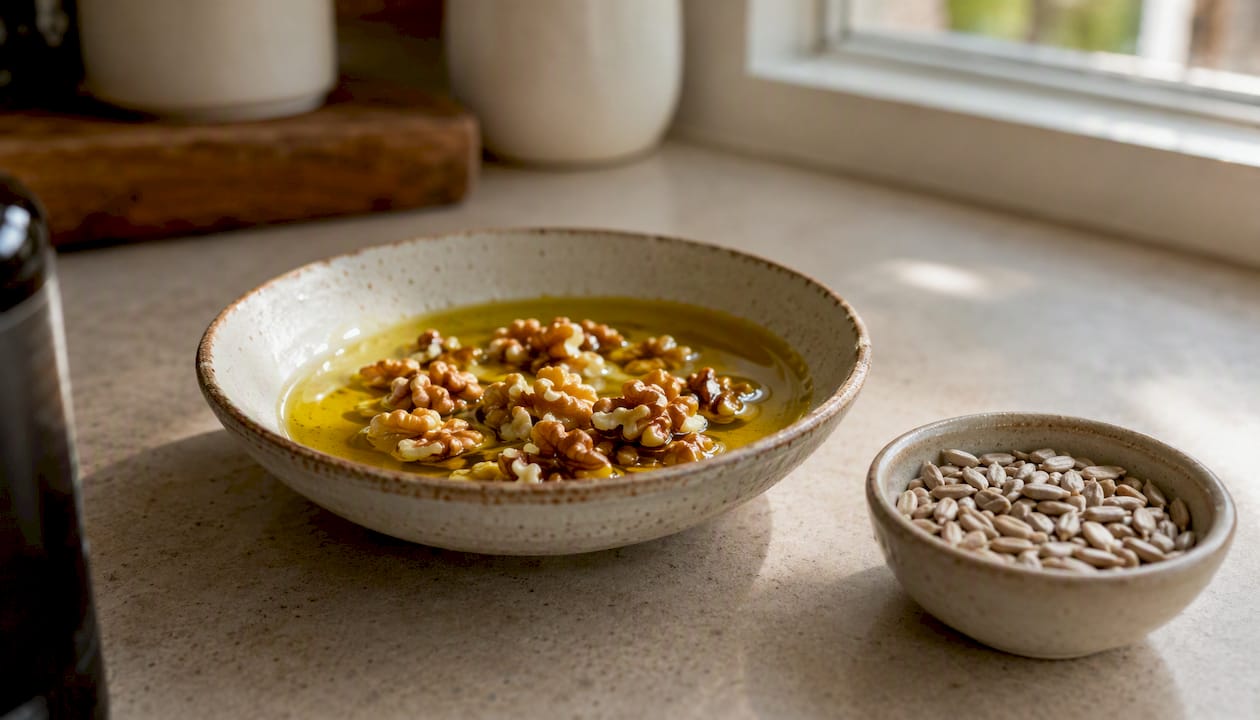
The other piece of the puzzle is chemistry, not clock-watching. CoQ10 is lipophilic, meaning it dissolves in fat rather than water. Without dietary fat present in the gut, much of an oral dose simply passes through unabsorbed. That’s why dietitians consistently point to meal pairing as the single biggest lever you control, well ahead of choosing morning versus evening.
So why does morning dosing get recommended so often? Not because it improves absorption. It comes down to tolerability. Some people report a mild energizing effect, and taking CoQ10 earlier in the day sidesteps any chance it disrupts sleep.
When Is the Best Time to Take CoQ10?
If you’re sensitive to supplements that affect energy or alertness, morning or early afternoon is the safer default. Most people never notice a stimulating effect at all, and for them, evening dosing works just as well, provided it fits into a consistent routine.
What actually moves the needle is fat content, not the hour on the clock. These meals reliably supply enough dietary fat to support absorption:
- Eggs cooked in butter or olive oil
- Avocado toast or a salad with olive oil dressing
- Full-fat Greek yogurt with nuts
- Salmon or another fatty fish
- A handful of almonds or walnuts alongside any meal
Pick whichever of these you actually eat on a normal day. A supplement paired with your largest, fattiest meal beats one scheduled for a theoretically ideal hour you keep forgetting.
Pro Tip: If you eat a light breakfast but a substantial, fat-rich lunch, take your CoQ10 with lunch instead of forcing it into a rushed morning routine. Adherence beats precision every time.
One caveat worth flagging: if you experiment with evening dosing and notice restlessness or trouble falling asleep, that’s your signal to shift it earlier. Otherwise, the exact hour is far less important than showing up for it daily.
Ubiquinone vs. Ubiquinol: Which Form and Dose Fit Your Needs?
CoQ10 supplements come in two chemical forms: ubiquinone, the oxidized form, and ubiquinol, the reduced form your cells actually use to generate energy. Your body converts ubiquinone into ubiquinol as needed, and that conversion process tends to become less efficient with age.
Older adults, and some people taking statin medications that lower natural CoQ10 production, may benefit more from ubiquinol simply because their conversion capacity is reduced. Younger, otherwise healthy adults typically absorb and convert standard ubiquinone without difficulty.
Dosage depends heavily on your goal:
| Goal | Typical Dose | Dosing Pattern |
|---|---|---|
| General maintenance | 100 to 200 mg daily | Single dose with a fat-containing meal |
| Statin-related support | 100 to 200 mg daily | Single dose or split into two |
| Migraine prevention (trial-level) | 200 mg daily or higher | Often split across two or three doses |
| Heart-failure research protocols | 200 mg daily or higher | Split into multiple doses per day |
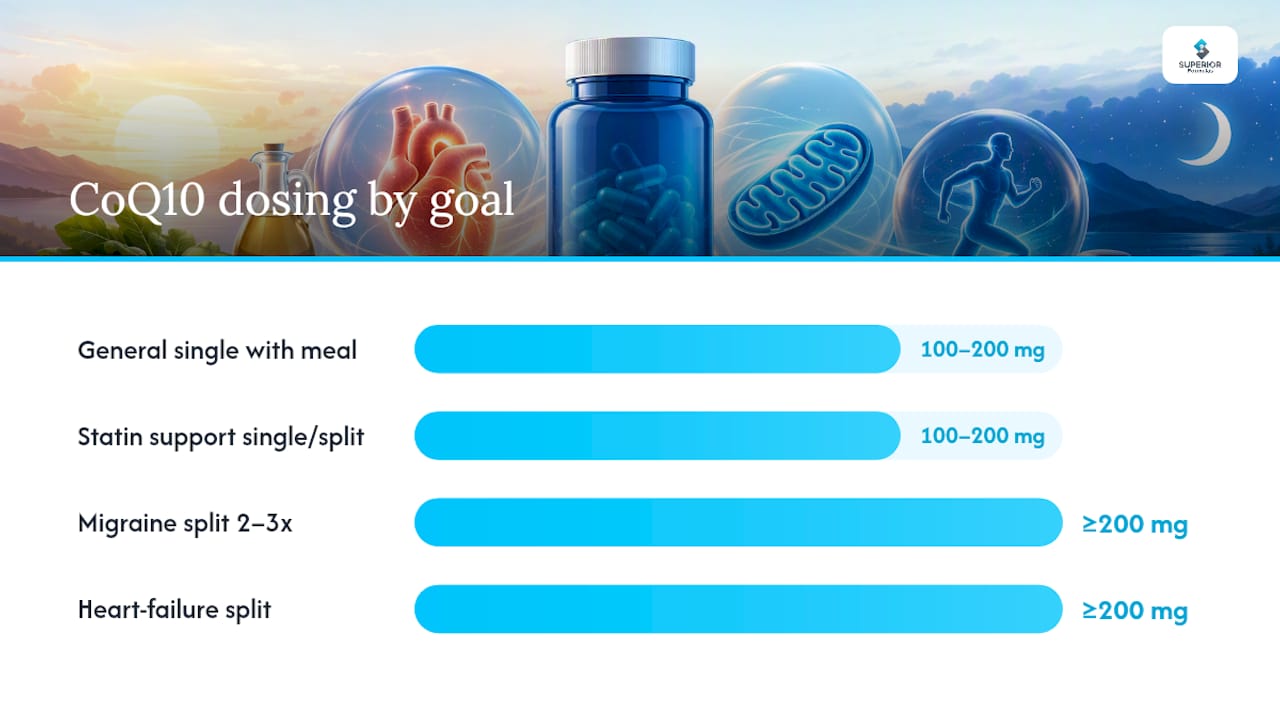
The reason for splitting higher doses isn’t arbitrary. Intestinal absorption of CoQ10 is saturable, meaning your gut can only process so much at once. Guidance on maximizing CoQ10 absorption notes that trial regimens above roughly 200 mg per day commonly split the total into two or three smaller servings, such as 100 mg three times daily, specifically to overcome that ceiling and increase total systemic uptake.
For most people using CoQ10 for general wellness, a single 100 to 200 mg dose with a meal is plenty. Trial-level dosing for specific conditions is a different conversation, one worth having with a clinician.
How to Maximize CoQ10 Absorption
Meal fat is the single biggest modifier of how much CoQ10 your body actually absorbs. Research on CoQ10 formulation and bioavailability shows that standard crystalline CoQ10 has notably low baseline absorption on its own, and that solubilized or specially processed formulations can reach higher peak concentrations, sometimes within a similar 5 to 8 hour window.
CoQ10 needs a lipid matrix to dissolve properly during digestion. What matters isn’t a large quantity of fat, just its presence. Even a tablespoon of olive oil or a small handful of nuts is enough to meaningfully improve uptake compared to taking the supplement on an empty stomach.
A few concrete habits make a real difference:
- Never take CoQ10 first thing in the morning before eating anything.
- Pair it with the meal of your day that naturally contains the most fat.
- If you’ve tried standard capsules without noticeable benefit, ask a clinician about solubilized or softgel formulations designed for better bioavailability.
- Store capsules away from heat and light, since CoQ10 can degrade over time if mishandled.
Pro Tip: If your breakfast already includes eggs, avocado, or olive oil, that’s your best absorption window. Don’t save the supplement for later in the day just because it feels more routine. Take it with the meal, not the clock.
CoQ10 Interactions and When to Talk to Your Doctor
CoQ10 is generally well tolerated, but it isn’t interaction-free, and a few situations call for a conversation with your clinician before you start or continue.
The most commonly discussed interaction involves statin medications. Statins can lower the body’s natural CoQ10 levels, and some people supplement specifically to offset statin-related muscle symptoms. That’s a legitimate reason to use CoQ10, but it should be discussed with the prescribing physician rather than assumed. CoQ10 can also interact with blood-thinning medications like warfarin, potentially reducing their effectiveness, and it may have mild blood-pressure-lowering effects worth monitoring if you’re already on antihypertensive medication.
Anyone starting a new prescription medication, especially blood thinners or blood pressure drugs, should confirm with their provider whether CoQ10 is appropriate before adding it to a daily routine. The interaction risk is generally modest, but it’s not zero, and self-managing a combination like this without medical input isn’t worth the risk.
Side effects tend to be mild when they occur at all: occasional stomach upset, nausea, or heartburn, usually resolved by taking the supplement with food rather than alone. According to the Mayo Clinic’s overview of CoQ10, serious adverse effects are rare, but safety data for pregnancy, breastfeeding, and use in children remains limited, so a clinician’s guidance matters in those cases.
Surgery is another point where CoQ10 deserves attention, since some supplements can affect bleeding risk or interact with anesthesia. Stop use before any scheduled procedure if your surgical team instructs you to.
Contact your provider before continuing CoQ10 if any of the following apply:
- You’ve started a new prescription, especially a blood thinner or blood pressure medication.
- You have surgery scheduled in the near future.
- You’re pregnant, breastfeeding, or considering supplementation for a child.
- You notice unexplained symptoms after starting or increasing your dose.
What Does the Clinical Evidence Say About CoQ10 Timing?
No high-quality clinical trial has identified a single best hour of the day to take CoQ10. That’s not a gap in the research so much as a reflection of the pharmacokinetics: with a half-life around 33 hours, daily consistency drives steady-state blood levels far more than whether you dose at 8 a.m. or 8 p.m.
Where the evidence does get specific is dosing pattern and timeline. Trials investigating migraine prevention and heart-failure outcomes have used split-dosing protocols, often two or three smaller doses across the day, and measured benefits over periods ranging from several weeks to multiple years depending on the condition studied. Statin-related symptom relief and subjective energy changes tend to surface faster, sometimes within a few weeks, while cardiovascular outcome trials were designed around much longer horizons.
| Study Focus | Dosing Pattern Used | Typical Timeline Measured |
|---|---|---|
| Statin-related muscle symptoms | Single or split daily dose | Several weeks |
| Migraine prevention | Split dosing (2 to 3 times daily) | Weeks to a few months |
| Heart-failure outcomes | Split dosing, higher totals | Months to years |
For readers who want to go deeper, a few sources are worth bookmarking: the pharmacokinetic review in PMC, the Mayo Clinic’s CoQ10 summary, and the clinical report indexed on PubMed covering trial-level outcomes across conditions.
How to Build a CoQ10 Routine You’ll Actually Stick To
Timing advice only helps if you follow it consistently, and consistency is where most supplement routines quietly fall apart. A few structural habits make adherence nearly automatic.
- Anchor your dose to a meal you already eat every day, not a time on the clock. If breakfast is inconsistent but lunch never is, build the habit around lunch.
- Keep the bottle physically near where you prepare that meal, whether that’s the coffee station or the spot where you pack lunch.
- Set a recurring phone reminder tied to the meal, not a specific hour, since your schedule shifts but your meal habits usually don’t.
- Check in with yourself at the 4 week mark for energy-related goals and the 8 to 12 week mark for anything tied to a longer-term outcome like cardiovascular support.
- If you experience stomach upset, try splitting your dose across two smaller servings or switching formulations before giving up on the supplement entirely.
- If sleep feels affected, move your dosing window earlier rather than discontinuing use altogether.
Small adjustments like these solve the vast majority of adherence problems people run into, and they cost nothing beyond a little attention during the first few weeks.
How a Clinician-Formulated Brand Thinks About CoQ10 Timing
The clinical case for meal pairing and morning-leaning dosing isn’t complicated, but it does require resisting the urge to overthink the clock. Absorption depends on fat in the gut, not the position of the sun. Tolerability, not efficacy, is the real reason morning dosing gets recommended so often, and that distinction matters when you’re deciding what works for your own routine.
Superiorformulas approaches formulation with that same evidence-first mindset. Products are manufactured in GMP-certified facilities and verified through third-party testing, which matters more than most people realize: a poorly absorbed or inconsistently dosed capsule undermines even the best timing strategy. Readers interested in how this plays out across a broader wellness plan can explore healthy aging strategies that place CoQ10 within the larger context of mitochondrial and cellular support.
Clinical practice tends to reward simplicity over complexity. Pick a fat-containing meal, take your dose with it, and let consistency do the work that precise timing can’t.
A Practical Next Step With Superiorformulas
If you’ve made it this far, you already know that timing advice only pays off when the product behind it is formulated to actually get absorbed. Superiorformulas designs its CoQ10 formulations around that exact principle, prioritizing bioavailability and manufacturing transparency over marketing claims that don’t hold up under scrutiny.
Every batch is produced in a GMP-certified facility and verified through third-party testing, so what’s on the label matches what’s in the capsule. That matters more for a fat-soluble compound like CoQ10 than almost any other supplement category, since poor formulation quality can undercut even perfect meal timing. If you’re ready to put this guidance into practice, review Superiorformulas’ supplement quality standards and explore the CoQ10 formulation built for daily consistency at Superiorformulas.
Frequently Asked Questions
Is it better to take CoQ10 in the morning or at night? Morning or early afternoon is a safer default if you’re sensitive to stimulating effects, but the science shows no meaningful absorption difference by hour. Evening works fine for most people as long as it’s paired with a fat-containing meal and taken consistently.
Does CoQ10 need to be taken with food? Yes. CoQ10 is fat-soluble, and taking it on an empty stomach significantly reduces how much your body actually absorbs. Even a small amount of dietary fat, like a few nuts or a drizzle of olive oil, improves uptake substantially.
How long does it take to notice benefits from CoQ10? Energy-related changes may appear within a few weeks, while benefits tied to statin-related symptoms or cardiovascular support are typically measured over several months in clinical research. Consistency matters more than any single dose.
Should I split my CoQ10 dose throughout the day? If your total daily dose exceeds roughly 200 mg, splitting it into two or three smaller servings improves total absorption, since intestinal uptake of CoQ10 is saturable at higher single doses.
Can CoQ10 interact with my medications? Yes, particularly statins, blood thinners, and blood pressure medications. Talk with your clinician before starting CoQ10 if you take any of these, and stop supplementation before surgery if your care team advises it.
This article is general information, not a substitute for advice from a qualified doctor. Consult a qualified healthcare professional about your own circumstances before acting on anything here.
Sources
- Clinical and pharmacokinetic review of Coenzyme Q10
- Coenzyme Q10 - Mayo Clinic
- How to Take CoQ10 for Maximum Absorption | Superpower
- The Best Time to Take CoQ10 for Maximum Absorption, According to Dietitians
Always discuss new supplements with your clinician before starting, particularly if you take prescription medications or have an upcoming procedure. This article provides general information and isn’t a substitute for personalized medical advice.


