


Fisetin is a plant flavonol that shows senolytic, antioxidant, and anti-inflammatory activity in lab and animal studies. Early human trials are promising but not yet definitive. The strongest signals point to reduced inflammatory markers, neuroprotection, and liver and metabolic support, though we recommend talking with your clinician before starting any high-dose protocol.
TL;DR:
- More than 20 human interventional trials are registered, but most remain small and short, tracking biomarkers rather than disease outcomes or mortality.
- Liposomal, micellar, and nanoparticle formulations have shown more than 20 times the bioavailability of plain fisetin in preclinical comparisons; check labels for absorption data.
- Fisetin may alter levels of drugs metabolized through CYP pathways and could raise bleeding risk with anticoagulants; consult a clinician or pharmacist before starting.
- Pregnant or breastfeeding people and those with unstable liver disease or complex medication regimens should avoid fisetin unless a clinician reviews their risks.
- A short course under clinician supervision may suit people with elevated inflammatory markers and stable medication lists; prioritize sleep, diet, exercise, and routine care.
Table of Contents
- How Fisetin Works: Senolytics, SASP, and Key Molecular Pathways
- What the Evidence Shows Now: Preclinical Consistency and Human Trials in Progress
- Potential Benefits by Body System
- Bioavailability and Formulation: Why Delivery Technology Matters
- Safety, Interactions, and Who Should Avoid Fisetin
- Practical Guidance: Choosing a Formulation and Setting Realistic Expectations
- Why We Formulate With the Evidence, Not Around It
- Where Fisetin Fits in a Longevity Plan
- Formula 3: A Physician-Formulated Senolytic Option
- FAQ
- Sources
How Fisetin Works: Senolytics, SASP, and Key Molecular Pathways
To understand why fisetin draws so much attention in longevity research, it helps to understand senescent cells. These are cells that have stopped dividing but refuse to die. Instead of disappearing quietly, they linger in tissue and secrete inflammatory compounds collectively known as the senescence-associated secretory phenotype, or SASP. Over years, this buildup contributes to chronic low-grade inflammation, a process many researchers associate with aging-related decline.
Fisetin belongs to a class of compounds called senolytics, agents studied for their ability to selectively trigger apoptosis, the body’s programmed cell death process, in senescent cells while sparing healthy ones. In preclinical models, fisetin has been shown to clear senescent cells and lower circulating SASP factors, which may help explain its broad pattern of tissue-protective effects across different organ systems.
The molecular story goes deeper than cell clearance alone. A peer-reviewed mechanistic review reports that fisetin modulates NF-κB and Nrf2 pathways, two switches that govern much of the body’s inflammatory and antioxidant response. NF-κB suppression tends to dial down the production of proinflammatory cytokines such as IL-1β and TNF-α, while Nrf2 activation ramps up the body’s internal antioxidant defenses, including enzymes that neutralize oxidative stress before it damages cells.
These pathways connect to broader cellular energy systems, including AMPK and SIRT1, both linked to how cells sense and respond to metabolic stress. The combined picture is a compound that works on several fronts at once:
- Promotes apoptosis selectively in senescent cells rather than healthy tissue.
- Suppresses NF-κB signaling, reducing proinflammatory cytokine output.
- Activates Nrf2, strengthening the cell’s internal antioxidant response.
- Supports AMPK and SIRT1 activity, pathways tied to metabolic resilience.
None of this guarantees clinical benefit in people. Mechanism-level plausibility is a strong starting point, but it is not the same as proof of outcome, which is why human trial data matters so much for interpreting fisetin’s real-world potential.
What the Evidence Shows Now: Preclinical Consistency and Human Trials in Progress
The preclinical record for fisetin is unusually consistent. Across rodent and cell-culture studies, fisetin repeatedly shows senolytic activity, organ-protective effects, and reductions in inflammatory and oxidative stress markers. That consistency is part of why fisetin moved from a research curiosity to one of the more closely watched compounds in aging science.

Human research is catching up, though it remains early-stage. Over 20 interventional clinical trials are registered investigating fisetin’s effects in humans, according to the Clinicaltrials, with several pilot studies focused on frailty, inflammation, and related biomarkers. This volume of registered research signals genuine scientific interest, even though most trials are still small and early-phase.
Two trials illustrate the kind of questions researchers are asking right now:
- NCT03430037 investigates fisetin’s effects in human subjects, contributing to the growing body of registered senolytic research.
- NCT03675724 is a pilot trial testing whether fisetin reduces inflammatory factors and frailty markers in older adults, with outcome measures that include inflammation, insulin resistance, and bone resorption markers.
These trials matter because they move beyond Petra dishes and mouse models into the messier, more individualized biology of aging humans. But limitations remain significant. Most current trials are small, short in duration, and designed to measure biomarkers rather than hard clinical outcomes like disease incidence or mortality. A 2024 to 2026 body of review literature has concluded that while fisetin reliably reduces senescent cell markers in animal and short human pilot studies, reliable clinical endpoints and long-term safety data are still being established.
Bioavailability adds another layer of complexity. Because fisetin is poorly absorbed in its raw form, studies using different formulations are not always comparable, which complicates efforts to draw firm conclusions from the existing trial landscape. Readers should treat fisetin’s human evidence base as promising and active, not settled.
Potential Benefits by Body System
The organ-specific evidence for fisetin varies in strength. Some systems have more robust preclinical support than others, and none yet have large-scale human outcome data to confirm clinical effectiveness.
- Brain and cognition. Animal studies show fisetin crossing relevant biological barriers and reducing neuroinflammation, with a broad peer-reviewed review describing neuroprotective effects in vitro and in vivo alongside a clear call for further human trials before drawing conclusions about cognitive benefit in people.
- Liver and metabolic health. Systematic review evidence indicates fisetin has hepatoprotective effects in preclinical models, including reduced lipid accumulation, inhibition of hepatic stellate cell activation, and suppression of fibrosis-related signaling pathways.
- Cardiovascular and endothelial function. Preclinical models associate fisetin with reduced endothelial cell senescence and improved nitric oxide availability, mechanisms relevant to vascular flexibility and blood flow, though human cardiovascular outcome trials have not yet confirmed these effects at scale.
- Surgical recovery and muscle preservation. The rationale here follows directly from fisetin’s anti-inflammatory and senolytic actions: less senescent cell burden and lower inflammatory signaling could theoretically support faster tissue recovery, but clinical evidence in surgical or muscle-wasting contexts remains in early stages.
Each of these areas shares a common thread. The mechanistic case is compelling, the animal data is consistent, and the human confirmation is still being built one trial at a time.
Bioavailability and Formulation: Why Delivery Technology Matters
Fisetin faces a biopharmaceutics problem common to many polyphenols: it dissolves poorly in water and gets metabolized quickly once absorbed, which limits how much reaches target tissues when taken as a plain compound. This is not a flaw unique to fisetin, but it does mean that the form a supplement takes can matter as much as the dose listed on the label.
Researchers have explored several delivery strategies to address this gap. Formulation science focused on absorption has produced measurable gains:
- Liposomal encapsulation wraps fisetin in a lipid layer that mimics cell membranes, aiding absorption.
- Micellar delivery systems use surfactant-like structures to improve solubility in the digestive tract.
- Nanoparticle formulations reduce particle size to increase surface area available for absorption.
Pharmacokinetic and formulation studies report that advanced delivery systems can produce more than 20-fold improvements in bioavailability compared to unformulated fisetin in preclinical comparisons. That gap helps explain why two products with identical fisetin content on the label can behave very differently once swallowed.
Dosing strategy is its own area of active study. Rather than daily low-dose supplementation, some senolytic protocols under research use short, intermittent high-dose courses, drawing on animal-to-human translational rationale, with monitoring focused on inflammatory biomarkers rather than lifespan endpoints. The logic is that senolytic clearance may not require continuous exposure the way a vitamin does.
Pro Tip: Look past the milligram count on the label and check whether a product discloses its formulation technology and any supporting absorption data, since raw fisetin content alone does not guarantee what actually reaches your bloodstream.
Safety, Interactions, and Who Should Avoid Fisetin
Short-term human pilot studies have generally reported fisetin as well tolerated, with mild gastrointestinal symptoms among the more commonly noted adverse events. That tolerability profile is reassuring, but it comes from small, short studies, not from the kind of large, long-duration safety databases available for well-established medications.
Interaction risk deserves real attention before you start, particularly because fisetin is metabolized through pathways shared with many prescription drugs:
- Fisetin may interact with medications metabolized through CYP enzyme pathways, altering their effective levels in the bloodstream.
- Flavonoids in this class carry a theoretical risk of potentiating anticoagulant or antiplatelet medications, which raises bleeding risk concerns for people on blood thinners.
- People managing unstable liver disease should be cautious given fisetin’s hepatic metabolism, even though the compound itself shows hepatoprotective signals in preclinical research.
- Pregnant or breastfeeding individuals, people on multiple hepatically metabolized medications, and anyone with a complex chronic condition should treat fisetin as an unresolved variable rather than a settled, low-risk addition.
The same caution that applies to blood thinner interactions applies broadly to anyone on multiple prescription medications: a short conversation with a pharmacist or physician before adding fisetin can catch an interaction that would otherwise go unnoticed until it causes a problem.
Practical Guidance: Choosing a Formulation and Setting Realistic Expectations
Approaching fisetin thoughtfully means evaluating the product in front of you, not just the compound’s research reputation.
- Check the formulation type. Favor liposomal, micellar, or otherwise bioavailability-enhanced delivery over plain powder capsules.
- Review the per-serving dose against what research protocols have actually tested, rather than assuming more is automatically better.
- Look for third-party certificates of analysis confirming potency and purity match the label.
- Confirm GMP manufacturing, which signals consistent quality control from batch to batch.
- Ask your clinician about baseline labs, such as a basic metabolic panel and liver enzyme check, especially if you take other medications regularly.
Expect inflammatory markers to be among the first measurable changes if fisetin is working for you; expect claims about lifespan extension to remain speculative until much larger human trials exist.
Pro Tip: Bring your supplement list, including fisetin, to your next physical so your clinician can screen for interactions before you start rather than after.
Why We Formulate With the Evidence, Not Around It
This article was prepared with a direct line to the research shaping fisetin’s reputation in aging science, including registered clinical trials and peer-reviewed mechanistic reviews. We built our approach around the same physician-formulated philosophy: a physician-scientist founder, GMP-certified manufacturing, and third-party testing applied to every batch. We do not treat preclinical promise as proof of outcome, and we believe readers deserve that same distinction when evaluating any supplement claim, including our own.
Where Fisetin Fits in a Longevity Plan
We would prioritize sleep, diet, exercise, and routine medical care over any supplement, fisetin included, for most people most of the time. A short-course, clinician-supervised fisetin trial seems reasonable for someone with elevated inflammatory markers and a stable medication list. Beyond that, we favor watching the trial data closely and keeping expectations conservative until larger studies report results.
— cristopher
Formula 3: A Physician-Formulated Senolytic Option
If you want to explore fisetin with a formulation built around absorption and transparency, we offer Formula 3, our Superior Senolytic+ blend combining fisetin and quercetin. We built this formula on the same physician-led process behind our full product line: GMP-certified manufacturing, third-party testing on every batch, and clean ingredient sourcing without unnecessary fillers.
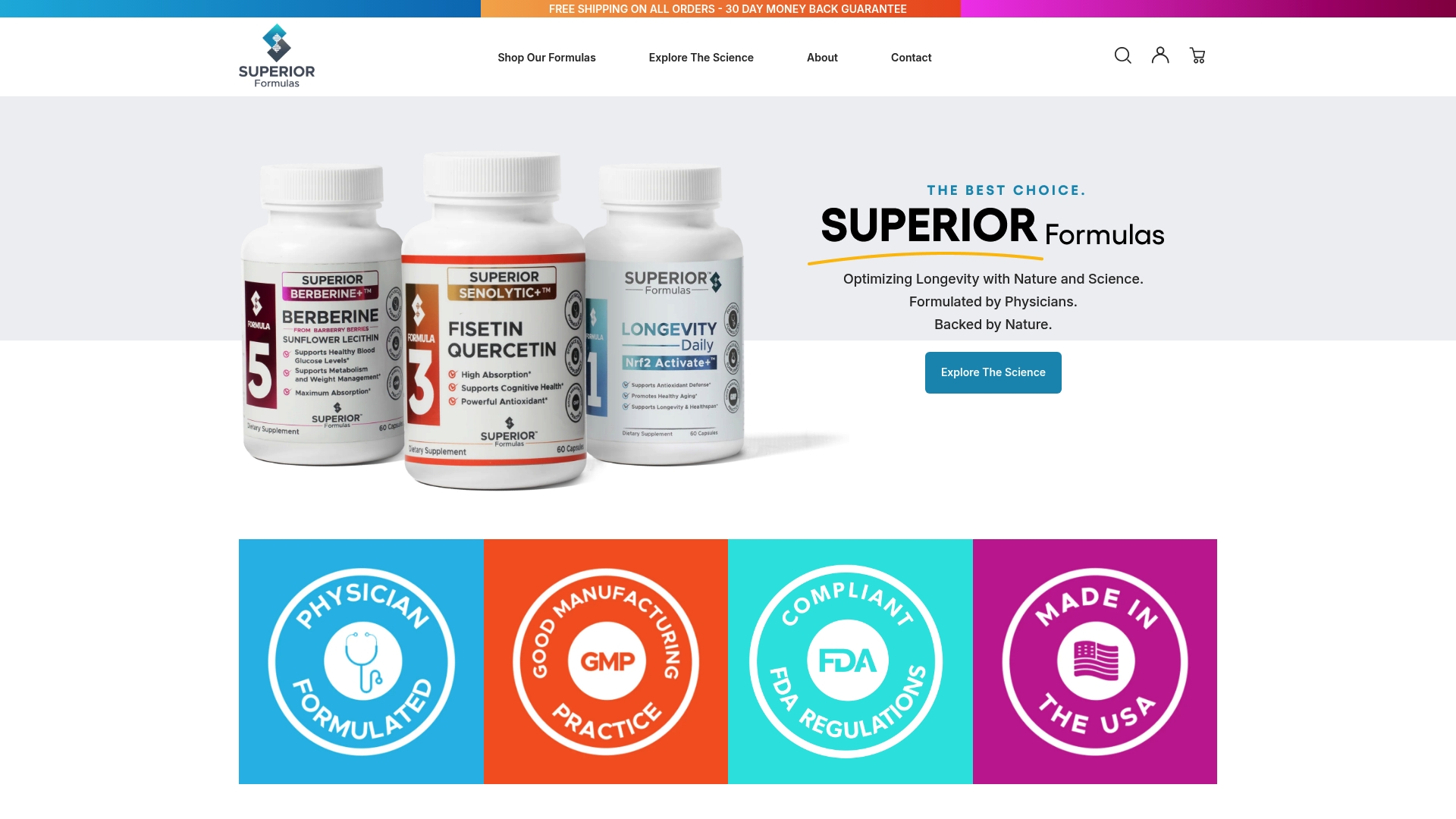
We know supplement claims can be hard to evaluate from the outside, which is why we publish our formulation rationale rather than asking you to take it on faith.
- See the ingredient breakdown, dosing, and manufacturing details on the Formula 3 product page.
- Review our formulation rationale and supporting evidence on our Explore the Science page.
- Read a deeper primer on how senolytics work if you want more background before deciding.
As with any supplement discussed in this article, we recommend a conversation with your clinician and baseline lab monitoring before starting, particularly if you take other medications. If frailty or mobility is part of what motivates your interest in cellular health, balance training programs designed for older adults offer a well-supported, non-pharmacologic complement worth discussing alongside any supplement plan.
This article is general information, not a substitute for advice from a qualified doctor. Consult a qualified healthcare professional about your own circumstances before acting on anything here.
FAQ
Who should not take fisetin?
People who are pregnant or breastfeeding, taking blood thinners, managing unstable liver disease, or on multiple hepatically metabolized medications should avoid fisetin without clinician guidance. Fisetin’s interaction profile through CYP metabolism pathways means a medication review is a reasonable precaution before starting.
What is the best form of fisetin to take?
Formulations using liposomal, micellar, or nanoparticle delivery tend to improve absorption over plain fisetin powder, since raw fisetin has low water solubility and limited oral bioavailability. Look for a product that discloses its formulation technology along with third-party testing rather than relying on milligram count alone.
How long does it take for fisetin to work?
Inflammatory markers are generally among the first measurable changes researchers track in pilot human studies, though timelines vary by individual and study design. Outcomes like long-term frailty reduction or lifespan extension remain under investigation and have not been established in large human trials.
Is fisetin hard on the liver?
Preclinical and systematic review evidence actually points toward hepatoprotective effects, including reduced lipid accumulation and suppression of fibrosis-related signaling in liver models. That said, anyone with existing unstable liver disease should still review fisetin use with a clinician given its hepatic metabolism.
Should I take fisetin and quercetin together?
Fisetin and quercetin are complementary flavonols with overlapping but distinct research profiles, with fisetin more prominent in senolytic research and quercetin more associated with broader cardiovascular and immune support. Some formulations combine both compounds, and a clinician can help you decide whether a combined approach fits your health history.
Sources
- Clinicaltrials
- PMC article on fisetin mechanisms
- PMC review: Fisetin neuroprotective and senotherapeutic overview
- Bentham Science — The Biological Effects and Mechanisms of Fisetin on Hepatotoxicity, Liver Injury and Liver Fibrosis


